
惯性聚合 高效追踪和阅读你感兴趣的博客、新闻、科技资讯
阅读原文 在惯性聚合中打开

推荐订阅源

P
Proofpoint News Feed
C
CERT Recently Published Vulnerability Notes
O
OpenAI News
V
Vulnerabilities – Threatpost
C
Cybersecurity and Infrastructure Security Agency CISA
S
Schneier on Security
Latest news
Latest news
F
Full Disclosure
T
Tenable Blog
T
Troy Hunt's Blog
The Last Watchdog
The Last Watchdog
S
Secure Thoughts
L
LangChain Blog
有赞技术团队
有赞技术团队
Project Zero
Project Zero
Cloudbric
Cloudbric
爱范儿
爱范儿
GbyAI
GbyAI
C
CXSECURITY Database RSS Feed - CXSecurity.com
T
The Exploit Database - CXSecurity.com
S
Security @ Cisco Blogs
Hugging Face - Blog
Hugging Face - Blog
Recorded Future
Recorded Future
大猫的无限游戏
大猫的无限游戏
Last Week in AI
Last Week in AI
C
Cisco Blogs
WordPress大学
WordPress大学
Apple Machine Learning Research
小众软件
小众软件
Cyber Security Advisories - MS-ISAC
V2EX - 技术
V2EX - 技术
Engineering at Meta
Engineering at Meta
Spread Privacy
Spread Privacy
cs.CL updates on arXiv.org
Hacker News: Ask HN
Hacker News: Ask HN
Recent Commits to openclaw:main
Schneier on Security
T
Threat Research - Cisco Blogs
M
MIT News - Artificial intelligence
让小产品的独立变现更简单 - ezindie.com
K
Kaspersky official blog
The Hacker News
The Hacker News
V
V2EX
F
Fortinet All Blogs
L
LINUX DO - 最新话题
Cisco Talos Blog
Cisco Talos Blog
钛媒体:引领未来商业与生活新知
钛媒体:引领未来商业与生活新知
N
News | PayPal Newsroom
博客园 - 三生石上(FineUI控件)
cs.CV updates on arXiv.org

Help Net Security

ChatGPT advanced account security adds passkeys and hardware keys Week in review: High-severity LPE vulnerability in the Linux kernel, cPanel 0-day exploited for months Automating Pentest Delivery: A Step-by-Step Guide - PlexTrac Open-source privacy proxy masks PII before prompts reach external AI services Shadow AI risks deepen as 31% of users get no employer training Identity is the control plane for distributed infrastructure AI traffic is getting bigger, louder, and less predictable New infosec products of the month: April 2026 cPanel zero-day exploited for months before patch release (CVE-2026-41940) Cisco releases open-source toolkit for verifying AI model lineage Met Police face criticism for using AI to spy on their own officers Nine-year-old Linux kernel flaw enables reliable local privilege escalation (CVE-2026-31431) Hacker with a special interest in breaching sports institutions ends behind bars - Help Net Security IP Fabric MCP server adds governance and control to enterprise AIOps workflows - Help Net Security Aqua Compass MCP server enables real-time investigation and containment of runtime threats - Help Net Security Google brings instant email verification to Android, no OTP needed - Help Net Security If cyber espionage via HDMI worries you, NCSC built a device to stop it - Help Net Security Apple fixes iPhone bug that let FBI retrieve deleted Signal messages(CVE-2026-28950) - Help Net Security GopherWhisper APT group hides command and control traffic in Slack and Discord - Help Net Security OpenAI tackles a bad habit people have when interacting with AI - Help Net Security A year in, Zoom's CISO reflects on balancing security and business - Help Net Security Scenario: Open-source framework for automated AI app red-teaming - Help Net Security GDPR works, but only where someone enforces it - Help Net Security Ransomware, fraud, and lawsuits drive cyber insurance claims to new peaks - Help Net Security Google’s Workspace Intelligence promises privacy while running on your data - Help Net Security Cyberattack on French government agency triggers phishing alert - Help Net Security Claude Mythos finds 271 Firefox flaws, Mozilla believes zero-days are numbered - Help Net Security Prove Identity Platform connects verification, authentication, and fraud prevention - Help Net Security New Mirai variants target routers and DVRs in parallel campaigns - Help Net Security Acronis GenAI Protection gives MSPs control over AI usage and data risks - Help Net Security Elastic MCP Apps bring security and observability workflows into AI tools - Help Net Security Progress Software fixes sneaky WAF bypass vulnerability (CVE-2026-21876) - Help Net Security Tencent's QClaw AI agent app arrives on Windows and macOS - Help Net Security Phishing reclaims the top initial access spot, attackers experiment with AI tools - Help Net Security OneDrive updates focus on AI, access control, and compliance - Help Net Security PentAGI: Open-source autonomous AI penetration testing system - Help Net Security Apple Intelligence flaw kept stolen tokens reusable on another device - Help Net Security Shadow AI, deepfakes, and supply chain compromise are rewriting the financial sector threat playbook - Help Net Security Thunderbird 150 arrives with encrypted message search and OpenPGP improvements - Help Net Security VirtualBox 7.2.8 is out with Linux kernel 7.0 support and crash fixes - Help Net Security Ransomware negotiator admits role in attacks he was hired to resolve - Help Net Security Scattered Spider hacker pleads guilty to stealing $8 million in cryptocurrency Ivanti Neurons AI automates IT operations, reducing manual work and security risk Silobreaker Mimir adds agentic AI to intelligence workflows with governance and transparency - Help Net Security OpenAI’s Chronicle feature lets Codex read your screen, raising privacy concerns CISA flags another Cisco Catalyst SD-WAN Manager bug as exploited (CVE-2026-20133) A single platform powers SIM farm proxy networks across 17 countries - Help Net Security NGate NFC malware targets Android users through trojanized payment app - Help Net Security Meta and PortSwigger drive offensive security further to find what others miss - Help Net Security EU pushes for stronger cloud sovereignty, awards €180 million to four providers - Help Net Security SmokedMeat: Open-source tool shows what attackers do inside CI/CD pipelines - Help Net Security How to spot a North Korean fake in a job interview - Help Net Security Product showcase: Syncthing for secure, private file synchronization - Help Net Security Week in review: Acrobat Reader flaw exploited, Claude Mythos offensive capabilities and limits Google wipes out 602 million scam ads with Gemini on duty Researcher drops two more Microsoft Defender zero-days, all three now exploited in the wild GitLab 18.11 brings agentic AI to security fixes, CI pipelines, and delivery analytics Liongard upgrades LiongardIQ with AI access, live asset data, and deeper discovery Mozilla challenges enterprise AI providers with Thunderbolt, open-source AI client under your control Codex can now operate between apps. Where are the boundaries? Android 17 Beta 4 arrives with post-quantum cryptography and new memory limits Apple AirTag tracking can be misled by replayed Bluetooth signals Social media bans might steer kids into riskier corners of the internet Workplace stress in 2026 is still worse than before the pandemic New infosec products of the week: April 17, 2026 - Help Net Security ImmuniWeb brings AI upgrades, post-quantum detection and more in Q1 2026 NIST admits defeat on NVD backlog, will enrich only highest-risk CVEs going forward Anthropic releases Claude Opus 4.7 with automated cybersecurity safeguards - Help Net Security Fortinet fixes critical FortiSandbox vulnerabilities (CVE-2026-39813, CVE-2026-39808) - Help Net Security Google Play is changing how Android apps access your contacts and location Tails 7.6.2 patches vulnerability that could expose saved files Cargo theft malware actor spent a month inside a decoy network before researchers pulled the plug Two US nationals jailed over scheme that generated $5 million for the North Korean regime Product showcase: Ente Auth encrypts, backs up, and syncs 2FA Wi-Fi roaming security practices for access network providers and identity providers European AI spending set to hit $290 billion by 2029 Windows is getting stronger RDP file protections to fight phishing attacks Capsule Security debuts with $7 million funding to secure AI agent behavior Hackers hijacked CPUID downloads, served STX RAT to victims $12 million frozen, 20,000 victims identified in crypto scam crackdown Rockstar Games receives “pay or leak” warning after cyberattack Google makes it harder to exploit Pixel 10 modem firmware Siemens expands Industrial Automation DataCenter with edge AI and cybersecurity Adobe issues emergency fix for Acrobat Reader flaw exploited in the wild (CVE-2026-34621) Seized VerifTools servers expose 915,655 fake IDs, 8 arrested Fixing vulnerability data quality requires fixing the architecture first ZeroID: Open-source identity platform for autonomous AI agents MITRE releases a shared fraud-cyber framework built from real attack data The fully free Linux OS Trisquel gets a major update with version 12.0 Ecne Week in review: Windows zero-day exploit leaked, Patch Tuesday forecast ClickFix campaign delivers Mac malware via fake Apple page Poisoned “Office 365” search results lead to stolen paychecks Gmail’s end-to-end encryption comes to mobile, no extra apps required To counter cookie theft, Chrome ships device-bound session credentials Product showcase: Session, a messenger without phone numbers or metadata Little Snitch for Linux shows what your apps are connecting to - Help Net Security Apiiro CLI turns AI coding assistants into full-stack security engineers - Help Net Security April 2026 Patch Tuesday forecast: Spring-cleaning of a preview - Help Net Security What vibe hunting gets right about AI threat hunting, and where it breaks down - Help Net Security Health insurance lead sites sell personal data within seconds of form submission - Help Net Security
What's new in Android 17? Anti-theft tools, scam detection, and parental controls - Help Net Security
Anamarija Pogorelec · 2026-06-17 · via Help Net Security

The Android 17 rollout has started for supported Pixel devices, delivering new security and privacy capabilities before expanding to other devices later this year.

Security and privacy updates

Google has improved location privacy features so users can choose to share their approximate location with websites and grant apps temporary access to their precise location when services require exact coordinates.

In previous Android versions, users had no OS-level way to grant an app access to only one or a few contacts. Contact Picker allows them to share selected contacts with an app instead of granting access to their entire address book, while READ_CONTACTS is reserved for apps that require ongoing access.

Find Hub’s Mark as lost feature allows users to lock a missing phone with biometrics, preventing anyone who knows the passcode from accessing data on the device or turning off location tracking. Marking a device as lost hides Quick Settings and prevents new Wi-Fi and Bluetooth pairings.
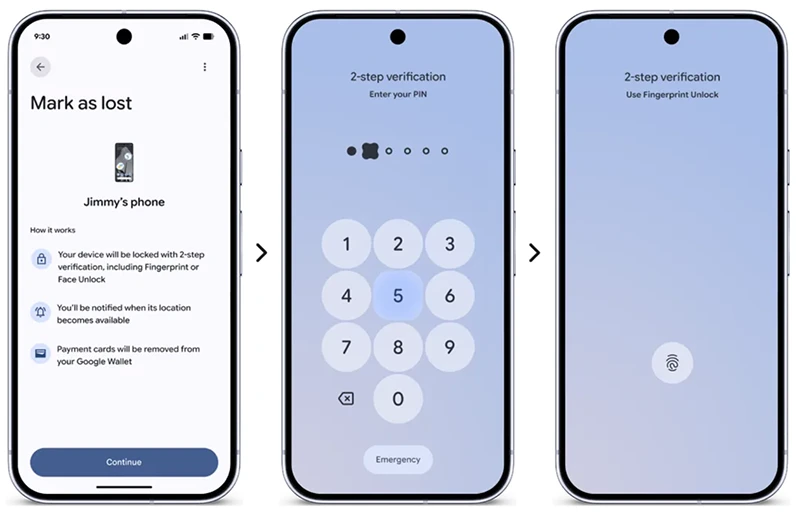
Android 17 security features

“Mark as lost” feature ‘Source: Google)

The company is expanding Live Threat Detection, an on-device AI feature that monitors app behavior and warns users about suspicious activity. New protections can detect actions such as SMS forwarding and misuse of accessibility overlays, which can be used to trick users.

Android 17 introduces dynamic signal monitoring, which detects known malicious behavior patterns in real time, such as apps hiding their icons, launching in the background, or abusing accessibility permissions. These protections will begin rolling out in the second half of the year.

To help protect users from sophisticated threats, Advanced Protection, Google’s one-tap security hardening mode, integrates scam detection for chat notifications, disables device-to-device unlocking and Chrome WebGPU support, and removes accessibility service access from apps that are not labeled as accessibility tools.

“To stop a thief who’s trying to guess their way into your phone, we also reduced the number of times someone can guess your PIN and added longer wait times between failed attempts,” Seang Chau, VP and GM of Android Platform, wrote in a blog.

New tools for families

Parental Controls are available on all devices that update to Android 17. This on-device feature is protected by a PIN and provides a direct link to Google Family Link, which offers additional capabilities such as School Time, app purchase approvals, and location alerts.

Parents can set daily screen time limits, schedule downtime that automatically locks a device at night, and restrict or block access to specific apps. They can also grant extra screen time when needed or extend a scheduled break. Web content filters can block explicit websites and search results.

Developer-focused changes

“Historically, apps required broad, permanent permissions to access information like contacts, precise location and media files. Android 17 continues the shift toward privacy-preserving choices that grant temporary, session-based access only to the data the user explicitly selects,” Matthew McCullough, VP of Product Management, Android Developer, explained.

Android 17 introduces the ACCESS_LOCAL_NETWORK permission, which apps must request before discovering or connecting to devices on a local network, such as smart home devices or casting receivers. The change limits access to local network data and helps prevent unauthorized tracking or data collection. Apps can also use Android’s built-in device pickers to connect to devices without requesting the permission directly.

SMS OTP protection delays access to SMS messages for three hours. It applies to WebOTP and messages that follow the standard SMS OTP format. Default SMS apps, digital assistants, and companion device apps are exempt. Google recommends that other apps use the SMS Retriever API or SMS User Consent API instead of requesting direct access to SMS messages.

Android 17 adds support for post-quantum cryptography. Compatible devices can generate ML-DSA digital signature keys in secure hardware through the Android Keystore, helping protect against future quantum computing threats. The new APK Signature Scheme v3.2 combines traditional and ML-DSA signatures to strengthen app authentication and software distribution.

Apps targeting SDK 37 or later must mark native libraries loaded with System.load() as read-only. Otherwise, the system will block them from loading and throw an UnsatisfiedLinkError. This extends the Safer Dynamic Code Loading protection introduced in Android 14 for DEX and JAR files to native libraries.

When users enter passwords, PINs, and other sensitive data with a physical keyboard, the last typed character will no longer be displayed. Users can customize these settings, subject to support from device manufacturers. The feature is supported by Android’s built-in SDK components and will be supported in Compose 1.12 for SecureTextFields.

Read more: