
惯性聚合 高效追踪和阅读你感兴趣的博客、新闻、科技资讯
阅读原文 在惯性聚合中打开

推荐订阅源

B
Blog
Microsoft Security Blog
Jina AI
Jina AI
博客园 - 叶小钗
J
Java Code Geeks
博客园 - 聂微东
博客园 - 司徒正美
大猫的无限游戏
大猫的无限游戏
阮一峰的网络日志
阮一峰的网络日志
V
V2EX
美团技术团队
WordPress大学
WordPress大学
M
MIT News - Artificial intelligence
雷峰网
雷峰网
酷 壳 – CoolShell
酷 壳 – CoolShell
GbyAI
GbyAI
罗磊的独立博客
T
The Blog of Author Tim Ferriss
aimingoo的专栏
aimingoo的专栏
T
Tailwind CSS Blog
The Cloudflare Blog
Stack Overflow Blog
Stack Overflow Blog
N
Netflix TechBlog - Medium
小众软件
小众软件

Help Net Security

ChatGPT advanced account security adds passkeys and hardware keys Week in review: High-severity LPE vulnerability in the Linux kernel, cPanel 0-day exploited for months Automating Pentest Delivery: A Step-by-Step Guide - PlexTrac Open-source privacy proxy masks PII before prompts reach external AI services Shadow AI risks deepen as 31% of users get no employer training Identity is the control plane for distributed infrastructure AI traffic is getting bigger, louder, and less predictable New infosec products of the month: April 2026 cPanel zero-day exploited for months before patch release (CVE-2026-41940) Cisco releases open-source toolkit for verifying AI model lineage Met Police face criticism for using AI to spy on their own officers Nine-year-old Linux kernel flaw enables reliable local privilege escalation (CVE-2026-31431) Hacker with a special interest in breaching sports institutions ends behind bars - Help Net Security IP Fabric MCP server adds governance and control to enterprise AIOps workflows - Help Net Security Aqua Compass MCP server enables real-time investigation and containment of runtime threats - Help Net Security Google brings instant email verification to Android, no OTP needed - Help Net Security If cyber espionage via HDMI worries you, NCSC built a device to stop it - Help Net Security Apple fixes iPhone bug that let FBI retrieve deleted Signal messages(CVE-2026-28950) - Help Net Security GopherWhisper APT group hides command and control traffic in Slack and Discord - Help Net Security OpenAI tackles a bad habit people have when interacting with AI - Help Net Security A year in, Zoom's CISO reflects on balancing security and business - Help Net Security Scenario: Open-source framework for automated AI app red-teaming - Help Net Security GDPR works, but only where someone enforces it - Help Net Security Ransomware, fraud, and lawsuits drive cyber insurance claims to new peaks - Help Net Security Google’s Workspace Intelligence promises privacy while running on your data - Help Net Security Cyberattack on French government agency triggers phishing alert - Help Net Security Claude Mythos finds 271 Firefox flaws, Mozilla believes zero-days are numbered - Help Net Security Prove Identity Platform connects verification, authentication, and fraud prevention - Help Net Security New Mirai variants target routers and DVRs in parallel campaigns - Help Net Security Acronis GenAI Protection gives MSPs control over AI usage and data risks - Help Net Security
Meta tries to get ahead of scammers before the World Cup ...
Sinisa Markovic · 2026-06-02 · via Help Net Security

Football fans are counting down the days until the FIFA World Cup begins, and scammers are doing the same.

Last week, the FBI warned that cybercriminals are spoofing FIFA websites to steal personal information, sell fake tickets, and promote fraudulent hospitality packages ahead of the tournament.

With millions of supporters expected to travel to the United States, Canada, and Mexico for the 2026 World Cup, fraudsters are likely to target demand for tickets, accommodation, and travel services.

Meta is responding with a series of measures aimed at combating scams and reducing online abuse targeting fans and players during the tournament.

“Scammers are constantly evolving their tactics and so are we,” Meta said.

“That’s why we recently announced new investments in advanced AI, tools for people to spot and avoid scams, and partnerships with law enforcement and industry peers to take action and hold scammers accountable.”

Meta notes that scammers rarely operate on a single platform, prompting the company to work with industry partners through intelligence-sharing initiatives designed to identify and disrupt fraud campaigns.

One example involved a collaboration with Visa that led to the disruption of a scam network using FIFA World Cup 2026 branding. Intelligence shared by Visa’s Scam Disruption team helped identify Facebook-linked pages directing users to fraudulent gambling websites.

The sites advertised unusually high winning rates and attempted to persuade visitors to hand over personal and financial information.

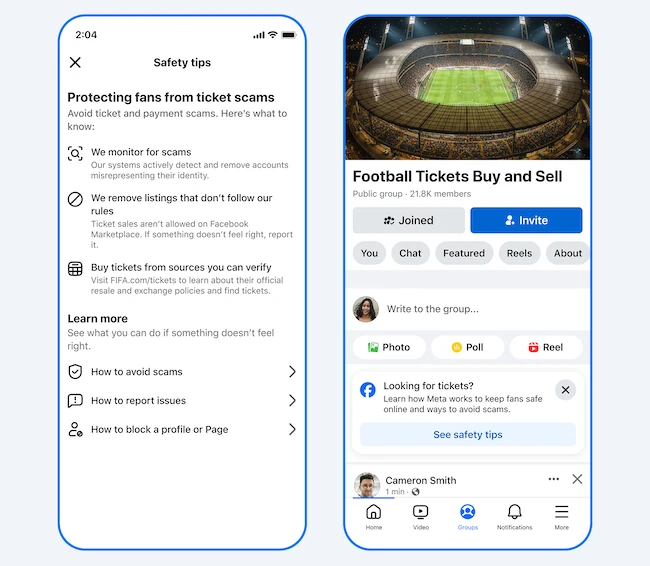
Meta also plans to display warnings to users searching for World Cup tickets on Facebook or visiting related Groups. The alerts are intended to help users identify fraudulent offers and avoid scams tied to ticket sales.
OPIS

World Cup ticket scam safety tips on Facebook (Source: Meta)

The company is preparing for an increase in online abuse targeting players, teams, officials, and public figures during the tournament. Major sporting events often trigger spikes in harassment following controversial incidents and match results.

Meta states that it uses AI systems and user reports to identify content that violates its policies on bullying, harassment, violent threats, and hateful conduct.

“We regularly speak to players, teams, and associations around the world to make sure they know about our latest safety policies and features, and we continue to listen carefully to their feedback,” they added.

Meta claims it removed 2.6 million pieces of hateful content from Facebook and Instagram between October and December 2025, with more than 74% detected before users reported it.