
惯性聚合 高效追踪和阅读你感兴趣的博客、新闻、科技资讯
阅读原文 在惯性聚合中打开

推荐订阅源

Blog — PlanetScale
Blog — PlanetScale
Vercel News
Vercel News
奇客Solidot–传递最新科技情报
奇客Solidot–传递最新科技情报
量子位
Y
Y Combinator Blog
IT之家
IT之家
博客园 - 聂微东
L
LangChain Blog
爱范儿
爱范儿
H
Help Net Security
GbyAI
GbyAI
F
Fortinet All Blogs
B
Blog
Microsoft Security Blog
罗磊的独立博客
C
Check Point Blog
博客园 - 三生石上(FineUI控件)
小众软件
小众软件
D
DataBreaches.Net
Last Week in AI
Last Week in AI
WordPress大学
WordPress大学
B
Blog RSS Feed
酷 壳 – CoolShell
酷 壳 – CoolShell
宝玉的分享
宝玉的分享

Help Net Security

ChatGPT advanced account security adds passkeys and hardware keys Week in review: High-severity LPE vulnerability in the Linux kernel, cPanel 0-day exploited for months Automating Pentest Delivery: A Step-by-Step Guide - PlexTrac Open-source privacy proxy masks PII before prompts reach external AI services Shadow AI risks deepen as 31% of users get no employer training Identity is the control plane for distributed infrastructure AI traffic is getting bigger, louder, and less predictable New infosec products of the month: April 2026 cPanel zero-day exploited for months before patch release (CVE-2026-41940) Cisco releases open-source toolkit for verifying AI model lineage Met Police face criticism for using AI to spy on their own officers Nine-year-old Linux kernel flaw enables reliable local privilege escalation (CVE-2026-31431) Hacker with a special interest in breaching sports institutions ends behind bars - Help Net Security IP Fabric MCP server adds governance and control to enterprise AIOps workflows - Help Net Security Aqua Compass MCP server enables real-time investigation and containment of runtime threats - Help Net Security Google brings instant email verification to Android, no OTP needed - Help Net Security If cyber espionage via HDMI worries you, NCSC built a device to stop it - Help Net Security Apple fixes iPhone bug that let FBI retrieve deleted Signal messages(CVE-2026-28950) - Help Net Security GopherWhisper APT group hides command and control traffic in Slack and Discord - Help Net Security OpenAI tackles a bad habit people have when interacting with AI - Help Net Security A year in, Zoom's CISO reflects on balancing security and business - Help Net Security Scenario: Open-source framework for automated AI app red-teaming - Help Net Security GDPR works, but only where someone enforces it - Help Net Security Ransomware, fraud, and lawsuits drive cyber insurance claims to new peaks - Help Net Security Google’s Workspace Intelligence promises privacy while running on your data - Help Net Security Cyberattack on French government agency triggers phishing alert - Help Net Security Claude Mythos finds 271 Firefox flaws, Mozilla believes zero-days are numbered - Help Net Security Prove Identity Platform connects verification, authentication, and fraud prevention - Help Net Security New Mirai variants target routers and DVRs in parallel campaigns - Help Net Security Acronis GenAI Protection gives MSPs control over AI usage and data risks - Help Net Security
Open-source CI/CD abuse detector guards against stolen cr...
Sinisa Markovic · 2026-06-15 · via Help Net Security

CI/CD Abuse Detector is an open-source project that uses a large language model to flag suspicious changes to continuous integration and continuous deployment pipelines, workflows, and automation configurations. The repository contains drop-in templates for GitHub Actions, GitLab CI, and Azure DevOps.
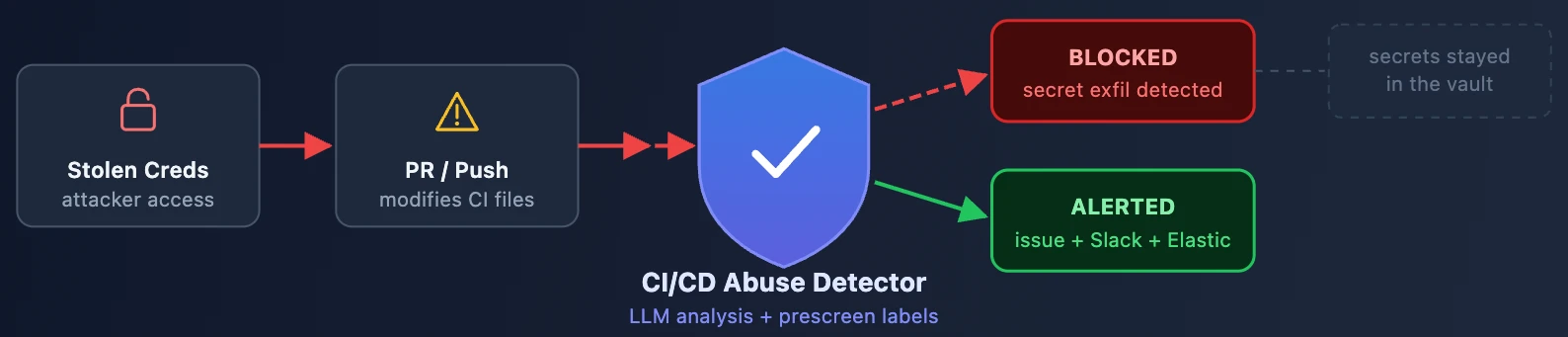
CI/CD abuse detector

The project targets a common attack chain in software supply chain compromises. Stolen developer credentials are used to push modifications to workflow files, which then harvest secrets stored in the CI environment. The detector aims to catch these modifications during code review, before the altered workflow executes.

How the analysis works

The workflow runs in six stages. Changed files in a pull request are first matched against path patterns for CI/CD, build, release, and packaging configurations. Files that match are diffed individually, with each diff capped at 10,000 characters to reduce bypass attempts that hide malicious changes inside large benign additions.

A prescreen step applies regex and metadata rules to attach context labels to each diff. The diff and labels are then sent to Claude through the Claude Code command line interface, which analyzes the content against a threat model focused on credential harvesting. Verdicts conform to a defined JSON schema.

Output options include a GitHub step summary, repository issues, Slack notifications via webhook, and Elasticsearch verdict shipping when severity meets the configured threshold. An optional fail gate can block a pull request when severity exceeds a separate threshold. Default behavior alerts only.

Setup requirements

Teams adopting the detector copy three files into their repository: a workflow YAML file, a prompt markdown file, and a JSON schema for the verdict format. Authentication requires either an Anthropic API key or, for enterprise deployments, a Foundry endpoint URL and API key pair stored as repository secrets.

Several environment variables tune behavior:

  • CI_CD_ABUSE_ALERT_THRESHOLD sets the minimum severity for alerts and defaults to high.
  • CI_CD_ABUSE_FAIL_ON_SEVERITY controls the blocking threshold and is empty by default, which keeps the detector in alert-only mode.
  • CI_CD_ABUSE_INCLUDE_PUSHES enables analysis of direct pushes to main and master branches and defaults to true.

Pre-processing in the templates relies on bash, jq, and grep. The Claude Code CLI, installed via Node, is the sole analysis dependency added to the CI environment. Python appears only in maintainer tooling for validation and the single-file build script, with no Python on the runtime path of the published workflows.

Status and scope

The repository is a prototype and reference implementation tied to Elastic Security Labs research titled “Detecting CI/CD pipeline abuse with LLM-augmented analysis.” Elastic describes the project as a prototype that sits outside its official product catalog, with limited support entitlements and no fixed roadmap.

Teams interested in the underlying methodology can consult the linked Elastic Security Labs article and the architecture, threat model, and scoring notes documents in the repository. Vulnerability reports follow Elastic’s disclosure process documented in SECURITY.md.

CI/CD Abuse Detector is available for free on GitHub.

Must read:

Subscribe to the Help Net Security ad-free monthly newsletter to stay informed on the essential open-source cybersecurity tools. Subscribe here!