
惯性聚合 高效追踪和阅读你感兴趣的博客、新闻、科技资讯
阅读原文 在惯性聚合中打开

推荐订阅源

Y
Y Combinator Blog
腾讯CDC
Recent Announcements
Cyber Security Advisories - MS-ISAC
Hugging Face - Blog
Hugging Face - Blog
H
Help Net Security
OSCHINA 社区最新新闻
OSCHINA 社区最新新闻
Last Week in AI
Last Week in AI
博客园_首页
D
DataBreaches.Net
P
Proofpoint News Feed
云风的 BLOG
云风的 BLOG
V
Visual Studio Blog
月光博客
月光博客
Jina AI
Jina AI
Stack Overflow Blog
Stack Overflow Blog
酷 壳 – CoolShell
酷 壳 – CoolShell
博客园 - 【当耐特】
Vercel News
Vercel News
WordPress大学
WordPress大学
J
Java Code Geeks
博客园 - 聂微东
奇客Solidot–传递最新科技情报
奇客Solidot–传递最新科技情报
U
Unit 42

Help Net Security

Your work apps are quietly handing 19 data points to someone ChatGPT advanced account security adds passkeys and hardware keys Week in review: High-severity LPE vulnerability in the Linux kernel, cPanel 0-day exploited for months Automating Pentest Delivery: A Step-by-Step Guide - PlexTrac Open-source privacy proxy masks PII before prompts reach external AI services Shadow AI risks deepen as 31% of users get no employer training Identity is the control plane for distributed infrastructure AI traffic is getting bigger, louder, and less predictable New infosec products of the month: April 2026 cPanel zero-day exploited for months before patch release (CVE-2026-41940) Cisco releases open-source toolkit for verifying AI model lineage Met Police face criticism for using AI to spy on their own officers Nine-year-old Linux kernel flaw enables reliable local privilege escalation (CVE-2026-31431) Hacker with a special interest in breaching sports institutions ends behind bars - Help Net Security IP Fabric MCP server adds governance and control to enterprise AIOps workflows - Help Net Security Aqua Compass MCP server enables real-time investigation and containment of runtime threats - Help Net Security Google brings instant email verification to Android, no OTP needed - Help Net Security If cyber espionage via HDMI worries you, NCSC built a device to stop it - Help Net Security Apple fixes iPhone bug that let FBI retrieve deleted Signal messages(CVE-2026-28950) - Help Net Security GopherWhisper APT group hides command and control traffic in Slack and Discord - Help Net Security OpenAI tackles a bad habit people have when interacting with AI - Help Net Security A year in, Zoom's CISO reflects on balancing security and business - Help Net Security Scenario: Open-source framework for automated AI app red-teaming - Help Net Security GDPR works, but only where someone enforces it - Help Net Security Ransomware, fraud, and lawsuits drive cyber insurance claims to new peaks - Help Net Security Google’s Workspace Intelligence promises privacy while running on your data - Help Net Security Cyberattack on French government agency triggers phishing alert - Help Net Security Claude Mythos finds 271 Firefox flaws, Mozilla believes zero-days are numbered - Help Net Security Prove Identity Platform connects verification, authentication, and fraud prevention - Help Net Security New Mirai variants target routers and DVRs in parallel campaigns - Help Net Security
Researcher drops two more Microsoft Defender zero-days, a...
Zeljka Zorz · 2026-04-17 · via Help Net Security

The security researcher who earlier this month published a proof-of-concept (PoC) exploit for a zero-day privilege escalation vulnerability in Microsoft Defender is back with two more.

The first, dubbed “RedSun,” is another privilege escalation flaw in the same platform. The second, “UnDefend,” allows a standard user to block Microsoft Defender from receiving signature updates or disable it entirely (if Microsoft pushes a major Defender update).

And, according to Huntress researchers, all three exploitation techniques have been leveraged in the wild by at least one threat actor.

The new exploits

The researcher, who goes by Chaotic Eclipse and Nightmare Eclipse, released the BlueHammer PoC on April 3, after claiming that a disclosure attempt with the Microsoft Security Response Center went nowhere.

On April 14, Microsoft pushed out security updates that fixed the vulnerability, which received the CVE-2026-33825 identifier. The researchers credited with reporting it – Zen Dodd and Yuanpei Xu – are not “Nightmare Eclipse”.

On April 16, this currently anonymous researcher published the “RedSun” and “UnDefend” PoC exploits to the same GitHub repository, which remains accessible despite a warning from the Microsoft-owned platform:
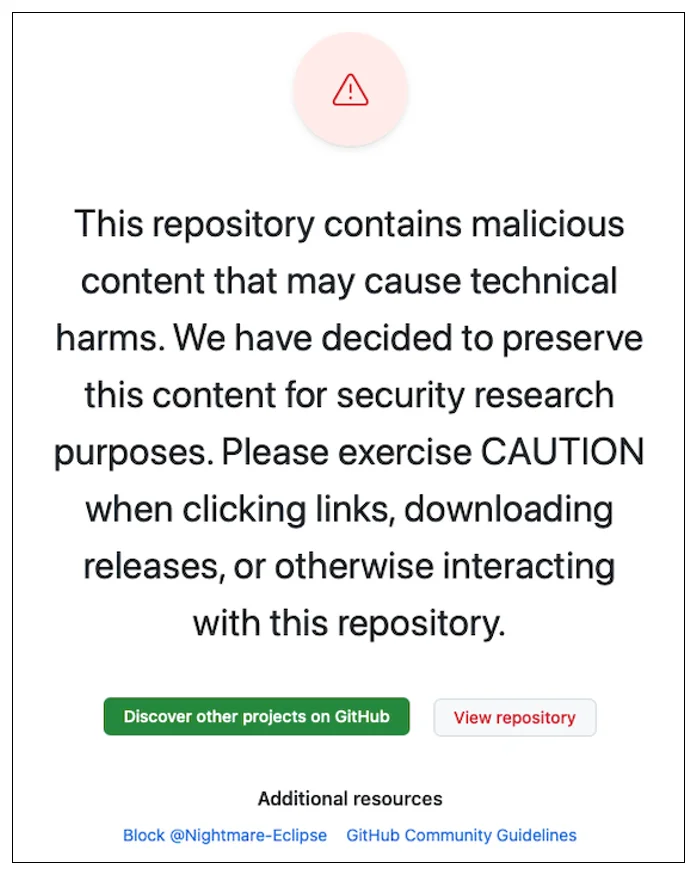
Microsoft Defender zero-days exploited

The effectiveness of the RedSun PoC has been confirmed by vulnerability analyst Will Dormann.

Attacks in the wild

Huntress researchers say that they’ve observed the BlueHammer exploit being blocked by Windows Defender on April 10. On April 16, they also observed the “RedSun” and “UnDefend” PoCs being used.

The attacker dropped the exploit files into the user’s Pictures and Downloads folders and renamed them to avoid suspicion. Then, before launching the exploits, they ran commands to map out user privileges, discovered stored credentials, and the Active Directory structure.

“Huntress has isolated the affected organization to prevent further post-exploitation,” the researchers added.

The ball is now in Microsoft’s court: with the next Patch Tuesday many weeks away, an out-of-band emergency patch looks like the most likely path forward.

UPDATE (April 21, 2026, 09:15 a.m. ET):

Huntress researchers published a more in-depth account of the above mentioned intrusion and how the three exploits work (and their limitations).

“The activity (…) appeared to be part of a broader intrusion rather than isolated proof-of-concept (PoC) testing. Huntress identified suspicious FortiGate SSL VPN access tied to the compromised environment, including a source IP geolocated to Russia, with additional suspicious infrastructure observed in other regions,” the researchers noted.

UPDATE (April 23, 2026, 05:20 a.m. ET):

CVE-2026-33825 (aka BlueHammer) has been added to CISA’s Known Exploited Vulnerabilities catalog

Subscribe to our breaking news e-mail alert to never miss out on the latest breaches, vulnerabilities and cybersecurity threats. Subscribe here!