
惯性聚合 高效追踪和阅读你感兴趣的博客、新闻、科技资讯
阅读原文 在惯性聚合中打开

推荐订阅源

Martin Fowler
Martin Fowler
V
Visual Studio Blog
有赞技术团队
有赞技术团队
T
Tailwind CSS Blog
B
Blog
I
InfoQ
博客园 - 三生石上(FineUI控件)
阮一峰的网络日志
阮一峰的网络日志
F
Fortinet All Blogs
H
Help Net Security
博客园 - Franky
宝玉的分享
宝玉的分享
博客园 - 司徒正美
C
Check Point Blog
G
Google Developers Blog
Cyber Security Advisories - MS-ISAC
Jina AI
Jina AI
T
The Blog of Author Tim Ferriss
MongoDB | Blog
MongoDB | Blog
云风的 BLOG
云风的 BLOG
A
About on SuperTechFans
罗磊的独立博客
大猫的无限游戏
大猫的无限游戏
IT之家
IT之家

Help Net Security

ChatGPT advanced account security adds passkeys and hardware keys Week in review: High-severity LPE vulnerability in the Linux kernel, cPanel 0-day exploited for months Automating Pentest Delivery: A Step-by-Step Guide - PlexTrac Open-source privacy proxy masks PII before prompts reach external AI services Shadow AI risks deepen as 31% of users get no employer training Identity is the control plane for distributed infrastructure AI traffic is getting bigger, louder, and less predictable New infosec products of the month: April 2026 cPanel zero-day exploited for months before patch release (CVE-2026-41940) Cisco releases open-source toolkit for verifying AI model lineage Met Police face criticism for using AI to spy on their own officers Nine-year-old Linux kernel flaw enables reliable local privilege escalation (CVE-2026-31431) Hacker with a special interest in breaching sports institutions ends behind bars - Help Net Security IP Fabric MCP server adds governance and control to enterprise AIOps workflows - Help Net Security Aqua Compass MCP server enables real-time investigation and containment of runtime threats - Help Net Security Google brings instant email verification to Android, no OTP needed - Help Net Security If cyber espionage via HDMI worries you, NCSC built a device to stop it - Help Net Security Apple fixes iPhone bug that let FBI retrieve deleted Signal messages(CVE-2026-28950) - Help Net Security GopherWhisper APT group hides command and control traffic in Slack and Discord - Help Net Security OpenAI tackles a bad habit people have when interacting with AI - Help Net Security A year in, Zoom's CISO reflects on balancing security and business - Help Net Security Scenario: Open-source framework for automated AI app red-teaming - Help Net Security GDPR works, but only where someone enforces it - Help Net Security Ransomware, fraud, and lawsuits drive cyber insurance claims to new peaks - Help Net Security Google’s Workspace Intelligence promises privacy while running on your data - Help Net Security Cyberattack on French government agency triggers phishing alert - Help Net Security Claude Mythos finds 271 Firefox flaws, Mozilla believes zero-days are numbered - Help Net Security Prove Identity Platform connects verification, authentication, and fraud prevention - Help Net Security New Mirai variants target routers and DVRs in parallel campaigns - Help Net Security Acronis GenAI Protection gives MSPs control over AI usage and data risks - Help Net Security
Most agentic AI projects in production have stalled over ...
Anamarija Pogorelec · 2026-06-18 · via Help Net Security

Enterprises are connecting AI agents to live data feeds and putting them to work on tasks that once required human review, from IT operations to software development. The number doing this in production reached 32 percent in 2026, up from 29 percent the year before, according to Confluent’s annual Data Streaming Report, which surveyed 4,625 IT leaders across 14 countries.
agentic AI in production

Governance and data quality top the list of agentic AI obstacles

IT leaders point to a set of recurring problems when they try to scale agentic AI. A skills gap and limited organizational readiness ranks first at 69 percent. Concerns about LLM reliability and non-determinism sit at 68 percent. Data infrastructure and quality issues reach 66 percent, and governance, risk, and compliance problems reach 65 percent. These four sit close together, and they describe a security and integrity challenge as much as a technical one.

The strain shows up further upstream. Many organizations still lack the infrastructure to process data in real time, and that gap widened over the past year. Uncertainty about where data came from, how current it is, and whether it can be trusted remains widespread.

An autonomous agent acts on whatever data it receives, which is what makes this a security concern. When provenance is uncertain and freshness is in doubt, the agent can take real actions based on data nobody has verified.

Stalled and abandoned projects signal the cost of getting data wrong

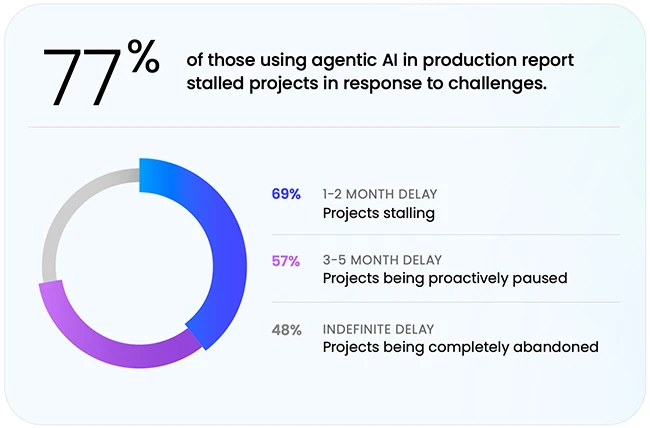
The consequences are visible among the organizations furthest along. Among those running agentic AI in production, 77 percent report stalled projects tied to these challenges. At the production stage, 61 percent report project abandonment as a problem. Delays of one to five months are common, and some initiatives stop indefinitely. Reliability problems with the underlying data carry a direct operational cost.

Security and governance move toward the data source

Much of the report centers on a practice researchers call shifting left, which means moving data processing, governance, and policy enforcement closer to where data is created. Applied to security, this means validating, encrypting, and applying access rules at the point of ingestion, so that everything downstream inherits those controls.

The survey data reflects growing attention to this idea. Inline security and governance enforcement ranks as the most mandatory capability IT leaders want in a data streaming platform, with 43 percent calling it required and 81 percent rating it a major or significant benefit. Natural support for shifting left draws a similar response, with 77 percent rating it mandatory or highly desirable.

Across thousands of IT leaders, the same concerns surface repeatedly: data that cannot be traced, data that arrives stale, and governance that breaks down across systems. These are the conditions under which autonomous agents make decisions. The questions for a security team follow from there. Where does data get validated, who can access it, how is its origin recorded, and what happens when an agent acts on a stream that has been tampered with. The investment numbers point one way. The risk questions remain open.

Download: The IT and security field guide to AI adoption