
惯性聚合 高效追踪和阅读你感兴趣的博客、新闻、科技资讯
阅读原文 在惯性聚合中打开

推荐订阅源

月光博客
月光博客
Cyberwarzone
Cyberwarzone
L
LINUX DO - 最新话题
N
News and Events Feed by Topic
T
Troy Hunt's Blog
Help Net Security
Help Net Security
S
Security @ Cisco Blogs
Google DeepMind News
Security Archives - TechRepublic
M
MIT News - Artificial intelligence
G
Google Developers Blog
Cyber Security Advisories - MS-ISAC
V2EX - 技术
V2EX - 技术
Y
Y Combinator Blog
D
Darknet – Hacking Tools, Hacker News & Cyber Security
大猫的无限游戏
大猫的无限游戏
OSCHINA 社区最新新闻
OSCHINA 社区最新新闻
Microsoft Security Blog
Cisco Talos Blog
Cisco Talos Blog
T
Threatpost
Recent Commits to openclaw:main
S
SegmentFault 最新的问题
I
InfoQ
H
Hacker News: Front Page
D
Docker
Scott Helme
Scott Helme
Threat Intelligence Blog | Flashpoint
Blog — PlanetScale
Blog — PlanetScale
人人都是产品经理
人人都是产品经理
博客园 - 叶小钗
freeCodeCamp Programming Tutorials: Python, JavaScript, Git & More
N
Netflix TechBlog - Medium
AWS News Blog
AWS News Blog
Know Your Adversary
Know Your Adversary
博客园 - 【当耐特】
T
Tor Project blog
U
Unit 42
H
Heimdal Security Blog
Microsoft Azure Blog
K
KPMG report finds enterprise disconnect between AI and its ROI | CIO
P
Privacy & Cybersecurity Law Blog
PCI Perspectives
PCI Perspectives
美团技术团队
O
OpenAI News
T
Tailwind CSS Blog
H
Hackread – Cybersecurity News, Data Breaches, AI and More
B
Blog
GbyAI
GbyAI
cs.CL updates on arXiv.org
MyScale Blog
MyScale Blog

Help Net Security

ChatGPT advanced account security adds passkeys and hardware keys Week in review: High-severity LPE vulnerability in the Linux kernel, cPanel 0-day exploited for months Automating Pentest Delivery: A Step-by-Step Guide - PlexTrac Open-source privacy proxy masks PII before prompts reach external AI services Shadow AI risks deepen as 31% of users get no employer training Identity is the control plane for distributed infrastructure AI traffic is getting bigger, louder, and less predictable New infosec products of the month: April 2026 cPanel zero-day exploited for months before patch release (CVE-2026-41940) Cisco releases open-source toolkit for verifying AI model lineage Met Police face criticism for using AI to spy on their own officers Nine-year-old Linux kernel flaw enables reliable local privilege escalation (CVE-2026-31431) Hacker with a special interest in breaching sports institutions ends behind bars - Help Net Security IP Fabric MCP server adds governance and control to enterprise AIOps workflows - Help Net Security Aqua Compass MCP server enables real-time investigation and containment of runtime threats - Help Net Security Google brings instant email verification to Android, no OTP needed - Help Net Security If cyber espionage via HDMI worries you, NCSC built a device to stop it - Help Net Security Apple fixes iPhone bug that let FBI retrieve deleted Signal messages(CVE-2026-28950) - Help Net Security GopherWhisper APT group hides command and control traffic in Slack and Discord - Help Net Security OpenAI tackles a bad habit people have when interacting with AI - Help Net Security A year in, Zoom's CISO reflects on balancing security and business - Help Net Security Scenario: Open-source framework for automated AI app red-teaming - Help Net Security GDPR works, but only where someone enforces it - Help Net Security Ransomware, fraud, and lawsuits drive cyber insurance claims to new peaks - Help Net Security Google’s Workspace Intelligence promises privacy while running on your data - Help Net Security Cyberattack on French government agency triggers phishing alert - Help Net Security Claude Mythos finds 271 Firefox flaws, Mozilla believes zero-days are numbered - Help Net Security Prove Identity Platform connects verification, authentication, and fraud prevention - Help Net Security New Mirai variants target routers and DVRs in parallel campaigns - Help Net Security Acronis GenAI Protection gives MSPs control over AI usage and data risks - Help Net Security Elastic MCP Apps bring security and observability workflows into AI tools - Help Net Security Progress Software fixes sneaky WAF bypass vulnerability (CVE-2026-21876) - Help Net Security Tencent's QClaw AI agent app arrives on Windows and macOS - Help Net Security Phishing reclaims the top initial access spot, attackers experiment with AI tools - Help Net Security OneDrive updates focus on AI, access control, and compliance - Help Net Security PentAGI: Open-source autonomous AI penetration testing system - Help Net Security Apple Intelligence flaw kept stolen tokens reusable on another device - Help Net Security Shadow AI, deepfakes, and supply chain compromise are rewriting the financial sector threat playbook - Help Net Security Thunderbird 150 arrives with encrypted message search and OpenPGP improvements - Help Net Security VirtualBox 7.2.8 is out with Linux kernel 7.0 support and crash fixes - Help Net Security Ransomware negotiator admits role in attacks he was hired to resolve - Help Net Security Scattered Spider hacker pleads guilty to stealing $8 million in cryptocurrency Ivanti Neurons AI automates IT operations, reducing manual work and security risk Silobreaker Mimir adds agentic AI to intelligence workflows with governance and transparency - Help Net Security OpenAI’s Chronicle feature lets Codex read your screen, raising privacy concerns CISA flags another Cisco Catalyst SD-WAN Manager bug as exploited (CVE-2026-20133) A single platform powers SIM farm proxy networks across 17 countries - Help Net Security NGate NFC malware targets Android users through trojanized payment app - Help Net Security Meta and PortSwigger drive offensive security further to find what others miss - Help Net Security EU pushes for stronger cloud sovereignty, awards €180 million to four providers - Help Net Security SmokedMeat: Open-source tool shows what attackers do inside CI/CD pipelines - Help Net Security How to spot a North Korean fake in a job interview - Help Net Security Product showcase: Syncthing for secure, private file synchronization - Help Net Security Week in review: Acrobat Reader flaw exploited, Claude Mythos offensive capabilities and limits Google wipes out 602 million scam ads with Gemini on duty Researcher drops two more Microsoft Defender zero-days, all three now exploited in the wild GitLab 18.11 brings agentic AI to security fixes, CI pipelines, and delivery analytics Liongard upgrades LiongardIQ with AI access, live asset data, and deeper discovery Mozilla challenges enterprise AI providers with Thunderbolt, open-source AI client under your control Codex can now operate between apps. Where are the boundaries? Android 17 Beta 4 arrives with post-quantum cryptography and new memory limits Apple AirTag tracking can be misled by replayed Bluetooth signals Social media bans might steer kids into riskier corners of the internet Workplace stress in 2026 is still worse than before the pandemic New infosec products of the week: April 17, 2026 - Help Net Security ImmuniWeb brings AI upgrades, post-quantum detection and more in Q1 2026 NIST admits defeat on NVD backlog, will enrich only highest-risk CVEs going forward Anthropic releases Claude Opus 4.7 with automated cybersecurity safeguards - Help Net Security Fortinet fixes critical FortiSandbox vulnerabilities (CVE-2026-39813, CVE-2026-39808) - Help Net Security Google Play is changing how Android apps access your contacts and location Tails 7.6.2 patches vulnerability that could expose saved files Cargo theft malware actor spent a month inside a decoy network before researchers pulled the plug Two US nationals jailed over scheme that generated $5 million for the North Korean regime Product showcase: Ente Auth encrypts, backs up, and syncs 2FA Wi-Fi roaming security practices for access network providers and identity providers European AI spending set to hit $290 billion by 2029 Windows is getting stronger RDP file protections to fight phishing attacks Capsule Security debuts with $7 million funding to secure AI agent behavior Hackers hijacked CPUID downloads, served STX RAT to victims $12 million frozen, 20,000 victims identified in crypto scam crackdown Rockstar Games receives “pay or leak” warning after cyberattack Google makes it harder to exploit Pixel 10 modem firmware Siemens expands Industrial Automation DataCenter with edge AI and cybersecurity Adobe issues emergency fix for Acrobat Reader flaw exploited in the wild (CVE-2026-34621) Seized VerifTools servers expose 915,655 fake IDs, 8 arrested Fixing vulnerability data quality requires fixing the architecture first ZeroID: Open-source identity platform for autonomous AI agents MITRE releases a shared fraud-cyber framework built from real attack data The fully free Linux OS Trisquel gets a major update with version 12.0 Ecne Week in review: Windows zero-day exploit leaked, Patch Tuesday forecast ClickFix campaign delivers Mac malware via fake Apple page Poisoned “Office 365” search results lead to stolen paychecks Gmail’s end-to-end encryption comes to mobile, no extra apps required To counter cookie theft, Chrome ships device-bound session credentials Product showcase: Session, a messenger without phone numbers or metadata Little Snitch for Linux shows what your apps are connecting to - Help Net Security Apiiro CLI turns AI coding assistants into full-stack security engineers - Help Net Security April 2026 Patch Tuesday forecast: Spring-cleaning of a preview - Help Net Security What vibe hunting gets right about AI threat hunting, and where it breaks down - Help Net Security Health insurance lead sites sell personal data within seconds of form submission - Help Net Security
Two CEOs on why security and AI readiness belong together - Help Net Security
Mirko Zorz · 2026-06-26 · via Help Net Security

SuperOps and Guardz are bundling PSA, RMM, MDM, and agentic SecOps into one offering for MSPs. In this Help Net Security Q&A, SuperOps CEO Arvind Parthiban and Guardz CEO Dor Eisner explain how a connected stack cuts the time and context lost to tool-switching, lowers costs against multi-vendor setups, and helps close the gap between average MSP margins of 8% and the 18% top performers reach. They also discuss what makes a platform AI-native, and why they treat security readiness and AI readiness as one conversation.
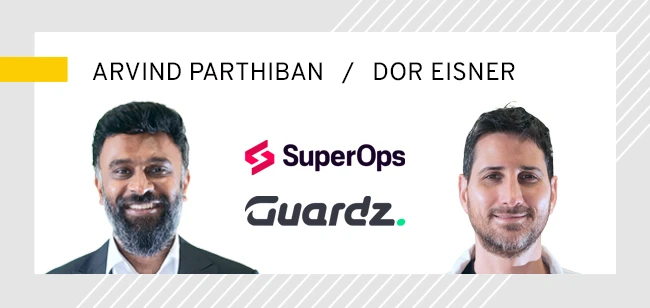
superops guardz ceo

SuperOps and Guardz are bundling PSA, RMM, MDM, and agentic SecOps into one offering. How does consolidating these into a single system address the tool-switching that reportedly consumes up to 25% of a technician’s working day?

Arvind Parthiban, CEO, SuperOps:

The 25% figure understates the real cost because it only measures time. What it doesn’t capture is the context loss that happens every time a technician moves between systems. When your PSA doesn’t talk to your RMM, and neither talks to your security platform, you’re not just losing time, you’re losing momentum and accuracy. A technician resolving a ticket has to mentally reconstruct what happened across three or four tools before they can act. That’s where mistakes happen and where response times stretch.

Consolidation addresses this by making context persistent. When operations and security data live in one system, a technician sees the full picture without moving. The time saving is real, but the bigger gain is decision quality: fewer missed signals, faster resolution, and less cognitive overhead on every single interaction.

This also becomes the foundation for agentic IT. AI agents depend on connected, real-time context to act autonomously: to triage a ticket, correlate a security signal, or trigger a remediation workflow without waiting for a human to connect the dots. When that context is fragmented across disconnected tools, AI can’t function at its potential. A unified stack isn’t just an efficiency play, it’s the prerequisite for AI to move from automation to autonomy. That’s the shift we’re building toward.

The companies describe the bundle as a more affordable package than traditional multi-vendor stacks, available globally at launch. What cost evidence backs that claim, and how can an MSP verify the savings for its own business

Arvind Parthiban, CEO, SuperOps:

The most straightforward way for an MSP to verify this is to add up what they’re currently paying across their PSA, RMM, MDM, and security vendors, then factor in the hidden costs that don’t appear on those invoices. Integration maintenance, staff time spent on tool administration, and the support overhead of managing multiple vendor relationships all carry real costs that most MSPs don’t formally track.

The bundle replaces multiple line items with one. We’re confident that for the vast majority of MSPs running a comparable multi-vendor stack, the total cost comparison will be favorable. We’d encourage any MSP to run that calculation against their own numbers. We’re not asking anyone to take our word for it.

The press release notes that the average MSP operates on net margins of roughly 8%, while top-performing firms reach 18%. How much of that gap can a connected stack close, and what other factors drive the difference?

Arvind Parthiban, CEO, SuperOps:

The stack is a significant contributor but it’s not the whole story. Top-performing MSPs have made a structural decision to stop adding tools and start building leverage. A connected stack is part of that. It reduces the operational overhead that quietly erodes margin on every ticket, every escalation, every onboarding. When your tools share context, your team spends less time administering systems and more time delivering outcomes.

But the other factors matter too. Pricing strategy, service packaging, customer mix, and how effectively an MSP has automated routine work all play a role. What we’d say is this: you cannot close the margin gap without addressing the stack, but closing the stack problem alone won’t get you to better margins. The best operators have done both; they’ve simplified the foundation and built a business model on top of it that reflects the value they actually deliver.

Both companies describe themselves as AI-native and argue that organizations cannot safely deploy AI without strong security and governance. How should an MSP evaluate whether a vendor’s “AI-native” label reflects capability rather than marketing?

Dor Eisner, CEO, Guardz:

Ask three questions. First: does the AI have access to connected, real-time data, or is it working from isolated data sets within a single tool? AI that can only see part of the picture will always produce partial answers. Second: how does the vendor handle the security and governance of the AI itself? What data does it access, how are decisions logged, and who is accountable when it acts autonomously? Third: can the vendor show you where AI is creating measurable outcomes in production environments today, not in a demo? In our own platform, that means identity, endpoint, and email signals correlate in one data fabric, with human-led MDR accountable for what the AI surfaces.

AI-native should mean the platform was designed from the ground up for AI to operate within it, with the data architecture, the security model, and the automation layer built to support agentic workflows. If a vendor has added an AI feature to a legacy platform, that’s not AI-native. The distinction matters because MSPs will be held accountable by their customers for how AI performs in their environment. The foundation has to be real.

The companies frame AI readiness and cybersecurity readiness as inseparable, arguing that neither delivers value without the other. Is that pairing a market reality for most MSPs right now, or is it ahead of where many providers and their customers currently stand?

Dor Eisner, CEO, Guardz:

Honestly, it’s both. For the leading edge of the market; the MSPs who are already in strategic conversations with their customers about AI adoption, this is a live reality. They’re being asked to govern AI deployments, advise on risk, and ensure that the data AI relies on is trustworthy and protected. For them, security and AI readiness collapsed into the same conversation some time ago.

For the majority of the market, there’s still a gap. Many MSPs are still treating security as a separate service line and AI as something they’ll figure out later. What we’re saying is that ‘later’ is arriving faster than most people expect, and the MSPs who wait until their customers force the conversation will be playing catch-up. The pairing isn’t a prediction; it’s a description of where the market is heading. We’re launching this partnership now because we believe being early matters.