
惯性聚合 高效追踪和阅读你感兴趣的博客、新闻、科技资讯
阅读原文 在惯性聚合中打开

推荐订阅源

M
MIT News - Artificial intelligence
罗磊的独立博客
Hugging Face - Blog
Hugging Face - Blog
Apple Machine Learning Research
Last Week in AI
Last Week in AI
S
SegmentFault 最新的问题
让小产品的独立变现更简单 - ezindie.com
美团技术团队
人人都是产品经理
人人都是产品经理
WordPress大学
WordPress大学
The Cloudflare Blog
IT之家
IT之家
雷峰网
雷峰网
小众软件
小众软件
博客园 - 叶小钗
博客园 - 聂微东
爱范儿
爱范儿
博客园 - 司徒正美
博客园 - 三生石上(FineUI控件)
V
Visual Studio Blog
博客园 - 【当耐特】
V
V2EX
博客园_首页
T
Tailwind CSS Blog

Help Net Security

Your work apps are quietly handing 19 data points to someone ChatGPT advanced account security adds passkeys and hardware keys Week in review: High-severity LPE vulnerability in the Linux kernel, cPanel 0-day exploited for months Automating Pentest Delivery: A Step-by-Step Guide - PlexTrac Open-source privacy proxy masks PII before prompts reach external AI services Shadow AI risks deepen as 31% of users get no employer training Identity is the control plane for distributed infrastructure AI traffic is getting bigger, louder, and less predictable New infosec products of the month: April 2026 cPanel zero-day exploited for months before patch release (CVE-2026-41940) Cisco releases open-source toolkit for verifying AI model lineage Met Police face criticism for using AI to spy on their own officers Nine-year-old Linux kernel flaw enables reliable local privilege escalation (CVE-2026-31431) Hacker with a special interest in breaching sports institutions ends behind bars - Help Net Security IP Fabric MCP server adds governance and control to enterprise AIOps workflows - Help Net Security Aqua Compass MCP server enables real-time investigation and containment of runtime threats - Help Net Security Google brings instant email verification to Android, no OTP needed - Help Net Security If cyber espionage via HDMI worries you, NCSC built a device to stop it - Help Net Security Apple fixes iPhone bug that let FBI retrieve deleted Signal messages(CVE-2026-28950) - Help Net Security GopherWhisper APT group hides command and control traffic in Slack and Discord - Help Net Security OpenAI tackles a bad habit people have when interacting with AI - Help Net Security A year in, Zoom's CISO reflects on balancing security and business - Help Net Security Scenario: Open-source framework for automated AI app red-teaming - Help Net Security GDPR works, but only where someone enforces it - Help Net Security Ransomware, fraud, and lawsuits drive cyber insurance claims to new peaks - Help Net Security Google’s Workspace Intelligence promises privacy while running on your data - Help Net Security Cyberattack on French government agency triggers phishing alert - Help Net Security Claude Mythos finds 271 Firefox flaws, Mozilla believes zero-days are numbered - Help Net Security Prove Identity Platform connects verification, authentication, and fraud prevention - Help Net Security New Mirai variants target routers and DVRs in parallel campaigns - Help Net Security
Product showcase: Syncthing for secure, private file sync...
Anamarija Po · 2026-04-20 · via Help Net Security

Syncthing is a free and open-source application that synchronizes files directly between your devices. Instead of uploading data to a central server, it uses a peer-to-peer approach, transferring files whenever peers are online. This decentralized model ensures that your data remains private and under your control.
Syncthing private file synchronization

Syncthing monitors shared folders for changes. When a file is created, modified, or removed, updates are propagated to connected peers. Synchronization happens automatically once they are online, keeping folder contents consistent without manual intervention.

Device identity and connections

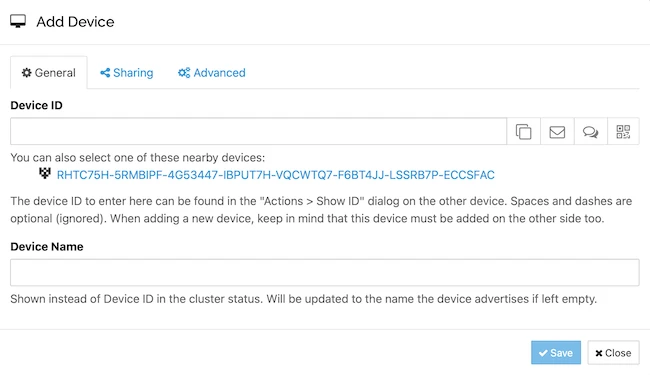
Syncthing does not require account creation because it does not rely on a central server. Identity, authentication, and trust are handled directly between peers. Each instance is assigned a unique device ID generated at first startup, which is used to establish trust. Connections are formed by exchanging these IDs and approving them on both sides, creating trusted relationships without external services.
Syncthing private file synchronization

Syncthing private file synchronization

Setup and interface

Initial setup involves installing the application, connecting devices, and selecting folders to share. In this setup, the application was installed on both a Windows system and a macOS device.

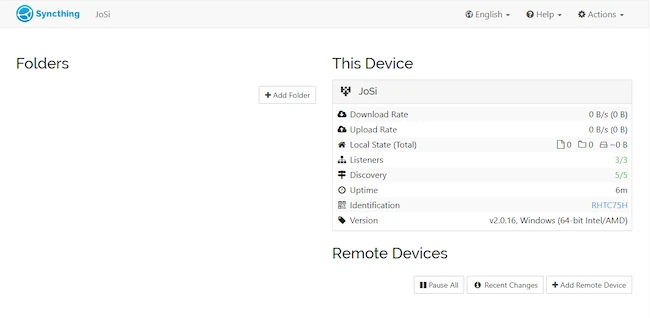
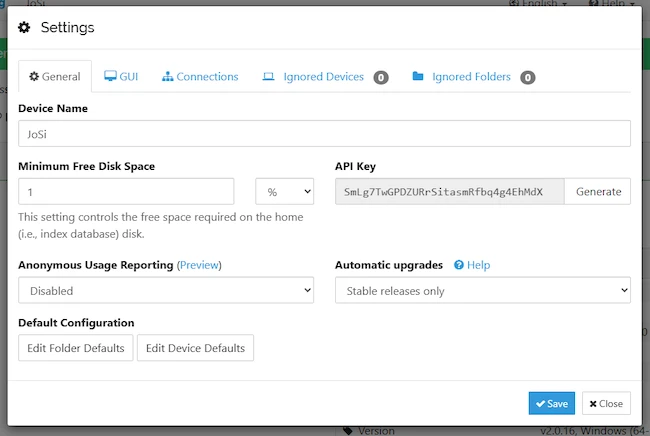
Syncthing is managed through a local web-based interface. The device ID generated at startup is used to add and authorize remote peers. The interface provides access to settings, folder management, and synchronization status.
Syncthing private file synchronization

To establish a connection, a remote peer is added using its device ID. The request must be approved on both sides before becoming active. Once approved, the peers are ready to share data.
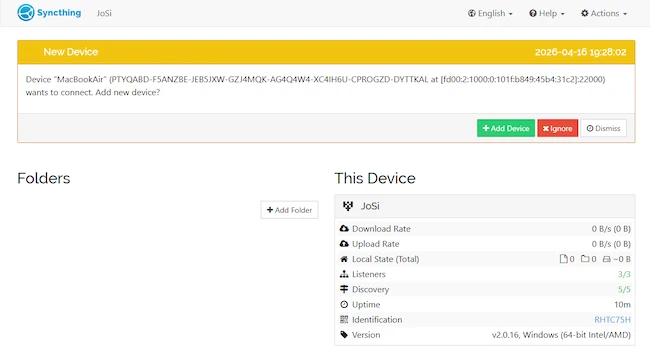
Syncthing private file synchronization

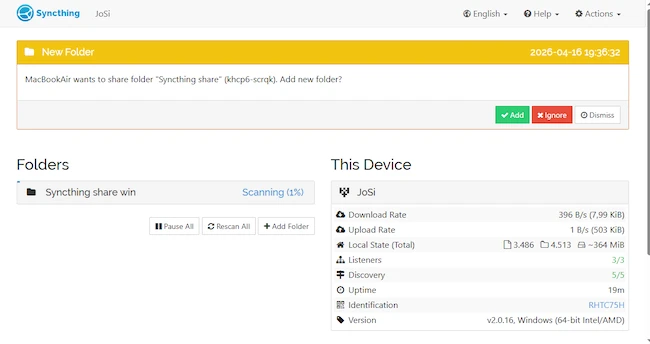
The synchronization process starts with indexing files, followed by comparing states between devices. Data is transferred directly, and the interface displays progress through stages such as scanning, preparing to sync, and active transfer. Once complete, the folder status indicates that it is up to date. The interface also shows transfer rates, file counts, and connection status.
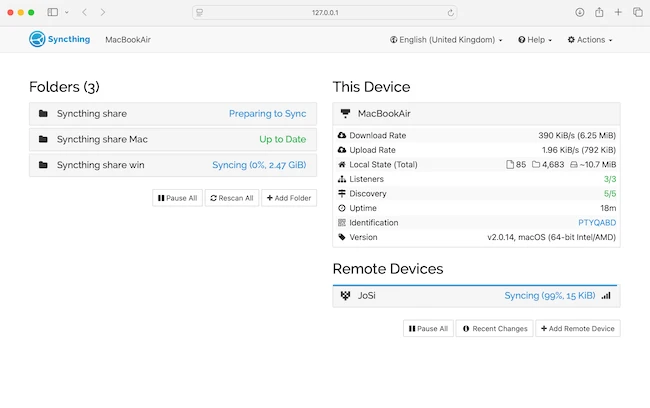
Syncthing private file synchronization

Built-in security and privacy

All communication between devices is encrypted, and connections are established only after mutual approval. Syncthing uses secure protocols to protect data during transfer, and no third-party servers store user files. This ensures that data remains on user-controlled devices and is shared only with explicitly trusted peers.

Conclusion

Syncthing provides a straightforward way to keep files synchronized across devices without relying on external services. In testing across Windows and macOS, file transfers were consistent and required minimal intervention, making Syncthing a practical solution for maintaining local control over data while keeping it accessible on multiple systems.