


The Agentic SOC market is loud. Dozens of vendors promise to take alert triage, investigation, and response off your analysts’ plates, but most claims have never been tested in production. The hard part is separating operational improvement from this marketing noise.
Gartner makes the stakes concrete. In Validate the Promises of AI SOC Agents With These Key Questions, analysts Craig Lawson and Andrew Davies project that 70% of large SOCs will pilot AI agents for Tier 1 and Tier 2 work by 2028, but only 15% will see measurable improvement without a structured way to evaluate them. Here is that framework and how Prophet AI addresses it.
Rather than grading vendors on feature checklists, Gartner organizes the decision around seven areas to interrogate before you grant an agent operational access:
1. Use-case fit: does it reduce today’s work and is it purpose-built for SOC roles, not generic automation?
2. Outcome measurement: are gains in real TDIR terms (false-positive reduction, mean time to contain), not raw alert counts?
3. Vendor viability and pricing: is the company durable, and does pricing scale with alert volume?
4. Analyst augmentation: does it make analysts better, or quietly deskill them?
5. Autonomy boundaries: what runs autonomously, what needs approval, and how are guardrails enforced?
6. Integration depth: does it work across your SIEM, cloud, EDR, identity, and SOAR stack without centralizing data first?
7. Governance and transparency: is every query, evidence item, and action logged for an auditor, insurer, and board?
Prophet Security is a leading agentic AI SOC platform, recognized in Rising in Cyber 2026, that autonomously triages, investigates, and responds to security alerts the way an expert analyst would. The Prophet AI platform continuously hardens your detection and response posture by surfacing tuning opportunities and detection gaps and helps you catch threats that your detections miss by enabling natural language threat hunting.
Prophet AI meets your stack where it is. It integrates with SIEMs, EDRs, identity providers, cloud platforms, email security, networks security, DLP, threat intel, collaboration and case management, and security data lakes to deliver full-context investigations within your existing workflows.
Results flow into Jira, Slack, and Microsoft Teams, with no requirement to rip and replace tooling or centralize your data, the integration test Gartner tells buyers to apply.
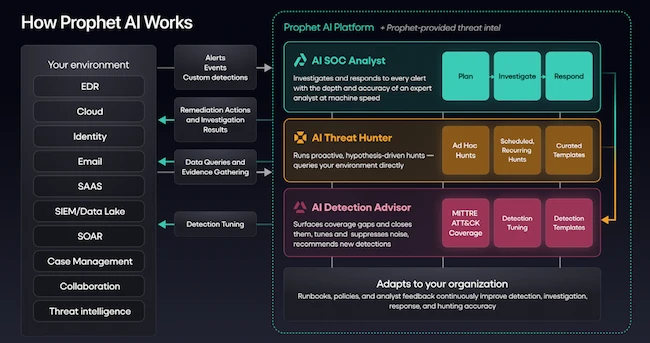
For each alert, Prophet AI builds the full set of questions an experienced analyst would ask and runs them at machine speed across multiple sources.
Accuracy comes from context, transparency, and deep SecOps expertise imbued in the platform. Prophet AI reasons over complete context rather than a single signal, and every finding carries citations back to the exact source, so analysts can expand any conclusion and view the precise query that was run. Its investigations are modeled on how senior analysts from Mandiant, Red Canary, and Expel work.
That discipline drives the outcomes Gartner tells you to measure: across its customer base, Prophet AI has run millions of autonomous investigations, each in under 5-minutes on average. That results in zero alert wait or dwell time, a 90% reduction in mean time to respond, and a 96% reduction in false positives across customers.
Gartner warns that a tool built only for alert triage leaves gaps elsewhere. Prophet AI spans the three jobs a modern SOC has to do: Investigation and response, threat hunting, and detection engineering. The same context and learning that compound across all of them.
The Prophet Agentic AI SOC Analyst investigates every alert end-to-end like your best SOC analyst, delivering a determination (benign, malicious, or inconclusive), a severity rating, remediation steps, and a compiled timeline.
High-confidence false positives can be auto-resolved and remain auditable, while actions that change access or contain a host can be either automated or default to human approval, which is the autonomy posture Gartner advises requiring.
The Prophet AI Threat Hunter turns hunting from a specialist chore into a natural-language conversation. Analysts ask questions in plain English and search globally, chasing hypotheses and surfacing threats before an alert ever fires, with no custom query language required.
The Prophet AI Detection Advisor transforms detection engineering by turning investigation outcomes into tuning intelligence, surfacing the noisiest alerts, and exposing detection gaps. Because investigation, hunting, and tuning share the same understanding of your environment, fixing a noisy detection reduces unnecessary investigations upstream.
An agentic SOC platform is only as good as its fit to your environment, and that fit can’t be static. Prophet AI adapts by ingesting playbooks, documentation, and analyst feedback. When a case comes back inconclusive for lack of context, an analyst explains it once in plain English, and Prophet AI applies that lesson to similar future investigations, with scope and an expiration date the analyst controls.
For enterprises, the question reaches past “can the agent act” to “who approved it, what did it see, and can we prove it later.” Every query, evidence item, and automated action is recorded in an immutable audit trail that stands up to an auditor, a cyber-insurer, and a board.
Prophet AI’s architecture is built around customer control: single-tenant isolation with data-residency support; bring-your-own-key (BYOK); no training on your data, a contractual guarantee that customer data never trains the underlying models; and model-agnostic design, so you are never locked to a single LLM. Together these settle the governance questions Gartner says to answer before granting an AI agent operational access.
Gartner’s framework pushes a buyer past the demo and onto the questions that predict production success: real workload reduction, outcomes in MTTC and false-positive reduction, deep integration without data centralization, augmentation over deskilling, clear autonomy boundaries, and enterprise-grade governance. Prophet AI was built to answer each one.
To see how Prophet AI measures up firsthand, request a demo.
The full Gartner report is available from Prophet Security.
此内容由惯性聚合(RSS阅读器)自动聚合整理,仅供阅读参考。 原文来自 — 版权归原作者所有。