
惯性聚合 高效追踪和阅读你感兴趣的博客、新闻、科技资讯
阅读原文 在惯性聚合中打开

推荐订阅源

freeCodeCamp Programming Tutorials: Python, JavaScript, Git & More
G
Google Developers Blog
Hugging Face - Blog
Hugging Face - Blog
博客园 - 【当耐特】
S
SegmentFault 最新的问题
宝玉的分享
宝玉的分享
博客园 - Franky
博客园_首页
钛媒体:引领未来商业与生活新知
钛媒体:引领未来商业与生活新知
WordPress大学
WordPress大学
有赞技术团队
有赞技术团队
月光博客
月光博客
博客园 - 聂微东
OSCHINA 社区最新新闻
OSCHINA 社区最新新闻
小众软件
小众软件
Microsoft Security Blog
Last Week in AI
Last Week in AI
Vercel News
Vercel News
Cyber Security Advisories - MS-ISAC
爱范儿
爱范儿
J
Java Code Geeks
博客园 - 叶小钗
Engineering at Meta
Engineering at Meta
阮一峰的网络日志
阮一峰的网络日志

Help Net Security

ChatGPT advanced account security adds passkeys and hardware keys Week in review: High-severity LPE vulnerability in the Linux kernel, cPanel 0-day exploited for months Automating Pentest Delivery: A Step-by-Step Guide - PlexTrac Open-source privacy proxy masks PII before prompts reach external AI services Shadow AI risks deepen as 31% of users get no employer training Identity is the control plane for distributed infrastructure AI traffic is getting bigger, louder, and less predictable New infosec products of the month: April 2026 cPanel zero-day exploited for months before patch release (CVE-2026-41940) Cisco releases open-source toolkit for verifying AI model lineage Met Police face criticism for using AI to spy on their own officers Nine-year-old Linux kernel flaw enables reliable local privilege escalation (CVE-2026-31431) Hacker with a special interest in breaching sports institutions ends behind bars - Help Net Security IP Fabric MCP server adds governance and control to enterprise AIOps workflows - Help Net Security Aqua Compass MCP server enables real-time investigation and containment of runtime threats - Help Net Security Google brings instant email verification to Android, no OTP needed - Help Net Security If cyber espionage via HDMI worries you, NCSC built a device to stop it - Help Net Security Apple fixes iPhone bug that let FBI retrieve deleted Signal messages(CVE-2026-28950) - Help Net Security GopherWhisper APT group hides command and control traffic in Slack and Discord - Help Net Security OpenAI tackles a bad habit people have when interacting with AI - Help Net Security A year in, Zoom's CISO reflects on balancing security and business - Help Net Security Scenario: Open-source framework for automated AI app red-teaming - Help Net Security GDPR works, but only where someone enforces it - Help Net Security Ransomware, fraud, and lawsuits drive cyber insurance claims to new peaks - Help Net Security Google’s Workspace Intelligence promises privacy while running on your data - Help Net Security Cyberattack on French government agency triggers phishing alert - Help Net Security Claude Mythos finds 271 Firefox flaws, Mozilla believes zero-days are numbered - Help Net Security Prove Identity Platform connects verification, authentication, and fraud prevention - Help Net Security New Mirai variants target routers and DVRs in parallel campaigns - Help Net Security Acronis GenAI Protection gives MSPs control over AI usage and data risks - Help Net Security
Google sets timeline for Android developer verification e...
Anamarija Pogorelec · 2026-06-19 · via Help Net Security

Android’s developer verification protections will take effect on September 30, 2026, starting with users in Brazil, Indonesia, Singapore, and Thailand. Developers distributing apps through participating stores in those markets must complete the verification process by the deadline. Google Play, HONOR App Market, OPPO App Market, Galaxy Store, Palm Store, V-Appstore, and GetApps will begin verifying app installations, with expansion to certified Android devices globally planned for 2027.
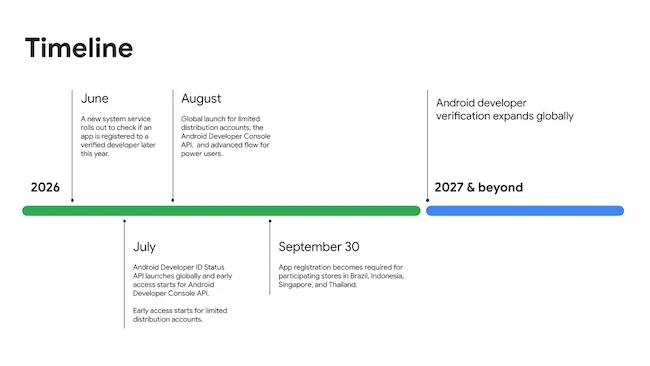
Android developer verification rollout

Google introduced Android developer verification last year and launched app registration in March, linking apps to verified identities. The initiative makes it harder for malicious actors to distribute harmful apps anonymously.

New APIs streamline app registration

Google is launching a suite of developer-requested APIs to help developers register apps in bulk or directly through CI/CD pipelines.

“The Android Developer ID Status API will let you check if a package name has already been registered, and the Android Developer Console API will let you register and manage package names directly within your development environment,” Matthew Forsythe, Director of Product Management, Android App Safety, said.

Both APIs support OAuth delegation, allowing third-party platforms, such as Android app stores, to perform these operations on behalf of developers. Google plans to roll out the APIs over the coming months.

What’s next

Starting this month, Google is rolling out a new system service that will be automatically installed on most Android devices. It will be used later this year to verify developer registration.

The Android Developer ID Status API will launch globally in July 2026, while early access for the Android Developer Console API will begin the same month. Google will open early access to limited distribution accounts in Android Developer Console. This new type of Android developer account is designed for students, hobbyists, and learners, allowing them to share apps with up to 20 devices without a government-issued ID or a fee.

Limited distribution accounts and the Android Developer Console API will launch globally in August 2026. Google will introduce an advanced flow for installing apps from unverified developers. It includes security checkpoints designed to resist coercion scams while allowing power users to continue sideloading apps from unverified developers.

Under the new requirements, only apps registered by verified developers can be installed and updated on certified Android devices from September 30, 2026. Unregistered apps can still be sideloaded through Android Debug Bridge (adb) or the advanced flow.

Google said most Play developers have already completed verification, and more than 99% of apps have been registered. They can check their verification status in Play Console and register any apps that were not automatically registered.