
惯性聚合 高效追踪和阅读你感兴趣的博客、新闻、科技资讯
阅读原文 在惯性聚合中打开

推荐订阅源

博客园_首页
J
Java Code Geeks
博客园 - 聂微东
量子位
C
Check Point Blog
T
The Blog of Author Tim Ferriss
T
Tailwind CSS Blog
G
Google Developers Blog
Google DeepMind News
B
Blog
罗磊的独立博客
腾讯CDC
GbyAI
GbyAI
博客园 - 【当耐特】
A
About on SuperTechFans
M
MIT News - Artificial intelligence
U
Unit 42
D
Docker
OSCHINA 社区最新新闻
OSCHINA 社区最新新闻
Y
Y Combinator Blog
大猫的无限游戏
大猫的无限游戏
小众软件
小众软件
S
SegmentFault 最新的问题
有赞技术团队
有赞技术团队

Help Net Security

Your work apps are quietly handing 19 data points to someone ChatGPT advanced account security adds passkeys and hardware keys Week in review: High-severity LPE vulnerability in the Linux kernel, cPanel 0-day exploited for months Automating Pentest Delivery: A Step-by-Step Guide - PlexTrac Open-source privacy proxy masks PII before prompts reach external AI services Shadow AI risks deepen as 31% of users get no employer training Identity is the control plane for distributed infrastructure AI traffic is getting bigger, louder, and less predictable New infosec products of the month: April 2026 cPanel zero-day exploited for months before patch release (CVE-2026-41940) Cisco releases open-source toolkit for verifying AI model lineage Met Police face criticism for using AI to spy on their own officers Nine-year-old Linux kernel flaw enables reliable local privilege escalation (CVE-2026-31431) Hacker with a special interest in breaching sports institutions ends behind bars - Help Net Security IP Fabric MCP server adds governance and control to enterprise AIOps workflows - Help Net Security Aqua Compass MCP server enables real-time investigation and containment of runtime threats - Help Net Security Google brings instant email verification to Android, no OTP needed - Help Net Security If cyber espionage via HDMI worries you, NCSC built a device to stop it - Help Net Security Apple fixes iPhone bug that let FBI retrieve deleted Signal messages(CVE-2026-28950) - Help Net Security GopherWhisper APT group hides command and control traffic in Slack and Discord - Help Net Security OpenAI tackles a bad habit people have when interacting with AI - Help Net Security A year in, Zoom's CISO reflects on balancing security and business - Help Net Security Scenario: Open-source framework for automated AI app red-teaming - Help Net Security GDPR works, but only where someone enforces it - Help Net Security Ransomware, fraud, and lawsuits drive cyber insurance claims to new peaks - Help Net Security Google’s Workspace Intelligence promises privacy while running on your data - Help Net Security Cyberattack on French government agency triggers phishing alert - Help Net Security Claude Mythos finds 271 Firefox flaws, Mozilla believes zero-days are numbered - Help Net Security Prove Identity Platform connects verification, authentication, and fraud prevention - Help Net Security New Mirai variants target routers and DVRs in parallel campaigns - Help Net Security
Little Snitch for Linux shows what your apps are connecti...
2026-04-10 · via Help Net Security

Network monitoring on Linux has long been a gap for users who want per-process visibility into outbound connections. Existing tools either operate at the command line or were designed for server security rather than desktop privacy. Objective Development, the Austrian company behind the macOS firewall utility Little Snitch, released a Linux version of the tool. It is free and, according to the company, will remain so.
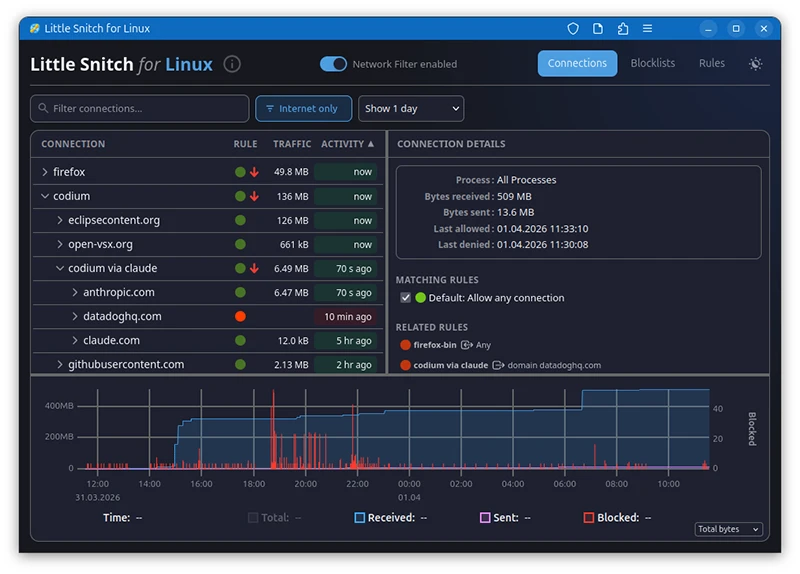
Little Snitch for Linux

Architecture choices

The kernel component uses eBPF for traffic interception. eBPF operates at the kernel level and offers greater portability than kernel extensions. The main backend is written in Rust. The user interface is a web application, which means a Linux server running Little Snitch can be monitored remotely from any device, including a Mac. The company lists server applications such as Nextcloud, Home Assistant, and Zammad as practical use cases for this capability.

The kernel component and the UI are open source. The kernel code is released so users can review its implementation, fix bugs, or adapt it to different kernel versions. The UI is licensed under GPL v2. The backend, which manages rules, block lists, and the connection view hierarchy, is free to use but closed source.

Feature scope and security limits

“From a feature perspective, Little Snitch for Linux sits somewhere between Little Snitch Mini and the full Little Snitch: functional and useful, but without all the polish and depth of the macOS version. Think of it as an honest first version,” the company said.

eBPF operates under resource constraints that make it possible to bypass the firewall, for example by flooding its tables. The tool is designed to show users what legitimate software is connecting to and to block those connections where desired. It is not designed to stop software that is actively attempting to evade it.

Compatibility

The release is confirmed to work on kernel 6.12 and above. On older kernels, the tool currently hits the eBPF verifier’s maximum instruction limit. The company states that compatibility down to kernel 5.17, where the bpf_loop() function was introduced, is theoretically achievable. Kernel 5.17 compatibility would extend support to Debian 12 (Bookworm) and Ubuntu 24.04 LTS (Noble). The company is inviting contributions from developers with the expertise to close that gap.

Little Snitch for Linux is available on GitHub.

Must read:

Subscribe to the Help Net Security ad-free monthly newsletter to stay informed on the essential open-source cybersecurity tools. Subscribe here!