
惯性聚合 高效追踪和阅读你感兴趣的博客、新闻、科技资讯
阅读原文 在惯性聚合中打开

推荐订阅源

月光博客
月光博客
J
Java Code Geeks
F
Fortinet All Blogs
Blog — PlanetScale
Blog — PlanetScale
P
Proofpoint News Feed
U
Unit 42
B
Blog
宝玉的分享
宝玉的分享
腾讯CDC
Microsoft Azure Blog
酷 壳 – CoolShell
酷 壳 – CoolShell
Last Week in AI
Last Week in AI
博客园 - Franky
博客园 - 三生石上(FineUI控件)
人人都是产品经理
人人都是产品经理
Martin Fowler
Martin Fowler
博客园_首页
freeCodeCamp Programming Tutorials: Python, JavaScript, Git & More
云风的 BLOG
云风的 BLOG
L
LangChain Blog
钛媒体:引领未来商业与生活新知
钛媒体:引领未来商业与生活新知
Y
Y Combinator Blog
The GitHub Blog
The GitHub Blog
博客园 - 叶小钗

Help Net Security

Your work apps are quietly handing 19 data points to someone ChatGPT advanced account security adds passkeys and hardware keys Week in review: High-severity LPE vulnerability in the Linux kernel, cPanel 0-day exploited for months Automating Pentest Delivery: A Step-by-Step Guide - PlexTrac Open-source privacy proxy masks PII before prompts reach external AI services Shadow AI risks deepen as 31% of users get no employer training Identity is the control plane for distributed infrastructure AI traffic is getting bigger, louder, and less predictable New infosec products of the month: April 2026 cPanel zero-day exploited for months before patch release (CVE-2026-41940) Cisco releases open-source toolkit for verifying AI model lineage Met Police face criticism for using AI to spy on their own officers Nine-year-old Linux kernel flaw enables reliable local privilege escalation (CVE-2026-31431) Hacker with a special interest in breaching sports institutions ends behind bars - Help Net Security IP Fabric MCP server adds governance and control to enterprise AIOps workflows - Help Net Security Aqua Compass MCP server enables real-time investigation and containment of runtime threats - Help Net Security Google brings instant email verification to Android, no OTP needed - Help Net Security If cyber espionage via HDMI worries you, NCSC built a device to stop it - Help Net Security Apple fixes iPhone bug that let FBI retrieve deleted Signal messages(CVE-2026-28950) - Help Net Security GopherWhisper APT group hides command and control traffic in Slack and Discord - Help Net Security OpenAI tackles a bad habit people have when interacting with AI - Help Net Security A year in, Zoom's CISO reflects on balancing security and business - Help Net Security Scenario: Open-source framework for automated AI app red-teaming - Help Net Security GDPR works, but only where someone enforces it - Help Net Security Ransomware, fraud, and lawsuits drive cyber insurance claims to new peaks - Help Net Security Google’s Workspace Intelligence promises privacy while running on your data - Help Net Security Cyberattack on French government agency triggers phishing alert - Help Net Security Claude Mythos finds 271 Firefox flaws, Mozilla believes zero-days are numbered - Help Net Security Prove Identity Platform connects verification, authentication, and fraud prevention - Help Net Security New Mirai variants target routers and DVRs in parallel campaigns - Help Net Security
Apple AirTag tracking can be misled by replayed Bluetooth...
Sinisa Markovic · 2026-04-17 · via Help Net Security

Apple’s AirTag is designed to help users track lost items by relying on a vast network of nearby Apple devices. New research shows that this same system can be manipulated to display locations where an AirTag has never been.
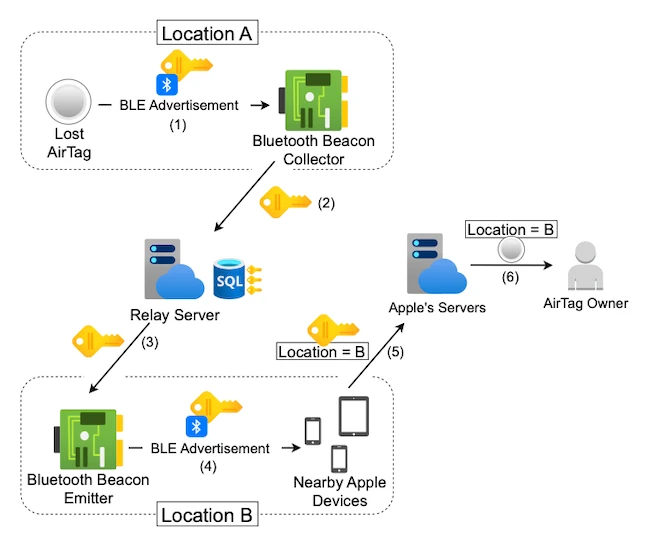
AirTag relay attack

Relaying an AirTag’s BLE advertisments over the Internet injects false location reports into the Find My system

How the attack works

The Find My network depends on Bluetooth Low Energy (BLE) signals broadcast by AirTags. When an iPhone or other Apple device detects one of these signals, it sends an encrypted location report to Apple. The owner then sees that location in the Find My app. The encryption protects identities but also prevents the system from checking whether the reported location is genuine.

Researchers demonstrated a relay attack that takes advantage of this limitation. They captured Bluetooth signals from a test AirTag using Android devices, Linux systems, and small embedded hardware. After recording the signals, they removed the battery from the original AirTag and replayed the captured data from a different location using custom transmitters.

Apple devices near the replayed signal treated it as if it came from the original AirTag. These devices generated location reports based on the new location, and the Find My app displayed that position. The same approach worked across long distances by sending the captured data over the internet and replaying it in another country.

Handling conflicting signals in Find My

When both the original AirTag and the replayed signal are active, the app can switch between two locations. The position shown may jump from the true location to the injected one, depending on which reports are processed.

The system handles reports in two ways. Cloud reports are accepted only if they use the current encryption key, which changes about every 24 hours. Older keys stop working after rotation. Local Bluetooth signals take priority when the owner’s device is nearby, which can override cloud data and influence what is shown.

Captured signals remain usable for a limited time. If key rotation is paused, for example by removing the AirTag’s battery, replayed signals can continue to produce location reports for up to seven days before the system marks them as outdated.

To support their testing, the researchers built a relay server that stored captured signals, tracked when they were first seen, and controlled when they were replayed. This setup allowed repeated tests of how long spoofed locations could persist.

“Our results demonstrate that the design of Apple’s Find My protocol is vulnerable to practical relay attacks. Beyond highlighting this attack vector to the security community, future work will examine whether relaying could be repurposed as an active countermeasure against stalking by obfuscating or disrupting unwanted tracking,” researchers wrote.