




 Similar debates resurfaced after a video showed a group of tourists performing Garba at Dubai's Burj Khalifa observation deck.
From airport tarmacs to European town squares, Indian tourists have found themselves at the centre of a string of viral moments abroad — sparking a debate over where cultural pride ends and public nuisance begins.
Whether it's an alleged shoplifting incident in Japan, Garba performances in airports and tourist hotspots, or dance reels filmed in crowded public spaces, these moments are increasingly drawing scrutiny and raising questions about how Indians are perceived overseas.
One controversy centres on an alleged shoplifting incident in Japan involving an Indian tourist. The episode came to light after investment advisor Muthukrishnan Dhandapani shared a detailed account on social media, claiming he was part of the same tour group.
Don't Miss: Move over Kerala? Why you must visit this lesser-known backwater paradise in Karnataka
According to Dhandapani, the woman was caught stealing items from a souvenir shop frequently visited by tourists. He alleged that fellow travellers were unaware of the situation until the shopkeeper confronted her.
"In our group, from the beginning one lady has been shoplifting. We were not aware of it. In one of the tourist souvenir shops, she was caught. She immediately offered to pay money. The Japanese shop keeper said that they are a high trust society where stealing is rare and have great respect for India. He said more than stealing, what offended him was offering money after being caught," Dhandapani wrote on X.
In our group, from the beginning one lady has been shoplifting. We were not aware of it. In one of the tourist souvenir shops, she was caught. She immediately offered to pay money. The Japanese shop keeper said that they are a high trust society where stealing is rare and have…
— Muthukrishnan Dhandapani (@dmuthuk) May 30, 2026
He further claimed that the shopkeeper contacted the police and the group's tour manager accompanied the woman to a police station.
"In Japan, you can never see police. Crime rate is very less. Traffic discipline is very high. The shopkeeper called the police. Our tour manager accompanied that lady to police station. In police station too that lady offered money. The Japanese police was not amused. They explained how severe the punishment is for stealing and said she needs to go to jail. But she being an Indian and they respect India a lot, she was let go with severe warning," he added.
According to his account, authorities eventually released the woman with a warning and chose not to pursue charges.
Garba on the tarmac
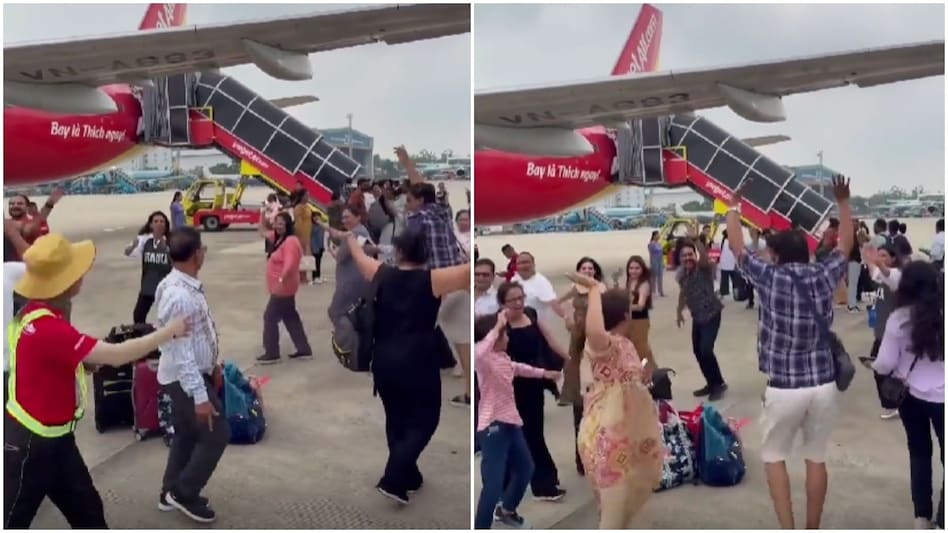
The discussion around Indian tourists abroad had already intensified earlier this year after a video from Vietnam showed a group of travellers performing Garba on an airport tarmac near a parked VietJet Air aircraft.
The clip, which spread widely across Instagram and Reddit, showed passengers dancing in a circle in a restricted operational zone close to the aircraft. While some viewers called it a joyful celebration of culture, many others questioned the appropriateness of staging a dance in a sensitive airport area.
Austria Garba sparks backlash
The Vietnam episode was not the first time Garba performed overseas had gone viral.
A video showed 43 Gujarati and Marwadi tourists dancing Garba in the historic old town of Innsbruck, Austria.
The woman who shared the clip said the group had approached two local street performers and requested that they play a Garba song. According to her account, the artists initially declined, saying it could create trouble with the police, but eventually agreed.
"Have you ever thought of playing Garba in Europe? Well, I had and now I can tick it off the bucket list," she captioned the video.
While the video attracted millions of views, many online users criticised the tourists.
Burj Khalifa and Wall Street moments
Similar debates resurfaced after a video showed a group of tourists performing Garba at Dubai's Burj Khalifa observation deck.
Shared by a Dubai-based content creator, the video featured tourists dancing in a circle to the song Chogada while other visitors moved through the crowded attraction.
Around the same time, another viral clip showed a wedding procession involving roughly 400 people dancing through New York's Wall Street, once again prompting discussion about cultural celebrations in public spaces abroad.
Viral reels and public spaces
The debate has also extended beyond Garba.
Another viral video recently showed an Indian content creator dancing to Mere Khwabon Mein from Dilwale Dulhania Le Jayenge at a crowded night market abroad.
Wrapped in a white towel, she danced in the middle of a busy street while tourists and locals walked around her. While some passersby paused to watch, others continued moving through the crowded market.
Like previous incidents, the clip divided viewers between those who saw it as harmless content creation and those who argued it reflected a growing tendency among travellers to prioritise social media attention over public etiquette.
Chaiyya Chaiyya In Vietnam
The debate received fresh fuel after a video of Indian tourists dancing to the Bollywood song Chaiyya Chaiyya on Vietnam's famous Train Street went viral on social media.
The clip was shared by Shweta Jain, founder of a Mumbai-based jewellery brand, who was visiting the country with friends. The video showed the group dancing on Hanoi's Train Street, a popular tourist attraction known for its narrow railway tracks that run through a bustling residential and café-lined neighbourhood.
"Vietnam ke Train Street gaye aur Chhaiyaa Chhaiyaa nahi kiya toh kya Train Street gaye (If you've visited Vietnam's Train Street but didn't do Chaiyya Chaiyya, did you really visit Train Street at all?)," read the text overlaid on the video, a reference to the iconic Shah Rukh Khan-Malaika Arora song filmed atop a moving train.
The post was captioned, "Filmy heart, global streets."
While many users found the clip entertaining, others criticised the group for what they described as attention-seeking behaviour. Several social media users argued that such performances contribute to negative stereotypes about Indian tourists abroad and reflect a growing tendency among travellers to prioritise viral content over local etiquette.
Published on: Jun 14, 2026 3:07 PM IST
此内容由惯性聚合(RSS阅读器)自动聚合整理,仅供阅读参考。 原文来自 — 版权归原作者所有。