





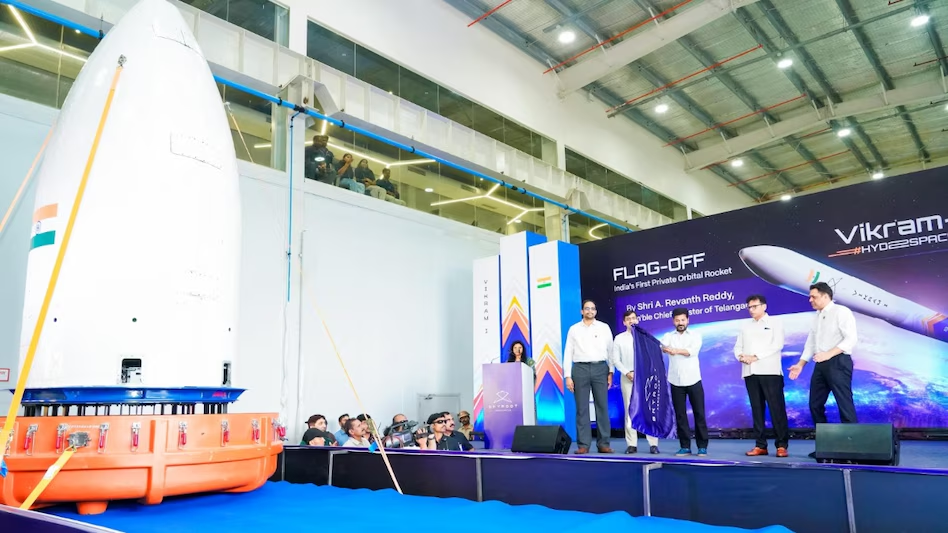
 The flag-off ceremony, held at Skyroot’s Max-Q campus in Hyderabad, was led by Telangana Chief Minister A Revanth Reddy, alongside state minister D Sridhar Babu.
India’s push into private spaceflight gathered momentum on April 25, with Skyroot Aerospace dispatching its Vikram-1 rocket to Sriharikota for what is set to be the country’s first privately-built orbital launch attempt.
The flag-off ceremony, held at Skyroot’s Max-Q campus in Hyderabad, was led by Telangana Chief Minister A Revanth Reddy, alongside state minister D Sridhar Babu.
As part of the ceremony, the Chief Minister flagged off the rocket’s space-ready payload fairing, the structure that protects satellites during ascent.
Reddy said the occasion marks a key milestone in Telangana’s aerospace ambitions, adding that the government is focused on skilling youth through partnerships with global universities and industry leaders.
— Skyroot Aerospace (@SkyrootA) April 24, 2026Vikram-1's Integrated Electrical Test Campaign — Phase 3 of pre-launch testing — is complete.
This campaign brought everything together — the vehicle, ground software, and electrical interfaces — running as one system for the first time.
Every on-board system had to… pic.twitter.com/aWgIe2XCwZ
The flag-off comes after the completion of pre-flight testing at Skyroot’s facilities, with the rocket’s propulsion stages already secured at the Sriharikota spaceport.
“The launch of this orbital rocket will mark a major milestone for India’s emerging private space-tech industry. With Vikram-1, we aim to open up space by enabling on-demand satellite launches for a fast-growing global market,” said Pawan Kumar Chandana, co-founder and CEO, Skyroot Aerospace.
The launch, expected in the coming months, will mark India’s first private attempt at an orbital mission, a segment currently dominated by a handful of global players.
Vikram-1 is a multi-stage orbital launch vehicle designed to deploy small satellites of up to 350 kg into low Earth orbit. Built using an all-carbon composite structure, the rocket is powered by in-house propulsion systems, including 3D-printed engines and high-thrust solid boosters.
The mission will be carried out under the authorisation of IN-SPACe, with technical oversight from ISRO.
For Unparalleled coverage of India's Businesses and Economy – Subscribe to Business Today Magazine
Published on: Apr 25, 2026 3:57 PM IST
此内容由惯性聚合(RSS阅读器)自动聚合整理,仅供阅读参考。 原文来自 — 版权归原作者所有。