









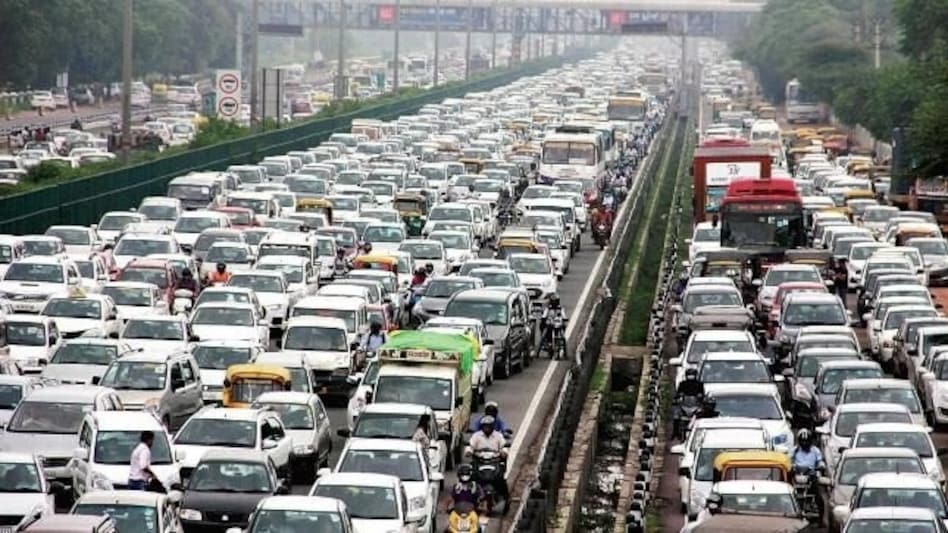
 For the hundreds of thousands of professionals who spend hours each day in bumper-to-bumper traffic, the government's endorsement of remote work feels like a long-overdue correction.
The daily migration into Gurgaon has become a relentless, gridlocked spectacle. Every morning, an estimated five lakh vehicles pour into the Millennium City from Delhi, Faridabad, and across the National Capital Region (NCR), choking highways and arterial roads.
Home to dozens of Fortune 500 companies and major technology firms, Gurgaon has emerged as a symbol of India's corporate success story — but also of its urban mobility crisis.
Now, mounting economic pressures are forcing policymakers to rethink the daily commute itself.
The Haryana government has formally urged private companies to revive work-from-home arrangements and adopt staggered office timings. The advisory comes against the backdrop of rising fuel costs and global supply-chain disruptions linked to the ongoing tensions in West Asia.
By reducing the number of vehicles on the road during peak hours, the state hopes to ease congestion while conserving energy. Instead of relying solely on new infrastructure projects to tackle traffic, Haryana is asking corporate India to fundamentally rethink how work is organised.
Bringing corporate India on board
According to a Times of India report, to push the initiative forward, the state has directed its industries department to engage with leading industry bodies, including Nasscom, the Confederation of Indian Industry (CII), and the Federation of Indian Chambers of Commerce and Industry (FICCI).
The proposal encourages companies to distribute employee reporting times across the day and shift suitable segments of the workforce to remote or hybrid models wherever operationally feasible. The objective is to flatten the sharp morning and evening rush-hour peaks that have long defined Gurgaon's daily commute.
The outreach to industry is part of a broader energy-conservation drive already underway within the state administration. Government departments have been instructed to reduce petroleum expenditure by 20% through September and cut official vehicle usage by 10% every month through a digital monitoring system. VIP convoy sizes have also been reduced by half, while purchases of new internal-combustion-engine vehicles have been temporarily suspended in favor of electric alternatives.
Industry sees practical benefits
Early reactions from the corporate sector suggest cautious optimism.
Nitin Sahini, President of Foqal Analytics, described the government's proposal as both practical and timely. He noted that knowledge-driven industries have already demonstrated the viability of hybrid and remote work models, particularly during and after the Covid-19 pandemic.
According to Sahini, flexible work arrangements can help organizations maintain productivity and client service standards while simultaneously reducing commuting time and operational costs. Lower fuel consumption, reduced traffic congestion, and improved air quality could emerge as additional benefits.
While acknowledging that implementation will vary across sectors, he said organizations capable of offering remote or flexible work options should seriously consider doing so.
Employees welcome the move
For the hundreds of thousands of professionals who spend hours each day in bumper-to-bumper traffic, the government's endorsement of remote work feels like a long-overdue correction.
Pramod Singh, an employee at a multinational corporation in Gurgaon, pointed out that businesses continued to function effectively during the Covid-19 years when remote working became the norm. In his view, work-from-home arrangements have little adverse impact on productivity while generating significant savings for both employers and employees through lower commuting, office-space, and operational costs.
Beyond offices: A wider sustainability push
The work-from-home push is only one part of Haryana's broader sustainability agenda.
Through its "Mera Bharat, Mera Yogdan" campaign, the state is encouraging households and businesses to adopt energy-saving practices. Citizens are being urged to maximize the use of piped natural gas, maintain energy-efficient air-conditioning settings, and rely more on public transport and carpooling.
Administrative departments, universities, and municipal bodies have already been instructed to implement these measures immediately.
Over the coming months, the success of the initiative could determine whether Gurgaon can gradually exchange its infamous gridlocked expressways for a leaner, more flexible, and increasingly digital corporate culture.
Published on: Jun 14, 2026 3:49 PM IST
此内容由惯性聚合(RSS阅读器)自动聚合整理,仅供阅读参考。 原文来自 — 版权归原作者所有。