





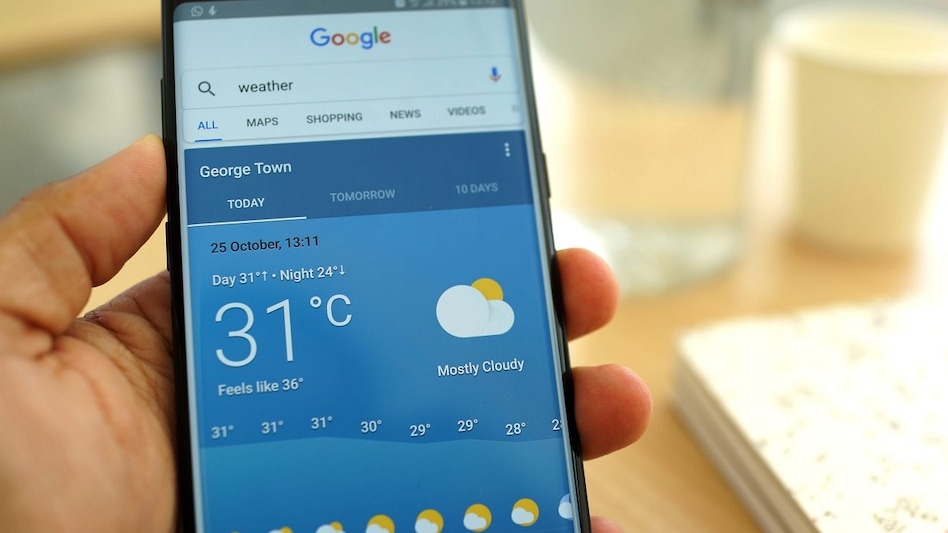
 When you check the default weather app on your smartphone, you are rarely looking at direct IMD data.
It’s a classic frustration: your weather app promises a clear sky, but 10 minutes later you are drenched in a sudden downpour. Or worse, you receive an orange alert for severe thunderstorms, only to look out at a bone-dry street.
The paradox is jarring. The India Meteorological Department (IMD) possesses a massive infrastructure: over 40 advanced Doppler weather radars, a fleet of INSAT satellites, and some of the world's fastest supercomputers (like Pratyush and Mihir). Nationally, their 24-hour heavy rainfall alerts hit an impressive 85% accuracy rate.
Yet, when it comes to predicting whether it will rain on your specific street in the next two hours, the system often misses the mark. This disconnect isn't a failure of technology — it is a combination of physics, geography, and a structural gap in how data is processed.
1. The Tropical Chaos Factor: The primary reason for local forecasting misses is India’s tropical climate.
In mid-latitude regions like Europe or the US, weather is driven by massive, slow-moving frontal systems that span hundreds of kilometers. These are highly predictable. If a storm front is moving across the American Midwest at 40 km/h, supercomputers can easily calculate exactly when it will hit Ohio.
India’s summer rain is entirely different. It is largely driven by convective precipitation. Intense solar heating causes warm, moist air to rise rapidly from small pockets of land. This air cools, condenses, and forms localized storm clouds (cumulonimbus) that dump heavy rain over a tiny area. These micro-events can form, peak, and dissipate in less than an hour, across an area of just 2-5 km.
Predicting exactly which neighborhood will trigger this convective reaction is like trying to guess exactly where the first bubble will pop in a pot of boiling water.
2. The "Grid Size" Problem: To forecast weather, supercomputers divide the country into a massive 3D grid, calculating physics equations for each block.
Until recently, the standard resolution for India’s regional models was a 12km x 12km grid. If an entire city like Noida or South Mumbai fits into just one or two grid boxes, the computer model can only output an average forecast for the whole area. It will predict "light rain across the grid," which translates on the ground to a torrential downpour in one sector and absolute dryness three kilometers away.
While the IMD is actively rolling out the Bharat Forecast System (BharatFS) to shrink this grid to 6 km — and even experimenting with a hyper-dense 330-meter model for Delhi — scaling this resolution nationwide demands astronomical computing power.
3. Radars see the rain, but models can't "Digest" it fast enough: The 40+ Doppler Weather Radars (DWRs) across India are incredibly precise. They emit radio waves that bounce off raindrops, showing exactly where a storm is moving in real-time.
However, there is a lag between a radar seeing the rain and a weather app predicting it. To make a forecast, raw radar and satellite data must be fed into a numerical weather model — a process called data assimilation. Running these complex mathematical simulations takes time, often hours.
By the time the supercomputer finishes processing a localised storm cell's data, the actual storm on the ground may have already moved or rained itself out.
For immediate 1-to-2-hour forecasts (known as nowcasting), meteorologists must rely on manual tracking and automated alerts rather than deep computer modeling, which leaves a window for error on consumer apps.
4. The Blind Spot in Your App's Pocket: When you check the default weather app on your smartphone, you are rarely looking at direct IMD data. Most commercial apps pull their forecasts from global aggregators like Weather Underground, The Weather Company, or AccuWeather.
These global companies primarily rely on international models, such as the American GFS (Global Forecast System) or the European ECMWF. While these models are stellar at global trends, they often lack access to India's high-density local automated weather stations, or they fail to accurately weigh unique regional factors like the complex Indian Ocean Dipole and micro-urban heat pockets.
Bridging the gap
To bridge this gap, the Ministry of Earth Sciences launched Mission Mausam. This initiative focuses on deploying next-generation observational tools to capture the atmosphere at a much more granular level, specifically targeting sudden events like cloudbursts and lightning.
Until those hyper-local networks are fully integrated nationwide, the best strategy for local rain planning is to skip the automated 5-day text forecast on your phone. Instead, look for live radar reflectivity maps on the IMD website or specialized regional weather handles — seeing the actual storm clouds moving in real-time is still the most reliable way to know if you need an umbrella.
Published on: May 23, 2026 4:08 PM IST
此内容由惯性聚合(RSS阅读器)自动聚合整理,仅供阅读参考。 原文来自 — 版权归原作者所有。