



惯性聚合 高效追踪和阅读你感兴趣的博客、新闻、科技资讯
阅读原文 在惯性聚合中打开

推荐订阅源

I
Intezer
Cyber Security Advisories - MS-ISAC
博客园 - 【当耐特】
H
Heimdal Security Blog
I
InfoQ
Blog — PlanetScale
Blog — PlanetScale
Apple Machine Learning Research
Spread Privacy
Spread Privacy
腾讯CDC
大猫的无限游戏
大猫的无限游戏
Recent Announcements
V
Vulnerabilities – Threatpost
D
DataBreaches.Net
The GitHub Blog
The GitHub Blog
C
CXSECURITY Database RSS Feed - CXSecurity.com
cs.AI updates on arXiv.org
G
Google Developers Blog
Application and Cybersecurity Blog
J
Java Code Geeks
MyScale Blog
MyScale Blog
P
Palo Alto Networks Blog
V
Visual Studio Blog
Microsoft Azure Blog
Google Online Security Blog
cs.CL updates on arXiv.org
W
WeLiveSecurity
宝玉的分享
宝玉的分享
aimingoo的专栏
aimingoo的专栏
博客园_首页
S
Security @ Cisco Blogs
Threat Intelligence Blog | Flashpoint
Recent Commits to openclaw:main
P
Privacy International News Feed
H
Hacker News: Front Page
Vercel News
Vercel News
T
Troy Hunt's Blog
Forbes - Security
Forbes - Security
N
News and Events Feed by Topic
钛媒体:引领未来商业与生活新知
钛媒体:引领未来商业与生活新知
U
Unit 42
Cloudbric
Cloudbric
MongoDB | Blog
MongoDB | Blog
B
Blog RSS Feed
T
Threat Research - Cisco Blogs
C
Cyber Attacks, Cyber Crime and Cyber Security
Schneier on Security
Last Week in AI
Last Week in AI
H
Help Net Security
M
MIT News - Artificial intelligence
美团技术团队

The Next Platform: In-depth coverage of high end computing

Uncle Sam Awards $2 Billion-Plus To Quantum Companies, But Wants A Cut Oak Ridge Starts Weaving Together A Quantum, Classical HPC, And AI System Stack Dell Bulks Up Hardware As AI Infrastructure Shifts To On-Premises Cisco Wins Over AI Customers With Merchant Silicon And Optics With Its IPO Done, Cerebras Can Get Back To Pushing The AI Envelope HPE Throws VM Users A Lifeline, Unifying Containers And VM Management In Cloud Stack OpenAI, Microsoft And Friends Build A Better, More Scalable Ethernet Compute And Memory Price Hikes Drive IT Spending Way Higher Sometimes, Air Is The Only Way For AI Systems To Keep Their Cool Arista Rides AI Scale Out Networks, Moves Into Scale Across, And Awaits Scale Up If You Can Make A Compute Engine, You Can Sell A Compute Engine Cleveland Clinic Simulates Large Proteins With Quantum-Centric Supercomputing Broadcom Helps CPU And XPU Makers Go Vertical With Compute Microsoft Committed To Doubling AI Infrastructure In Two Years Google Is A Full Stack AI Player, And Is Playing Well AWS Will Be An OEM, Just Like Google And Maybe Microsoft New Google Networks Tuned Up For GenAI Inference And Training Microsoft And OpenAI Remain Friends, Are Looking To Hook Up With Others AI-Driven CPU Shortage Saves Intel’s Financial Cookies The GenAI Battle Shifts From Frontier Models To Agentic Platforms With TPU 8, Google Makes GenAI Systems Much Better, Not Just Bigger Cisco Scales Out Quantum Systems With A Quantum Network Switch The Second Time Will Be The IPO Charm For Cerebras Imagine An Army Of AI Minions Handling Incident Response AI Will Soon Drive A Third Of TSMC’s Business Bechtolsheim & Friends Breathe Life Into Pluggable Optics One Last Time How HPC And AI Digital Twins Accelerate Quantum Error Correction The Embrace Of AI In Design Transforms Cadence And Its Customers Nvidia Brings The Power Of Open Source AI Models To Quantum Computing Building The Imperfect Beast For Enterprises, GPUs Need Virtualization As Much As CPUs Ever Did CoreWeave Takes As Much Financial Engineering As It Does Datacenter Design Contemplating Meta’s Homegrown MTIA Compute Engine Roadmap Most Neoclouds, Sovereigns, And Enterprises Will Buy, Not Build, Their AI Stacks Broadcom And Google Benefit Mightily From Anthropic’s Meteoric Growth Rebellions AI Rings Up The Money To Rack Up AI Inference Systems Nvidia Software Pushes MLPerf Inference Benchmarks To New Highs Broadcom Makes Its Pitch To Run Kubernetes On VMware VCF The $2 Billion Nvidia Deal With Marvell Is About A Lot More Than NVLink Fusion Classiq Says Quantum Is On Its Way, But Patience Is Needed Demonstrating The Scientific Usefulness Of Quantum Systems We Need Servers – Lots Of Servers. . . . Arm Comes Full Circle With Homegrown, AI-Tuned Server CPU Riding The Memory Boom And Trying To Avoid The Bust Data Analytics Helps Make The Mighty Lionesses Roar Driving Down The AI System Roadmap With Nvidia The Open Agentic AI World According To Nvidia Nvidia Finally Admits Why It Shelled Out $20 Billion For Groq Nvidia Says OpenClaw Is To Agentic AI What GPT Was To Chattybots IBM Unrolls Blueprint For Quantum-Classical HPC Computing Women Get Data-Driven Health Boost As The FA Tackles Sports Science Four Months Into Its Comeback, Zapata Stakes Its Claim In Quantum Software Eridu Cuts To The AI Networking Chase With High Radix Switch System HPE Works Harder And Smarter To Chase Datacenter Profits We Need A Proper AI Inference Benchmark Test How AI Is Boosting Gender Equality In High Performance Racing Custom Compute Engine Biz Growing More Than Marvell Ever Hoped Broadcom May Become The Biggest Counterbalance To Nvidia Ayar Labs Gets $500 Million To Ramp Photonics Into 2028 AI Systems With Cisco Outshift, Agentic AI Is Teed Up For the Internet Of Cognition Nvidia Sees The Light On Silicon Photonics And Maybe Optical Switching AI Servers Finally Dominate Dell’s Systems Business VAST Data: What Controls The Data Is More Important Than What Stores It So Far, Nobody Turns Tokens Into Money Like Nvidia SambaNova Pits Its Engineering Against Nvidia For Agentic AI Some More Game Theory, This Time On The AMD-Meta Platforms Deal AMD Says “Helios” Racks And MI400 Series GPUs On Track For 2H 2026 Taalas Etches AI Models Onto Transistors To Rocket Boost Inference Some Game Theory On That Nvidia-Meta Platforms Partnership AI Eats The World, And Most Of Its Flash Storage The Current AI Networking Wave Will Be A Tsunami Of Money By 2027 The Memory Crunch Pinches Cisco’s Profits Only A Few AI Platforms Can Survive The Greatest AI Show On Earth Cisco Doubles Up The Switch Bandwidth To Take On AI Scale Out And Eventually Scale Up Datacenter Spending Forecast Revised Upwards – Yet Again The Twin Engine Strategy That Propels AWS Is Working Well With GenAI Turbochargers, Google Is Shifting Its Cloud Into A Higher Gear AMD Finally Makes More Money On GPUs Than CPUs In A Quarter Dassault And Nvidia Bring Industrial World Models To Physical AI TACC Explores Mixed Precision And FP64 Emulation For HPC With Horizon Robotics Will Break AI infrastructure: Here's What Comes Next Oracle’s Financing Primes The OpenAI Pump Gartner Takes Another Stab At Forecasting AI Spending Microsoft Is More Dependent On OpenAI Than The Converse Big Blue Poised To Peddle Lots Of On Premises GenAI Microsoft Takes On Other Clouds With “Braga” Maia 200 AI Compute Engines Nvidia’s $2 Billion Investment In CoreWeave Is A Drop In A $250 Billion Bucket Intel Is Still Struggling In The Datacenter, But It Could Get Better Is Nvidia Assembling The Parts For Its Next Inference Platform? TSMC Has No Choice But To Trust The Sunny AI Forecasts Of Its Customers Cerebras Inks Transformative $10 Billion Inference Deal With OpenAI By Decade’s End, AI Will Drive More Than Half Of All Chip Sales Startup Quantum Elements Brings AI, Digital Twins To Quantum Computing D-Wave Makes Gate-Model Power Move With Quantum Circuits Buy Building The Future Of Software In The AI-Native Era Arista Modular Switches Aim At Scale Across Networks, Hit Scale Out, Too NextSilicon Takes Aim At CPUs And GPUs With “Maverick-2” Dataflow Engine How HPC Is Igniting Discoveries In Dinosaur Locomotion – And Beyond Oracle First In Line For AMD “Altair” MI450 GPUs, “Helios” Racks
CPU-Only Compute Still Matters To A Lot Of HPC Centers
2026-02-23 · via The Next Platform: In-depth coverage of high end computing

It has taken three decades for HPC to move to the cloud, and the truth is that a lot of simulation and modeling applications are still coded to run on CPUs. The good news is that the major clouds and some of the smaller ones have tuned up their CPU estates with fast networking and proper HPC software stacks so they can be of good use for HPC centers that, for whatever reason or another, desire to rent rather than to buy some compute capacity.

This week, Amazon Web Services trotted out the latest of its HPC-tuned virtual servers, the HPC8a instances, which are based on a customized versions of AMD’s “Turin” Epyc 9005 series processors. The Turin CPUs.

NEXTPLATFORM AD

The Turin CPUs were launched in October 2024, and come in two flavors: One set based on the regular Zen 5 cores that span from 8 to 128 cores, and from 16 to 256 threads, per socket and another set based on the L3 cache-halved Zen 5c cores that span from 96 to 192 cores and 192 to 384 threads. We think the new HPC8a instances – there is really only one at the moment, but that could change – are based on a custom Epyc 9R15 processor, much as the prior HPC6a and HPC7a instances were based on custom “Milan” Epyc 7R13 from March 2021 and “Genoa” Epyc 9R14 processors from November 2022. The Epyc 9R15 chip seems to be based on a the Epyc 9655 processor, which has the same base clock speed of 2.6 GHz and the same turbo clock speed of 4.5 GHz that the Epyc 9R15 is said to have.

We know that these HPC instances, with the exception of those based on the Graviton3E, are two socket machines because we know that all of the HPC instances have simultaneous multithreading turned off. On HPC workloads using the Message Passing Interface (MPI) protocol to share work across loosely couple memory pools composed of the HPC cluster nodes, the MPI communications is very sensitive to cache latencies, which in turn are adversely affected by SMT. When you turn SMT off, you are only using one thread per core and the cache behaves more predictably and performance doesn’t degrade.

So, the new hpc8a-96xlarge is not a single 96-core processor, but rather a pair of them that deliver 192 physical cores that are in turn virtualized into 192 vCPUs.

The important thing about the HPC8a is that by moving to the Turin design, there are a dozen memory controllers on each Turin processor across the 96 cores (and therefore 96 vCPUs) on the Epyc 9R15 socket instead of only eight memory controllers with the Genoa chips used in the HPC7a instances.

NEXTPLATFORM AD

The combination of the higher memory controller count and the move to faster DDR5 memory means that on workloads that are constrained by memory bandwidth, the Turin instances will do up to 40 percent more work than the Genoa instances with the same vCPU count even though. This is despite the fact that the peak theoretical performance at the base clock speed of 2.6 GHz of the Epyc 9R15 for FP64 floating point precision used in the HPC8a instance is almost exactly the same as the peak FP64 oomph of the Epyc 9R14 used in the HPC7a instances.

You can see this in the AWS HPC instance table we have created below:
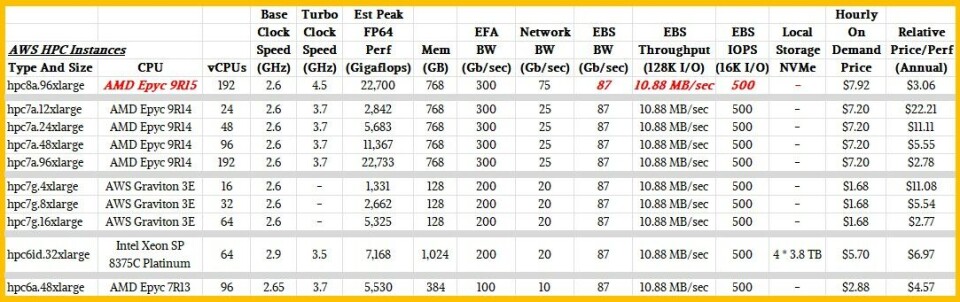
If you do the math, then, which is what HPC centers do for a living, then almost all of the performance gain and nearly all of the 25 percent price/performance gain that AWS cites in its HPC8a announcement when compared to the top-end HPC7a instance comes from that extra memory bandwidth from more channels and faster DDR5. Clearly, from the table, you see the trouble with using peak theoretical performance alone to gauge real-world performance and therefore price/performance. If you based your buying decisions on this table alone, you would go with the Genoa instance, not the Turin instance.

Both the HPC8a and HP7a instances make use of the 300 Gb/sec EFA-2 Ethernet adapters on the HPC8a instances, so there is no network advantage driving performance across the latest Turin instances. We are surprised that AWS has not yet delivered a 400 Gb/sec or better still 800 Gb/sec EFA-3 adapter for its formal HPC instances, to be honest, which might contribute to cluster throughput in a big way for Genoa and Turin instances used at scale.

NEXTPLATFORM AD

You will notice a few things odd about the HPC instances that AWS has put together. The HPC6 instances came in two flavors: One based on a “Ice Lake” Xeon SP v3 processor from Intel and one based on the custom Milan Epyc 7R13 processor from AMD. The name of the instance tells you the core count and the vCPU number tells you the thread count. There is one instance per type, and it has the maximum core and thread count.

With the HPC7g instances, which are based on the HPC-tuned Graviton3E variant of the AWS-designed Graviton3 processor and which were launched in December 2022, and with the HPC7a instances based on the custom Genoa Epyc 9R14 processors, which launched in August 2023, AWS did something different. Rather than just have a single instance with maximum cores and a reasonably large memory, AWS made the memory capacity static but allowed for the core counts to be reduced so that customers could pick a ratio of memory capacity and memory bandwidth to cores as they often do when they configure server nodes in their on-premises CPU clusters.

So, with the Graviton3E-based HPC7g instances, customers could configure cores against that 128 GB of main with 2 GB, 4 GB, or 8 GB of memory across each of those cores. (As the core counts shrank, the amount of memory bandwidth per core grew in the same proportion.) Interestingly, AWS didn’t change the cost of on demand instances based on the core count or these other metrics. The price was the same at $1.68 per hour.

Ditto for the HPC7a instances based on Genoa. By reducing the core count by selecting a smaller instance slice (but with a fixed memory capacity no matter what the core count is), customers could configure 4 GB, 8 GB, 16 GB, or 32 GB of main memory per core and, again, a proportionally smaller amount of memory bandwidth per core as the core counts go up.

NEXTPLATFORM AD

With the HPC8a instance just announced, AWS is back to just selling the full, fat configuration, in this case with 96 cores against 768 GB of main memory, or the 4 GB per core that is often used with nodes in HPC clustered systems.

One other thing you will also note: The Elastic Block Storage (EBS) bandwidth and throughput is the same across all of these instances, and it is not particularly high, at 87 Mb/sec and 500 I/O operations per second (IOPS). There is a special turbo mode for EBS that allows HPC customers to run at 2,085 Mb/sec bandwidth and drive 11,000 IOPS for a 30 minute period within every 24 hours. It is not clear if this is being used for snapshotting of state for the virtual HPC clusters, which do not have local storage with the exception of the one HPC6id instance launched many years ago.

Clearly, AWS does not want customers to set up parallel file systems atop its EBS block storage, although there is probably not a technical reason it could be done. And clearly, AWS very much wants HPC shops running their ModSim in the cloud to use is FSx for Lustre, a fully managed implementation of the open source Lustre parallel file system. That said, there is nothing that will stop you from setting up a VAST Data or WekaIO cluster on AWS iron and link that to an HPC instance cluster if you want to.