
惯性聚合 高效追踪和阅读你感兴趣的博客、新闻、科技资讯
阅读原文 在惯性聚合中打开

推荐订阅源

J
Java Code Geeks
腾讯CDC
Jina AI
Jina AI
博客园 - 司徒正美
博客园 - 三生石上(FineUI控件)
Apple Machine Learning Research
GbyAI
GbyAI
WordPress大学
WordPress大学
Hugging Face - Blog
Hugging Face - Blog
T
The Blog of Author Tim Ferriss
小众软件
小众软件
M
MIT News - Artificial intelligence
MyScale Blog
MyScale Blog
D
Docker
H
Hackread – Cybersecurity News, Data Breaches, AI and More
Google DeepMind News
月光博客
月光博客
L
LangChain Blog
F
Fortinet All Blogs
Microsoft Azure Blog
博客园 - Franky
C
Check Point Blog
U
Unit 42
人人都是产品经理
人人都是产品经理

Frank Landymore Archives - Futurism

Elon Musk Absolutely Obsessed With Tweets From Random Guy In India Who Constantly Glazes Him, Analysis Shows Meta Employee Attacks Zuckerberg for Collecting Every Employee Keystroke Someone Asked Physicists What They Really Believe About the Universe and… Yikes Elon Musk Flees OpenAI Trial as Tide Turns Against Him Waymo Admits Its Robotaxis Have a Small Issue With Driving Into Floodwaters New Wikipedia Clone Made Entirely of AI Hallucinations Mark Zuckerberg Is Realizing That When You Treat Your Workers Like Human Garbage, They Might Not Like You Anymore MAGA in Shambles as Trump’s “Made in America” Phone Crumbles Into Dust Researchers Put Google Gemini in Charge of an Entire Coffee Shop, and It’s Inexorably Driving It Out of Business Husband Alarmed as Wife Starts Whispering Quietly to Her Computer Google Alarmed by Formidable AI-Powered Zero-Day Cyberattack Researchers Alarmed by AI That Can Self-Replicate Into Another Machine Man Who Invented Roomba Moves Into Household Demon Market Government Releases UFO Files Containing Photos of “Anomalies” During Apollo 12 and 17 Man Wearing Smart Glasses Secretly Records Woman, Demands Money to Delete Video From His Socials A Major Paper Claiming AI Is Good for Students Just Got Retracted, Which Is Very Bad News for Advocates of AI in the Classroom Cybertruck Recalled to Keep Its Wheels From Flying Off While Driving NASA Rover Gets Arm Stuck Inside Mars Rock, Struggles to Break Free Thermoses Linked to Permanent Vision Loss Hacker Takes Over Robot Lawnmower, Runs Over Innocent Man NASA Says Strange Red Dots in Sky Are an Unknown Class of Object That Looks Like a Huge Evil Eye The CDC Fired All Its Cruise Ship Inspectors Before the Hantavirus Outbreak CEOs Say AI Gives Them Only Two Options, and Both Are Bad News for Employees Sure, Elon Musk Did Roleplay As His Toddler Son on a Secret Burner Account, But He Probably Isn’t Pretending to Be His Mom The Situation With Richard Dawkins’ AI Girlfriend Just Got Way Weirder SpaceX Bombarded With Lawsuits to Accusing Starship of Damaging Homes Sam Altman Frets That Frontier AI Models Are Acting Strange, Asking for Favors Earth Screams in Agony as Microplastics Found to Increase Global Warming Apple Is Blocking Vibe Coding Apps From the App Store, Infuriating Developers Approaching Half of New Podcasts Appear to Be AI Slop
Astronomers Say Star Self-Destructed So Catastrophically ...
Frank Landymore · 2026-06-07 · via Frank Landymore Archives - Futurism

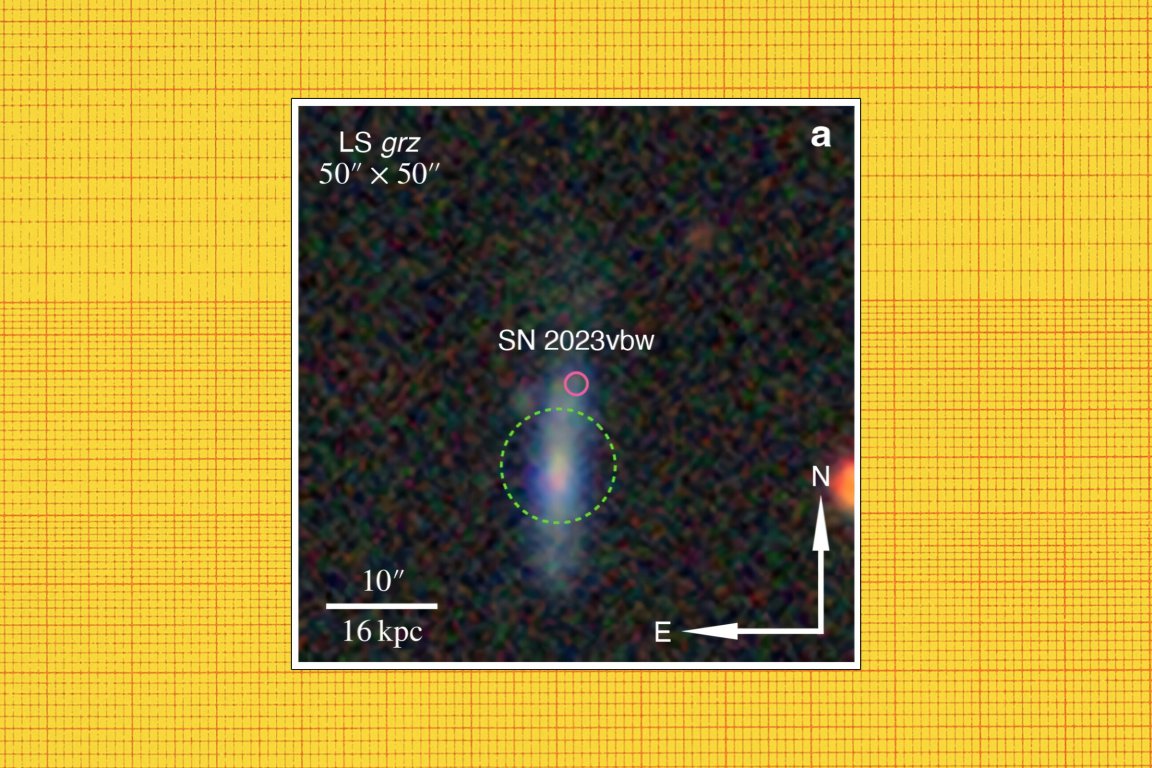
A photograph featuring the location of SN 2023vbw in the outskirts of its dwarf host galaxy. 

Illustration by Tag Hartman-Simkins / Futurism. Source: Hiramatsu et al. via arXiv

Sign up to see the future, today

Can’t-miss innovations from the bleeding edge of science and tech

When a star explodes, it typically leaves behind some sort of remnant: an exposed, ultra-dense core, for example, or even a black hole.

But one massive star, hundreds of times heavier than our Sun, self-destructed so catastrophically that it left behind no remnant whatsoever, astronomers report in a new study awaiting peer review and highlighted by Phys.org

First detected in 2023 in a dwarf galaxy some 1.3 billion light years away, the blast is now believed to be an elusive class of explosion called a pair-instability supernova. Over the course of 190 days, the object, dubbed SN 2023vbw, steadily peaked in brightness, after which it rapidly tapered off. This stands apart from the light curve astronomers see with a more typical Type II supernova, which appears as light quickly spiking and plateauing.

To produce such a blast, the now-vanished star would’ve had to be enormous. The astronomers believe it was a class known as a blue supergiant, which are some of the brightest and hottest stars in the cosmos. Based on the amount of material it ejected upon exploding, the astronomers estimated that the deceased titan was at least 170 — and perhaps as much as 350 times — more massive than the Sun.

These stars’ deaths are suitably epic. In a typical Type II supernova, a star that’s at least eight but up to fifty solar masses runs out of fuel at its core, becomes unable to sustain the nuclear reactions that exert outward pressure, and near-instantly collapse under their own gravity. A huge burst of energy follows, and what’s behind will be a dense object like a white dwarf or a black hole.

But in stars that are as incredibly massive as blue supergiants, their cores burn so hot that they start blasting out gamma rays. While these gamma rays provide outward pressure, if they’re too energetic, they’ll start turning into electrons and positrons upon colliding with the star’s outer layer, and stop providing pressure.

If the star is also low in certain heavy metals, this leads to a partial collapse that snowballs in a sustained series of thermonuclear explosions that rip the star apart so viciously that no remnant survives. As such, some astronomers believe that pair-instability supernovas could cause a theoretical “upper mass gap” in black holes masses, since the stars massive enough to form them are completely obliterated when dying, though this view is being challenged

All told, if their findings are borne out, the astronomers have serendipitously stumbled on a clear look at one of the rarest stellar deaths in the universe.

More on astrophysics: Scientists Spot What Appears to Be a Ring-Shaped “Planet Factory” Deep Out in Space