

惯性聚合 高效追踪和阅读你感兴趣的博客、新闻、科技资讯
阅读原文 在惯性聚合中打开

推荐订阅源

Blog — PlanetScale
Blog — PlanetScale
B
Blog
A
About on SuperTechFans
大猫的无限游戏
大猫的无限游戏
爱范儿
爱范儿
OSCHINA 社区最新新闻
OSCHINA 社区最新新闻
H
Help Net Security
H
Hackread – Cybersecurity News, Data Breaches, AI and More
博客园 - 三生石上(FineUI控件)
有赞技术团队
有赞技术团队
酷 壳 – CoolShell
酷 壳 – CoolShell
WordPress大学
WordPress大学
IT之家
IT之家
D
Docker
Google DeepMind News
罗磊的独立博客
T
The Blog of Author Tim Ferriss
aimingoo的专栏
aimingoo的专栏
博客园 - 叶小钗
Recent Announcements
阮一峰的网络日志
阮一峰的网络日志
D
DataBreaches.Net
博客园 - 司徒正美
Engineering at Meta
Engineering at Meta

Frank Landymore Archives - Futurism

Programmer Breaks Out of the Matrix Elon Musk Absolutely Obsessed With Tweets From Random Guy In India Who Constantly Glazes Him, Analysis Shows Meta Employee Attacks Zuckerberg for Collecting Every Employee Keystroke Someone Asked Physicists What They Really Believe About the Universe and… Yikes Elon Musk Flees OpenAI Trial as Tide Turns Against Him Waymo Admits Its Robotaxis Have a Small Issue With Driving Into Floodwaters New Wikipedia Clone Made Entirely of AI Hallucinations Mark Zuckerberg Is Realizing That When You Treat Your Workers Like Human Garbage, They Might Not Like You Anymore MAGA in Shambles as Trump’s “Made in America” Phone Crumbles Into Dust Researchers Put Google Gemini in Charge of an Entire Coffee Shop, and It’s Inexorably Driving It Out of Business Husband Alarmed as Wife Starts Whispering Quietly to Her Computer Google Alarmed by Formidable AI-Powered Zero-Day Cyberattack Researchers Alarmed by AI That Can Self-Replicate Into Another Machine Man Who Invented Roomba Moves Into Household Demon Market Government Releases UFO Files Containing Photos of “Anomalies” During Apollo 12 and 17 Man Wearing Smart Glasses Secretly Records Woman, Demands Money to Delete Video From His Socials A Major Paper Claiming AI Is Good for Students Just Got Retracted, Which Is Very Bad News for Advocates of AI in the Classroom Cybertruck Recalled to Keep Its Wheels From Flying Off While Driving NASA Rover Gets Arm Stuck Inside Mars Rock, Struggles to Break Free Thermoses Linked to Permanent Vision Loss Hacker Takes Over Robot Lawnmower, Runs Over Innocent Man NASA Says Strange Red Dots in Sky Are an Unknown Class of Object That Looks Like a Huge Evil Eye The CDC Fired All Its Cruise Ship Inspectors Before the Hantavirus Outbreak CEOs Say AI Gives Them Only Two Options, and Both Are Bad News for Employees Sure, Elon Musk Did Roleplay As His Toddler Son on a Secret Burner Account, But He Probably Isn’t Pretending to Be His Mom The Situation With Richard Dawkins’ AI Girlfriend Just Got Way Weirder SpaceX Bombarded With Lawsuits to Accusing Starship of Damaging Homes Sam Altman Frets That Frontier AI Models Are Acting Strange, Asking for Favors Earth Screams in Agony as Microplastics Found to Increase Global Warming Apple Is Blocking Vibe Coding Apps From the App Store, Infuriating Developers
Astronomers Create Entire Synthetic Universe “Indistingui...
Frank Landym · 2026-04-23 · via Frank Landymore Archives - Futurism

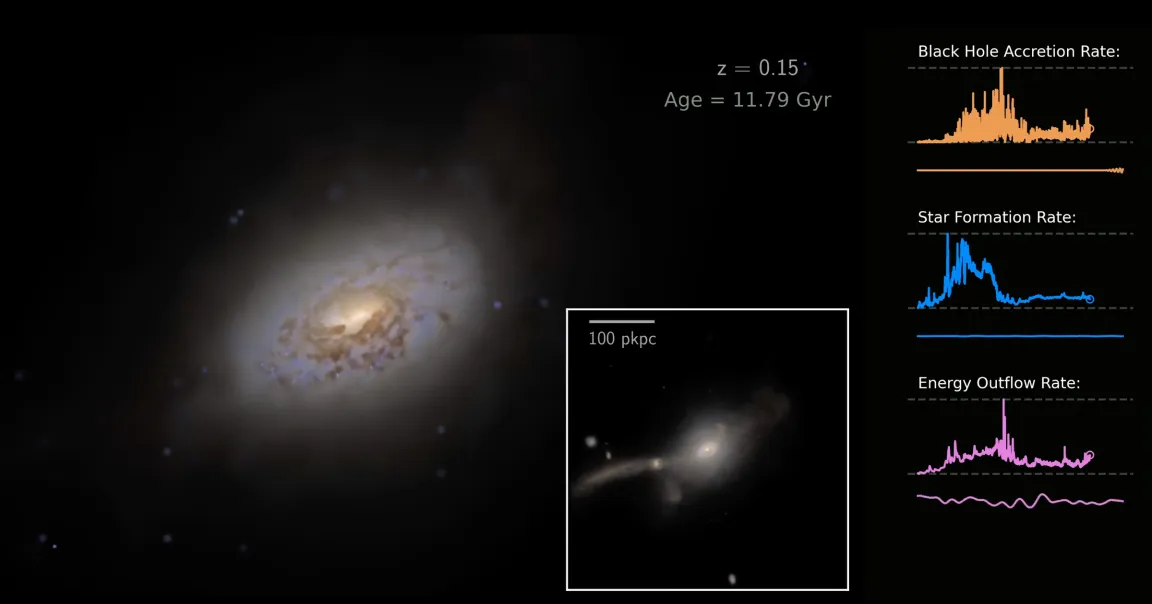
A spiral galaxy with a bright core and faint spiral arms is shown against a dark background. To the right, there are three graphs.

Colibre Simulations via YouTube

Sign up to see the future, today

Can’t-miss innovations from the bleeding edge of science and tech

Astronomers say they’ve created an entire synthetic universe which uncannily reproduces the properties of our real one. 

The point of the feat, which was detailed in a new study published in the journal Monthly Notices of the Royal Astronomical Society, wasn’t to play god, but to test the standard cosmological model. Nonetheless, the researchers couldn’t resist basking in the glory of their impressive creation, dubbed the COLIBRE project.

“It is exhilarating to see ‘galaxies’ come out of our computer that look indistinguishable from the real thing and share many of the properties that astronomers measure in real data such as their number, luminosities, colors and sizes,” said coauthor Carlos Frenk, a physicist at Durham University, in a statement about the work.

“What is most remarkable is that we are able to produce this synthetic universe purely by solving the relevant equations of physics in the expanding universe,” Frenk added.

The similarities here are a good thing for cosmologists, who can let out a sigh of relief. The researchers say their virtual universe demonstrates that the standard model can explain galaxy formation even better than previously thought — a welcome source of respite, as recent discoveries, including those made with the James Webb Space Telescope, have poked holes in the prevailing model.

The team says its synthetic universe is the first large volume simulation to model cold gases and cosmic dust inside galaxies, the free-floating material that coalesces to form stars. Previous simulations imposed a hard cut off on gasses colder than 10,000 degrees Fahrenheit, because at these low temperatures they were too complex to model.

But with enough brain and computing power, the researchers overcame this obstacle. The international team spent nearly ten years building the COLIBRE model, which they ran on the COSMA8 supercomputer at Durham University, taking 72 million CPU hours to complete the largest simulation. It will take several more years to deeply analyze the troves of data the simulations have yielded.

So far, the simulations closely align with observations of both the early and our present day universe, which crucially includes the masses of some of the first galaxies. But the researchers concede the model doesn’t explain the James Webb’s discovery of what’s come to be known as the “Little Red Dots,” a class of luminous and apparently mega-massive objects spotted peppering the cosmos when it was less than a billion years old, but are nowhere to be found today. Theories range from unprecedentedly compact galaxies to a previously unseen stage of supermassive black hole evolution.

“Some early JWST results were thought to challenge the standard cosmological model,” coauthor Evgenii Chaikin of Leiden University acknowledged in the statement. But “COLIBRE shows that, once key physical processes are represented more realistically, the model is consistent with what we see.”

More on space: Physicists Have a Major Problem With the Universe