





Sign up to see the future, today
Can’t-miss innovations from the bleeding edge of science and tech
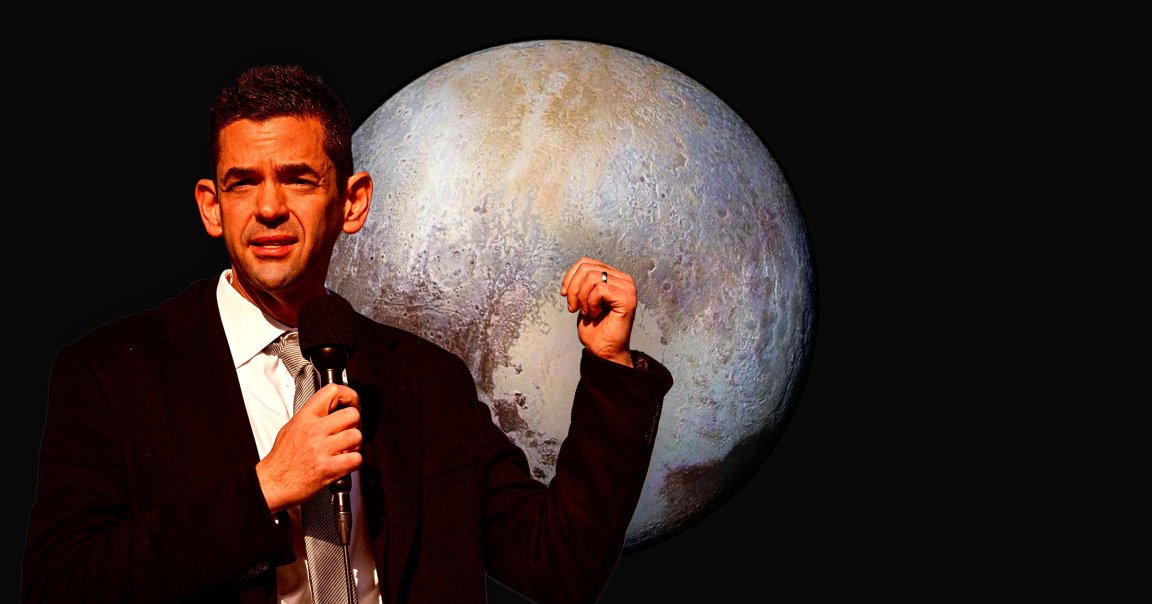
NASA administrator Jared Isaacman is necroposting about an age-old debate in astronomy that was considered officially settled two decades ago: whether Pluto should be counted as a planet.
“I am very much in the camp of, ‘Make Pluto A Planet Again,'” Isaacman said during a Tuesday Senate hearing, as quoted by Space.com.
While “MPAPA” doesn’t have quite the same ring to it as his president’s political slogan, it’s a position that Isaacman is apparently serious enough about to mobilize the minds at NASA over.
During the hearing, he teased that the space agency is “doing some papers right now” on a “position that we would love to escalate through the scientific community to revisit this discussion and ensure that Clyde Tombaugh gets the credit he received once and rightfully deserves to receive again.”
Isaacman is referring to the American astronomer who discovered Pluto in 1930, classifying it as a planet. But that was nearly ninety years ago, and the definition of planet subsequently shifted.
In 2006, the International Astronomical Union formally defined what a planet was using three primary criteria: a planet must orbit the Sun, be massive enough to be spherical, and it must “clear the neighborhood,” meaning that it has no objects of similar size along its orbit, pushing or deflecting contenders out of the way, other than its own natural satellites — moons, in other words — that it has gravitational dominance over. (It’s worth noting that before the IAU agreed on one, there was no consensus definition on what a planet actually was.)
Pluto fell short of that third criteria and was reclassified as a “dwarf planet” following the ratified definition, one of the five official such objects in the solar system; its diameter of around 1,500 miles is only about half the width of the US, so the diminutive modifier is not unwarranted.
This was controversial to the public, though, with many feeling that Pluto had been demoted in a dishonorable sense, unjustly kicked out of the club of astronomical objects that people actually care about. The perception was that some faceless bureaucracy had butted in to needlessly upend how we understood our little corner of the universe, relegating a formerly beloved planet to a footnote.
Of course, many astronomers are on board with the decision for scientific reasons, and aren’t pleased that the head of an influential institution like NASA is relitigating the debate with political sloganeering.
“While NASA administrators are free to wax nostalgic for the days when Pluto was a planet, the actual scientists working in the field will continue to try to explain and classify objects in the solar system in the way that actually helps us understand the world in which we live,” Mike Brown, a professor of planetary astronomy at the California Institute of Technology, told The Independent.
Bill McKinnon, Director of the McDonnell Center for the Space Sciences at Washington University in St. Louis, called the debate “a waste of time.”
“Of course Pluto’s a planet, but it is a dwarf planet, a subspecies of planet,” he stressed to the newspaper. “The argument seems to swirl about those who wish to say whether dwarf planets are or are not planets.”
The fact of the matter is that yes, what constitutes a planet is a question that not all astronomers agree on. But that’s for the astronomers to work out. As we learn more about our solar systems, and perhaps other planetary systems, the definition will evolve and be fine-tuned. You can admire Isaacman’s enthusiasm for the topic — but it’s arguably beyond his remit, and you can understand why it might nettle experts to hear him blithely declare they’re wrong.
More on space: Scientists Scan Gigantic Structure Hiding Behind Our Galaxy