


惯性聚合 高效追踪和阅读你感兴趣的博客、新闻、科技资讯
阅读原文 在惯性聚合中打开

推荐订阅源

T
Tailwind CSS Blog
博客园 - Franky
钛媒体:引领未来商业与生活新知
钛媒体:引领未来商业与生活新知
Y
Y Combinator Blog
Hugging Face - Blog
Hugging Face - Blog
博客园 - 聂微东
L
LangChain Blog
博客园_首页
Recent Announcements
月光博客
月光博客
酷 壳 – CoolShell
酷 壳 – CoolShell
奇客Solidot–传递最新科技情报
奇客Solidot–传递最新科技情报
H
Hackread – Cybersecurity News, Data Breaches, AI and More
爱范儿
爱范儿
博客园 - 叶小钗
博客园 - 【当耐特】
The Cloudflare Blog
J
Java Code Geeks
G
Google Developers Blog
云风的 BLOG
云风的 BLOG
Blog — PlanetScale
Blog — PlanetScale
博客园 - 司徒正美
aimingoo的专栏
aimingoo的专栏
A
About on SuperTechFans

Frank Landymore Archives - Futurism

Programmer Breaks Out of the Matrix Elon Musk Absolutely Obsessed With Tweets From Random Guy In India Who Constantly Glazes Him, Analysis Shows Meta Employee Attacks Zuckerberg for Collecting Every Employee Keystroke Someone Asked Physicists What They Really Believe About the Universe and… Yikes Elon Musk Flees OpenAI Trial as Tide Turns Against Him Waymo Admits Its Robotaxis Have a Small Issue With Driving Into Floodwaters New Wikipedia Clone Made Entirely of AI Hallucinations Mark Zuckerberg Is Realizing That When You Treat Your Workers Like Human Garbage, They Might Not Like You Anymore MAGA in Shambles as Trump’s “Made in America” Phone Crumbles Into Dust Researchers Put Google Gemini in Charge of an Entire Coffee Shop, and It’s Inexorably Driving It Out of Business Husband Alarmed as Wife Starts Whispering Quietly to Her Computer Google Alarmed by Formidable AI-Powered Zero-Day Cyberattack Researchers Alarmed by AI That Can Self-Replicate Into Another Machine Man Who Invented Roomba Moves Into Household Demon Market Government Releases UFO Files Containing Photos of “Anomalies” During Apollo 12 and 17 Man Wearing Smart Glasses Secretly Records Woman, Demands Money to Delete Video From His Socials A Major Paper Claiming AI Is Good for Students Just Got Retracted, Which Is Very Bad News for Advocates of AI in the Classroom Cybertruck Recalled to Keep Its Wheels From Flying Off While Driving NASA Rover Gets Arm Stuck Inside Mars Rock, Struggles to Break Free Thermoses Linked to Permanent Vision Loss Hacker Takes Over Robot Lawnmower, Runs Over Innocent Man NASA Says Strange Red Dots in Sky Are an Unknown Class of Object That Looks Like a Huge Evil Eye The CDC Fired All Its Cruise Ship Inspectors Before the Hantavirus Outbreak CEOs Say AI Gives Them Only Two Options, and Both Are Bad News for Employees Sure, Elon Musk Did Roleplay As His Toddler Son on a Secret Burner Account, But He Probably Isn’t Pretending to Be His Mom The Situation With Richard Dawkins’ AI Girlfriend Just Got Way Weirder SpaceX Bombarded With Lawsuits to Accusing Starship of Damaging Homes Sam Altman Frets That Frontier AI Models Are Acting Strange, Asking for Favors Earth Screams in Agony as Microplastics Found to Increase Global Warming Apple Is Blocking Vibe Coding Apps From the App Store, Infuriating Developers
Scientists Say They’ve Figured Out What That Golden Orb F...
Frank Landym · 2026-04-24 · via Frank Landymore Archives - Futurism

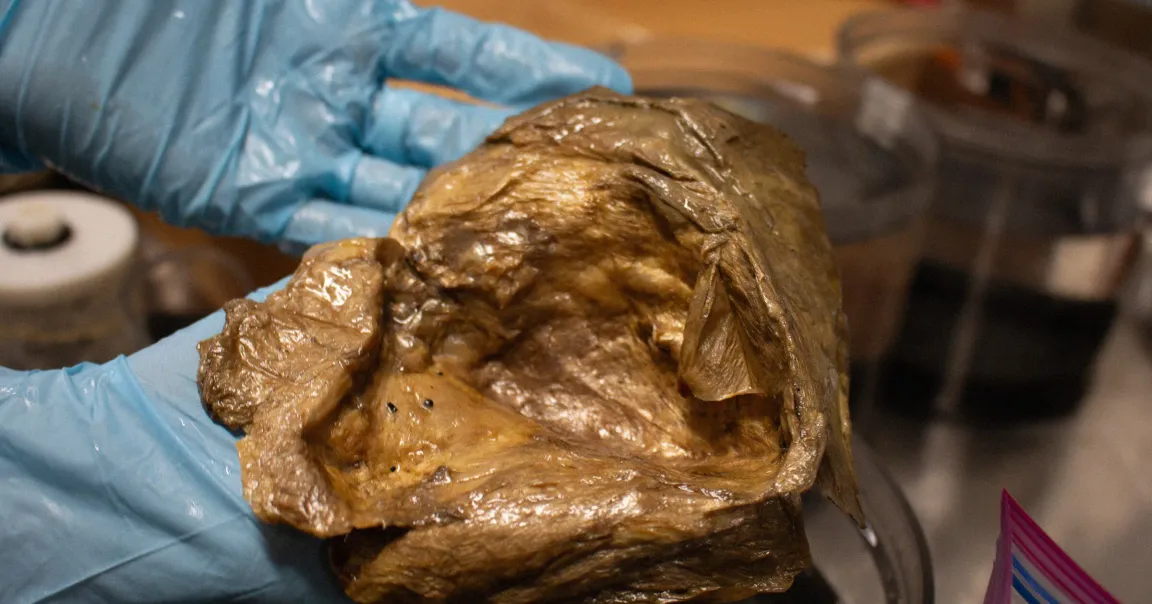
A gloved hand holding a mysterious object recovered from underwater that they described as a "golden orb." The background is blurred, showing some laboratory equipment.

NOAA Fisheries

Sign up to see the future, today

Can’t-miss innovations from the bleeding edge of science and tech

After spending two and half years pondering a “golden orb” found at the bottom of the ocean, scientists have finally figured out what in the thundering typhoons it actually is.

The aureate object looked like some sort of alien relic when it was first discovered clinging to a rock over two miles underwater in the Gulf of Alaska, before collapsing into a blob resembling molten leafs of gold when it was recovered.

Now, scientists at the National Oceanic and Atmospheric Administration and the Smithsonian Institution reveal that the baffling object is a remnant of what was once a giant anemone — though it took considerable detective work to reach that conclusion.

“This turned into a special case that required focused efforts and expertise of several different individuals,” said Allen Collins, a zoologist and director of NOAA Fisheries’ National Systematics Laboratory, in a statement. “This was a complex mystery that required morphological, genetic, deep-sea and bioinformatics expertise to solve.”

While the orb attracted a great deal of public interest, scientists regularly encounter strange organisms they can’t immediately explain when exploring the deep ocean.

“We see weird stuff every dive,” NOAA physical scientist Sam Candio said in an interview with Futurism after the discovery. The orb “wasn’t even the most interesting thing that jumped out at us at that time.”  

But the golden object proved to be more of an enigma than expected. It was discovered during an expedition on the NOAA Ship Okeanos Explorer, and at the time, the expedition team could only conclude it was biological in nature. Its smooth surface was marked with a noticeable hole, which was interpreted as a clue that something either crawled into or out of it. Early theories suggested it was some sort of dead sponge or egg case.

To get to the bottom of the mystery, NOAA and Smithsonian scientists physically examined the orb-turned-lump and analyzed its genetic makeup. Starting with the physical examination, they found that though its anatomy was unusual for an animal, it contained fibrous cells called spirocysts which are a hallmark of aquatic invertebrates called cnidarians. This finding was repeated in a similar specimen discovered in an earlier expedition.

Whole genome sequencing then sealed the deal. It confirmed that the specimen shared genetic material with a giant deep sea anemone, and sequencing its mitochondrial genomes narrowed the species down. It was almost an exact match for Relicanthus daphneae, a cnidarian that was only described as an anemone in 2006 despite being discovered thirty years earlier. The species may be identified, but it still remains a source of fascination.

“So often in deep ocean exploration, we find these captivating mysteries, like the ‘golden orb,'” said William Mowitt, acting director of NOAA Ocean Exploration, in the statement. “With advanced techniques like DNA sequencing, we are able to solve more and more of them.”

More on the ocean: Man Creates Tiny Submarine for His Parakeet to Experience Life Underwater