

惯性聚合 高效追踪和阅读你感兴趣的博客、新闻、科技资讯
阅读原文 在惯性聚合中打开

推荐订阅源

人人都是产品经理
人人都是产品经理
宝玉的分享
宝玉的分享
小众软件
小众软件
有赞技术团队
有赞技术团队
月光博客
月光博客
钛媒体:引领未来商业与生活新知
钛媒体:引领未来商业与生活新知
MyScale Blog
MyScale Blog
Engineering at Meta
Engineering at Meta
Stack Overflow Blog
Stack Overflow Blog
H
Hackread – Cybersecurity News, Data Breaches, AI and More
N
Netflix TechBlog - Medium
D
Docker
OSCHINA 社区最新新闻
OSCHINA 社区最新新闻
MongoDB | Blog
MongoDB | Blog
WordPress大学
WordPress大学
J
Java Code Geeks
罗磊的独立博客
V
Visual Studio Blog
雷峰网
雷峰网
H
Help Net Security
T
The Blog of Author Tim Ferriss
奇客Solidot–传递最新科技情报
奇客Solidot–传递最新科技情报
大猫的无限游戏
大猫的无限游戏
F
Fortinet All Blogs

Frank Landymore Archives - Futurism

Elon Musk Absolutely Obsessed With Tweets From Random Guy In India Who Constantly Glazes Him, Analysis Shows Meta Employee Attacks Zuckerberg for Collecting Every Employee Keystroke Someone Asked Physicists What They Really Believe About the Universe and… Yikes Elon Musk Flees OpenAI Trial as Tide Turns Against Him Waymo Admits Its Robotaxis Have a Small Issue With Driving Into Floodwaters New Wikipedia Clone Made Entirely of AI Hallucinations Mark Zuckerberg Is Realizing That When You Treat Your Workers Like Human Garbage, They Might Not Like You Anymore MAGA in Shambles as Trump’s “Made in America” Phone Crumbles Into Dust Researchers Put Google Gemini in Charge of an Entire Coffee Shop, and It’s Inexorably Driving It Out of Business Husband Alarmed as Wife Starts Whispering Quietly to Her Computer Google Alarmed by Formidable AI-Powered Zero-Day Cyberattack Researchers Alarmed by AI That Can Self-Replicate Into Another Machine Man Who Invented Roomba Moves Into Household Demon Market Government Releases UFO Files Containing Photos of “Anomalies” During Apollo 12 and 17 Man Wearing Smart Glasses Secretly Records Woman, Demands Money to Delete Video From His Socials A Major Paper Claiming AI Is Good for Students Just Got Retracted, Which Is Very Bad News for Advocates of AI in the Classroom Cybertruck Recalled to Keep Its Wheels From Flying Off While Driving NASA Rover Gets Arm Stuck Inside Mars Rock, Struggles to Break Free Thermoses Linked to Permanent Vision Loss Hacker Takes Over Robot Lawnmower, Runs Over Innocent Man NASA Says Strange Red Dots in Sky Are an Unknown Class of Object That Looks Like a Huge Evil Eye The CDC Fired All Its Cruise Ship Inspectors Before the Hantavirus Outbreak CEOs Say AI Gives Them Only Two Options, and Both Are Bad News for Employees Sure, Elon Musk Did Roleplay As His Toddler Son on a Secret Burner Account, But He Probably Isn’t Pretending to Be His Mom The Situation With Richard Dawkins’ AI Girlfriend Just Got Way Weirder SpaceX Bombarded With Lawsuits to Accusing Starship of Damaging Homes Sam Altman Frets That Frontier AI Models Are Acting Strange, Asking for Favors Earth Screams in Agony as Microplastics Found to Increase Global Warming Apple Is Blocking Vibe Coding Apps From the App Store, Infuriating Developers Approaching Half of New Podcasts Appear to Be AI Slop
NASA Satellite Images Show Huge Colored Plumes Staining t...
Frank Landymore · 2026-05-17 · via Frank Landymore Archives - Futurism

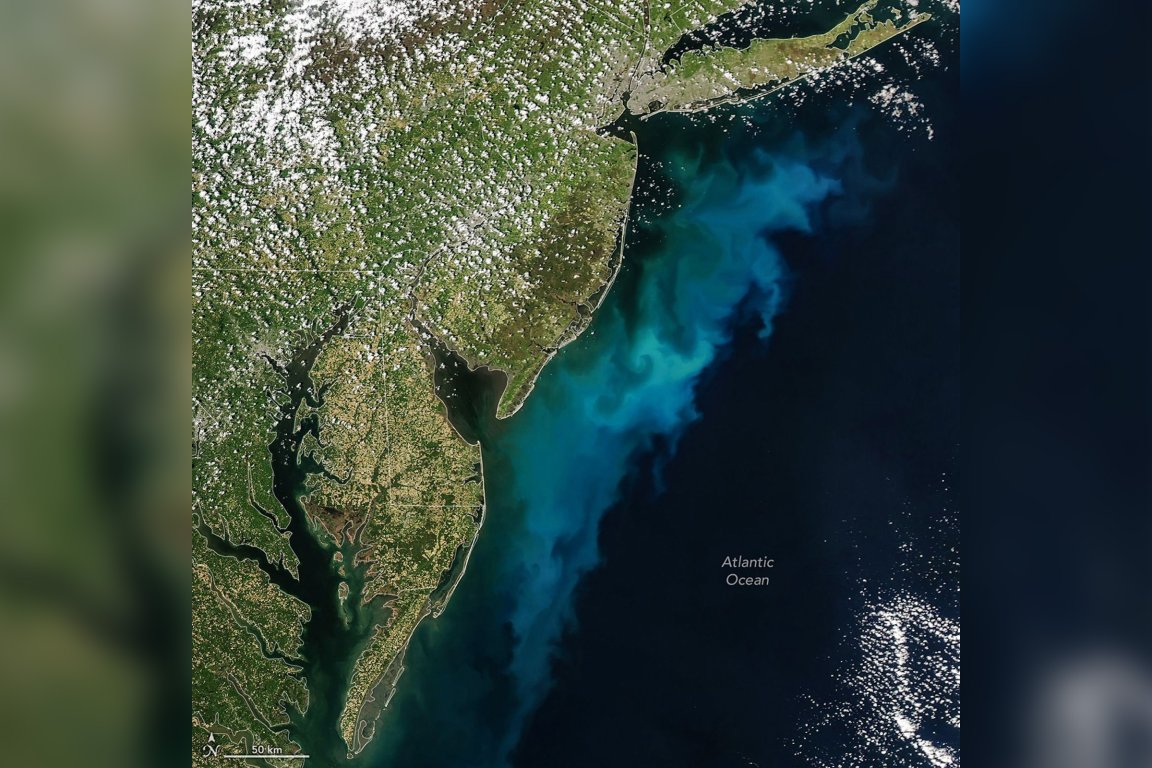
Satellite view of the mid-Atlantic region of the United States, showing a blue-green swirl pattern.

NASA Earth Observatory / Michala Garrison

Sign up to see the future, today

Can’t-miss innovations from the bleeding edge of science and tech

NASA satellites are tracking an intriguing patch of colored plumes in the waters off the US’s Mid-Atlantic coast.

Swirling with vivid hues of green and turquoise, and tinged with a little brown, the stained waters were first detected by orbital observatories in early April. But they were most intense in the Mid-Atlantic Bight, an area where the waters from several bays, including the Chesapeake, merge with the open ocean, according to an update from the space agency.

Discerning what’s swirling through these so-called “noisy” and “dirty” coastal waters is a challenge to scientists, because they can be caused by a hodgepodge of phenomena, unlike in the open ocean, which is fairly uniform. The colorful plumes could be tinged by sediments, plant life, and other organic matter. They could also be the result of phytoplankton blooms, meaning periods when the microscopic algae rapidly explode in number. Or it could be a combination of all of the above.

Thanks to the latest NASA satellites like PACE — which stands for Plankton, Aerosol, Cloud, Ocean Ecosystem — oceanographers can make more confident conclusions than ever. Some of the colors in the images may be due to outflows from coastal rivers and sediment churned up by spring storms, but “there are likely phytoplankton blooms happening,” Anna Windle, a NASA research scientist supporting the PACE science team, said in an agency statement.

Windle added that diatoms — single-celled algae —  “typically dominate blooms early in the spring, but we are seeing some signs of coccolithophores mixed in as well.”

Diatom-dominated blooms tend to happen in the spring and look greenish in natural-color satellite imagery, according to NASA. Coccolithophores, which are phytoplankton clad in a sort of limestone armor plating, produce a milkier, turquoise colored bloom, and typically occur in late spring or summer.

Scientists don’t track these colorful plumes as mere curiosities. They serve as a barometer of phytoplankton populations, and as such, a health check of the ocean’s ecosystems at large. Phytoplankton are the ocean’s main carbon recycles and produce at least half of the Earth’s oxygen, and are a source of food for other aquatic creatures. Scientists worry that fluctuations in phytoplankton populations could be changing the color of the ocean and affecting the depth that light can penetrate its surface.

Phytoplankton blooms often dissipate as quickly as they appear, though this is normally part of a healthy cycle. Initially, they feast on an abundance of nutrients present in the water after cold winter winds bring the nutrients to the surface.

“But over time, as big spring phytoplankton blooms grow, they deplete the nutrients,” Oscar Schofield, an oceanographer Rutgers University, said in the NASA release. “Unless big river outflows or storms replenish the nutrients, we’ll likely see this bloom start to decline in the coming weeks.” 

More on biology: Scientists Say They’ve Figured Out What That Golden Orb Found at the Bottom of the Pacific Ocean Actually Was