




惯性聚合 高效追踪和阅读你感兴趣的博客、新闻、科技资讯
阅读原文 在惯性聚合中打开

推荐订阅源

宝玉的分享
宝玉的分享
Engineering at Meta
Engineering at Meta
让小产品的独立变现更简单 - ezindie.com
博客园 - 聂微东
钛媒体:引领未来商业与生活新知
钛媒体:引领未来商业与生活新知
Last Week in AI
Last Week in AI
酷 壳 – CoolShell
酷 壳 – CoolShell
博客园 - 三生石上(FineUI控件)
T
Tailwind CSS Blog
Apple Machine Learning Research
Hugging Face - Blog
Hugging Face - Blog
爱范儿
爱范儿
博客园 - 司徒正美
人人都是产品经理
人人都是产品经理
Jina AI
Jina AI
博客园 - 叶小钗
雷峰网
雷峰网
罗磊的独立博客
OSCHINA 社区最新新闻
OSCHINA 社区最新新闻
博客园 - Franky
WordPress大学
WordPress大学
奇客Solidot–传递最新科技情报
奇客Solidot–传递最新科技情报
阮一峰的网络日志
阮一峰的网络日志
量子位

Joe Wilkins Archives - Futurism

FBI Director Kash Patel Says AI Has Stopped Numerous Violent Attacks Against America. We’d Love to See a Single Whiff of Evidence Video Shows Amazon Drone Dropping Package Into Pond Ordinary People Fear AI, While the Tech Leaders Working to Create a Permanent Underclass Say They’re Extremely Psyched About It Busy Roadways Clogged as Waymo Becomes Stumped by Small Puddle Passengers Groan as Robot Passenger Causes Hour-Long Delay at Oakland Airport Zuckerberg Trying to Simulate Human Biology at the Cellular Level Startup Says It’s Invented a Beanie That Reads Your Mind Man Says His Waymo Ditched Him at the Airport Before He Could Get His Luggage Out of the Trunk, Refused to Return Frontier AI Models Giving Specific, Actionable Instructions to Perpetrate Bioterror Attack The “Pentastack” of Illegal Drugs That Looksmaxxers Like Clavicular Are Taking to Enjoy a Night Out Sounds Like a One-Way Trip to the Hospital Chinese Court Rules That a Worker Cannot Be Replaced by AI There’s Something Bizarre About the Offices of AI Startups Trump’s US Forest Service Spraying Deadly Toxins on America’s Woodlands Wild Video Shows Ukrainian Troops Evacuate Babushka With a Military Robot AV Companies Might be in Trouble Now As Cops Start Ticketing Driverless Cars Elon Musk Just Got Badly Humiliated in Court If You Bet on Polymarket, This New Study May Cause You Physical Pain Mark Zuckerberg Just Got Shot Down by China, Again Startup Says It Can Read Your Brain Signals Using a Pair of Headphones AI Spy Cameras Suddenly Blanketing America Man Trapped in Dystopian Nightmare Thanks to AI Surveillance Cameras Flagging His Every Move Police Are Using AI Camera Networks to Stalk Women Woman Convicted for Attacking Police With Swarm of Furious Bees A Tiny Town Is Building So Many Data Centers That There’ll Be Almost Nothing Else Left The War in Iran Is Causing China to Sell So Many Solar Panels That Your Jaw Will Drop Waymo Has a Bike Lane Problem Ransomware Negotiator Pleads Guilty to Deploying Ransomware Himself America Trembles as Transportation Secretary Announces Plans for Air Traffic Controllers to Lean on AI Tools Experts Warn of AI Swarms Hijacking Democracy With Fake Citizens Climate Scientists Shake Their Heads as First US City Running Completely Out of Water
New York City Installing Sensors to Detect Pedestrians, V...
Joe Wilkins · 2026-06-08 · via Joe Wilkins Archives - Futurism

A photo illustration featuring a pedestrian crossing sign in Manhattan.

Illustration by Tag Hartman-Simkins / Futurism. Source: Getty Images

Sign up to see the future, today

Can’t-miss innovations from the bleeding edge of science and tech

It may sound like yet another rollout of a dystopian surveillance state network of facial recognition cameras — but the New York Department of Transportation’s latest initiative has a far more tame goal in mind: tracking modes of transport to improve street design.

According to the Gothamist, the New York Department of Transportation has added 100 roadside sensors across the city in order to pick up data on vehicle, bike, and pedestrian traffic.

The effort is an expansion of a 2023 sensor pilot meant to gather data on city traffic, which saw 20 such devices installed on signposts in various locations. The machine-learning sensors — explained as a tool to help improve pedestrian crossings and bicycle infrastructure — are trained to anonymize faces and license plates, DOT deputy commissioner Eric Beaton told the Gothamist.

An image shared by the DOT shows the sensor in action: a hazy blur obscures some details, but a machine learning algorithm ensures each pedestrian and vehicle is visually tracked in color-coded boxes, each with their own label.
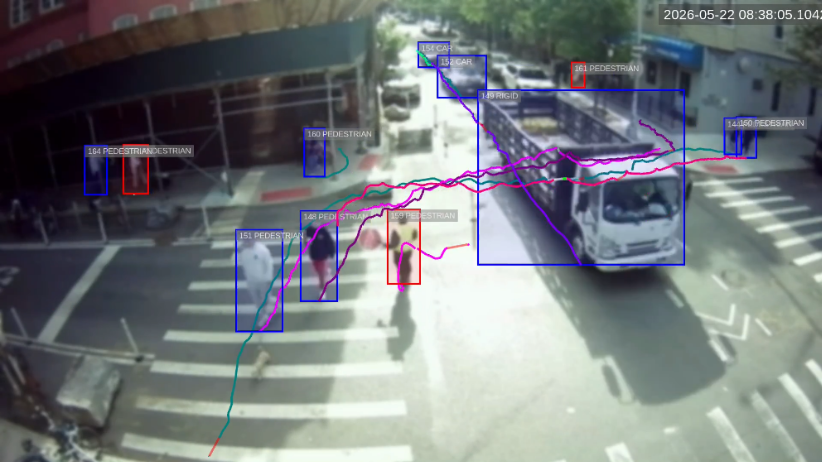
A view from the New York City Department of Transportation's traffic sensors, with various traffic elements highlighted and labeled in color-coordinated boxes.

“There’s nothing that we ever touch or that anyone could ever touch that has anything identifying to any person or any vehicle,” the DOT’s Beaton claimed. “These sensors provide a much richer set of data for us to work with.”

As part of the surveillance move, the DOT said it will share a portion of the data collected with the community. Accountability watchdogs, however, are demanding all of it.

“If they’re collecting this data on behalf of the public, as a taxpayer-funded agency, we deserve to know what it says and so there should be regular reporting,” transit advocate and former policy director for the DOT Jon Orcutt told the Gothamist.

Still, the situation highlights the tricky position city officials find themselves in, where collecting enough data to make informed decisions about better transit options necessitates an expansion of municipal surveillance.

As Orcutt explains: “there are [currently] 20 or 25 sites where bikes are counted. You get a very small data set from that. You know we have 6,000 miles of streets.”

More on New York City: Authorities Alarmed as Mysterious Figures Emerge From Sewers