

惯性聚合 高效追踪和阅读你感兴趣的博客、新闻、科技资讯
阅读原文 在惯性聚合中打开

推荐订阅源

博客园 - 【当耐特】
小众软件
小众软件
S
SegmentFault 最新的问题
GbyAI
GbyAI
量子位
爱范儿
爱范儿
L
LangChain Blog
Vercel News
Vercel News
A
About on SuperTechFans
腾讯CDC
博客园_首页
酷 壳 – CoolShell
酷 壳 – CoolShell
月光博客
月光博客
博客园 - 聂微东
Stack Overflow Blog
Stack Overflow Blog
H
Help Net Security
U
Unit 42
奇客Solidot–传递最新科技情报
奇客Solidot–传递最新科技情报
V
V2EX
V
Visual Studio Blog
美团技术团队
D
DataBreaches.Net
The GitHub Blog
The GitHub Blog
N
Netflix TechBlog - Medium

Joe Wilkins Archives - Futurism

Billionaire Declares That “Tax the Rich” Is Hate Speech That Offends Him Horribly FBI Director Kash Patel Says AI Has Stopped Numerous Violent Attacks Against America. We’d Love to See a Single Whiff of Evidence Video Shows Amazon Drone Dropping Package Into Pond Ordinary People Fear AI, While the Tech Leaders Working to Create a Permanent Underclass Say They’re Extremely Psyched About It Busy Roadways Clogged as Waymo Becomes Stumped by Small Puddle Passengers Groan as Robot Passenger Causes Hour-Long Delay at Oakland Airport Zuckerberg Trying to Simulate Human Biology at the Cellular Level Startup Says It’s Invented a Beanie That Reads Your Mind Man Says His Waymo Ditched Him at the Airport Before He Could Get His Luggage Out of the Trunk, Refused to Return Frontier AI Models Giving Specific, Actionable Instructions to Perpetrate Bioterror Attack The “Pentastack” of Illegal Drugs That Looksmaxxers Like Clavicular Are Taking to Enjoy a Night Out Sounds Like a One-Way Trip to the Hospital Chinese Court Rules That a Worker Cannot Be Replaced by AI There’s Something Bizarre About the Offices of AI Startups Trump’s US Forest Service Spraying Deadly Toxins on America’s Woodlands Wild Video Shows Ukrainian Troops Evacuate Babushka With a Military Robot AV Companies Might be in Trouble Now As Cops Start Ticketing Driverless Cars Elon Musk Just Got Badly Humiliated in Court If You Bet on Polymarket, This New Study May Cause You Physical Pain Mark Zuckerberg Just Got Shot Down by China, Again Startup Says It Can Read Your Brain Signals Using a Pair of Headphones AI Spy Cameras Suddenly Blanketing America Man Trapped in Dystopian Nightmare Thanks to AI Surveillance Cameras Flagging His Every Move Police Are Using AI Camera Networks to Stalk Women Woman Convicted for Attacking Police With Swarm of Furious Bees A Tiny Town Is Building So Many Data Centers That There’ll Be Almost Nothing Else Left The War in Iran Is Causing China to Sell So Many Solar Panels That Your Jaw Will Drop Waymo Has a Bike Lane Problem Ransomware Negotiator Pleads Guilty to Deploying Ransomware Himself America Trembles as Transportation Secretary Announces Plans for Air Traffic Controllers to Lean on AI Tools Experts Warn of AI Swarms Hijacking Democracy With Fake Citizens
The Moon Astronauts Brought Along USB Stick-Sized Living ...
2026-04-03 · via Joe Wilkins Archives - Futurism

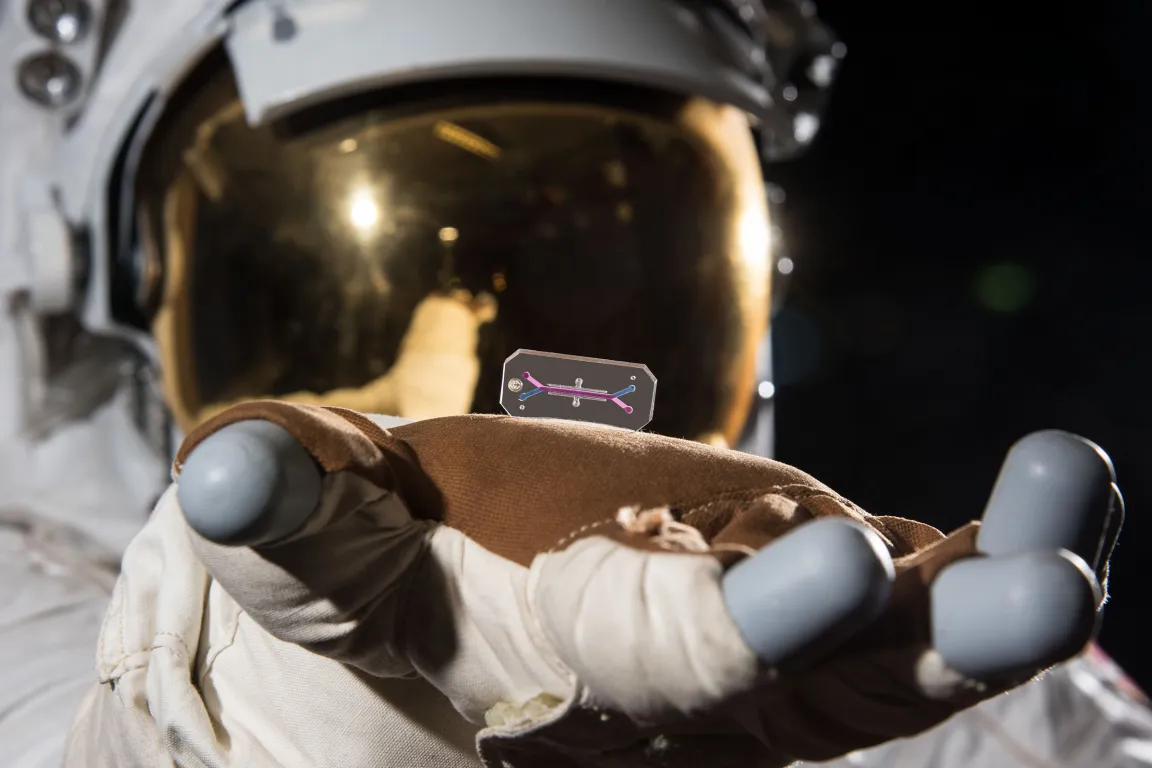
An astronaut wearing a white spacesuit and gold-tinted helmet visor is holding a small, rectangular transparent chip with colored lines and dots on it, resting on the gloved hand. The background is dark, suggesting space.

Josh Valcarcel / NASA

Sign up to see the future, today

Can’t-miss innovations from the bleeding edge of science and tech

Beyond their snazzy flight suits and mango peach smoothies, the crew of NASA’s Artemis II mission is packing something unusual: living mini-organs grown from their own bones.

That bizarre cargo is traveling alongside astronauts Reid Wiseman, Victor Glover, Christina Koch, and Jeremy Hansen, whose 10-day journey will take them around the back side of the Moon and then home again, in the process traveling farther from the Earth than any previous humans.

According to space publication Supercluster, the astronauts are carrying “completely functional” organ chips: organelles composed of bone marrow made from each astronauts’ cells.

In a highly complicated space mission, the justification for taking these organ chips is actually pretty straightforward. In leaving the protection of the Earth’s atmosphere, the four travelers expose themselves to heaps of solar and cosmic radiation. That radiation environment will present a unique window into the kind of dangers future astronauts will face in the dark reaches of space, so researchers are taking as many samples as they can get.

Mini organs aren’t new — scientists have been messing around with them since 2013 — but the decision to map them to their human counterparts in a space mission is.

“This is the first time we’re going to have crew with their matched organ chips,” David Chou, principal investigator of the chip experiment told SC. Having the humans and their micro organs side by side on the same voyage, he says, will enable scientists to compare the two biological materials against each other.

By using bone marrow cells — which are particularly vulnerable to radiation — to produce the chips, researchers are “maximizing the chance that we’ll see biologic differences, as opposed to modeling the skin or something else,” Chuo said.

For good measure, NASA also kicked duplicates of the astronauts’ organ chips up to the International Space Station, in order to compare deep space radiation with low earth orbit radiation over the same period. While they may seem small — and they are, at about the size of a USB stick — data provided by the chips could offer a major leap in our understanding of how the human body reacts to deep space, and at minimal cost, not to mention risk to human beings.

“Being able to understand how a broader representation of the public would respond to spaceflight is something you could do with organ chips much more cost-effectively,” Chou told SC. “You can make hundreds of these and send them up.”

More on NASA: Scientists Investigating Whether Object NASA Is Approaching Is Core of Destroyed Planet