


Sign up to see the future, today
Can’t-miss innovations from the bleeding edge of science and tech
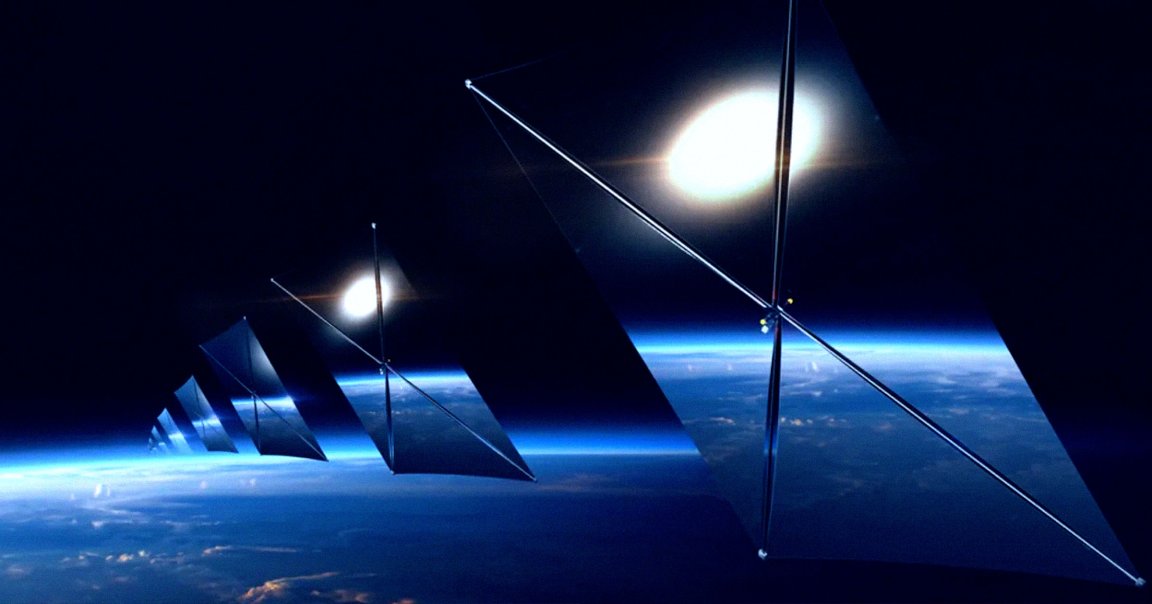
Last month, the Federal Communications Commission approved an experimental and controversial new satellite being developed by venture Reflect Orbital to reflect sunlight down onto the Earth to illuminate patches of it at night for paying customers.
The purported goal is to allow solar farms to continue generating electricity even after nightfall and provide illumination during emergencies. Those may sound like noble ideas on the surface, but the concept comes with major downsides as well.
One is that such bright satellites could easily wreck deep space observations. Astronomers were appalled at the news, with the FCC receiving nearly nearly 2,000 public comments criticizing the proposal, as Wired reported at the time.
And it’s not just professional astronomers that could be affected, as experts told The Verge. Amateur astronomers gazing up at the prototype mirror satellite, dubbed Eärendil-1 — continuing Silicon Valley’s obsession with borrowing names from JRR Tolkien’s “Lord of the Rings” — could easily be blinded. Even looking through a 12-inch telescope, a common type used by enthusiasts, could result in permanent eye damage.
It’s a considerable risk to human health that makes the FCC’s approval “extraordinary,” as Royal Astronomical Society deputy executive director Robert Massey told The Verge.
It’s a risk experts have known for decades now. Case in point, observing a similar proposed Russian prototype, dubbed Znamya, could cause damage equivalent to staring at the Sun around a total eclipse, according to a 2000 research article by the Royal Astronomical Society of Canada. (Russia launched two experimental Znamya space mirror satellites in the 1990s, but later abandoned the program.)
Critics of the FCC’s approval of Reflect Orbital’s plans pointed out the risk of eye damage to the regulator, which wound up being deemed irrelevant and too “small” of a factor compared to the “benefits of permitting American companies to test innovative technology in space.”
As The Verge points out, astronomers won’t even be warned of when and where the mirror satellite will be in the night sky, which could result in them gazing at it inadvertently.
Reflect Orbital spokesperson Christopher Buscombe told the publication that the company is in active talks with “scientists, astronomers, environmental researchers and other stakeholders” and that it will use its initial demonstration satellite to test out built-in safeguards.
The Air Line Pilots Association has also raised concerns over Reflect Orbital’s inadequate approach to air safety. The satellites could also disrupt sleep and the circadian rhythms migratory species.
“The proposed scale of orbital deployment would represent a significant alteration of the natural night-time light environment at a planetary scale,” the presidents of several international chronobiology assocaitions said in a joint statement quoted by The Guardian.
Buscombe told The Verge that the company would limit the amount of light being reflected and calibrate brightness to “levels humans and animals already tolerate.” But experts warn there are far too many variables that the company won’t be able to control for, from light scattering in the atmosphere to interactions with clouds.
Satellites in general are an increasingly controversial topic. The number of spacecraft in low Earth has exploded over the past decade, and many are being delivered at lower altitudes that make them appear even brighter.
“The stars above us are a valued part of human heritage – deploying more than one million exceptionally bright satellites would utterly destroy this and permanently scar the natural landscape,” Massey told The Verge.
More on the satellites: Astronomers Horrified by Enormous Mirror Satellite That Reflects Sunlight Back Down to Earth at Night