
惯性聚合 高效追踪和阅读你感兴趣的博客、新闻、科技资讯
阅读原文 在惯性聚合中打开

推荐订阅源

MyScale Blog
MyScale Blog
J
Java Code Geeks
Vercel News
Vercel News
A
About on SuperTechFans
G
Google Developers Blog
C
Check Point Blog
腾讯CDC
N
Netflix TechBlog - Medium
博客园 - 司徒正美
S
SegmentFault 最新的问题
D
DataBreaches.Net
博客园_首页
美团技术团队
Stack Overflow Blog
Stack Overflow Blog
博客园 - 聂微东
量子位
雷峰网
雷峰网
IT之家
IT之家
小众软件
小众软件
Blog — PlanetScale
Blog — PlanetScale
博客园 - 三生石上(FineUI控件)
H
Help Net Security
宝玉的分享
宝玉的分享
博客园 - 叶小钗

Futurism

China Deploys Rare Type of Space Junk That Pollutes Orbit for Hundreds of Years Researchers Alarmed as GPS Readings Suddenly Veer Off by 33 Feet, Enough to Crash Self-Driving Cars Scientists Baffled by Bizarre "Anomaly" Deep Beneath the Surface of Mars NASA's Powerful New Space Telescope, Just Cleared for Launch, Was Developed by an Intelligence Agency to "Spy on America's Adversaries" NASA Set Up a Major Test of Its New Strategy Under Trump by Hiring a Startup to Launch a Daring Mission to Rescue a Dying Space Telescope in Orbit. The Unfortunate Result Will Have Long-Ranging Repercussions. Scientists Warn That New Satellites Could Cause Eye Damage for People on the Ground Scientist Reveals Plan to Save Earth From Destruction by the Sun NASA Rescue Mission Spirals Into Crisis Incredible Video Shows Chinese Rocket Get Hit by Lightning Mid-Launch SpaceX Plunges to All-Time Low After Competitor Makes Major Leap Scientists Test New Spacecraft Thruster That Uses No Fuel, Just Earth's Magnetic Field, in Orbit Experts Say Mysterious Metallic Orbs Appear to Have Fallen From the Sky Anybody Who Thinks Orbital Data Centers are a Good Idea Is Suffering from AI Psychosis, Experts Argue NASA Prepping to Launch Extremely Risky Rescue Mission Boeing's Starliner Is Such a Disaster That We Don't Even Have Words NASA Has a Major Problem Threatening Its Entire Moon Plans NASA Rover Finds "Complex Organic Matter" on Mars SpaceX Launches Secretive New Spacecraft Shaped Like Flying Saucer Saturn's Icy Moon Is the Perfect Place to Settle, NASA Scientist Argues Scientists Building World's Most Powerful Radio Telescope Deep in the Nevada Desert NASA Loads Moon Rocket onto Giant Trump-Branded Train NASA’s Next Moon Mission Is a Rube Goldberg Machine of Corporate Failure Points Scientists Release Results After Scanning 3I/ATLAS for Alien Signals NASA’s James Webb Discovers That 3I/ATLAS Let One Rip as It Passed Through Solar System Scientists Find Chunk of Lost Planet in Desert ISS Astronauts Ordered to Enter Evacuation Mode Paper Claims the “Asteroid” Japan’s Probe Is Approaching Is Actually a Derelict Spacecraft Scientists Say They’ve Found Fungi That Turn Dead Martian Soil Into Fertile Cropland Jeff Bezos’ Rocket Explodes Into Mushroom Cloud, Dealing Massive Blow to NASA’s Moon Plans NASA Releases Sweeping Plans for Moon Base
China Is Catching Up With SpaceX Fast, Landing First Reus...
Victor Tangermann · 2026-07-10 · via Futurism

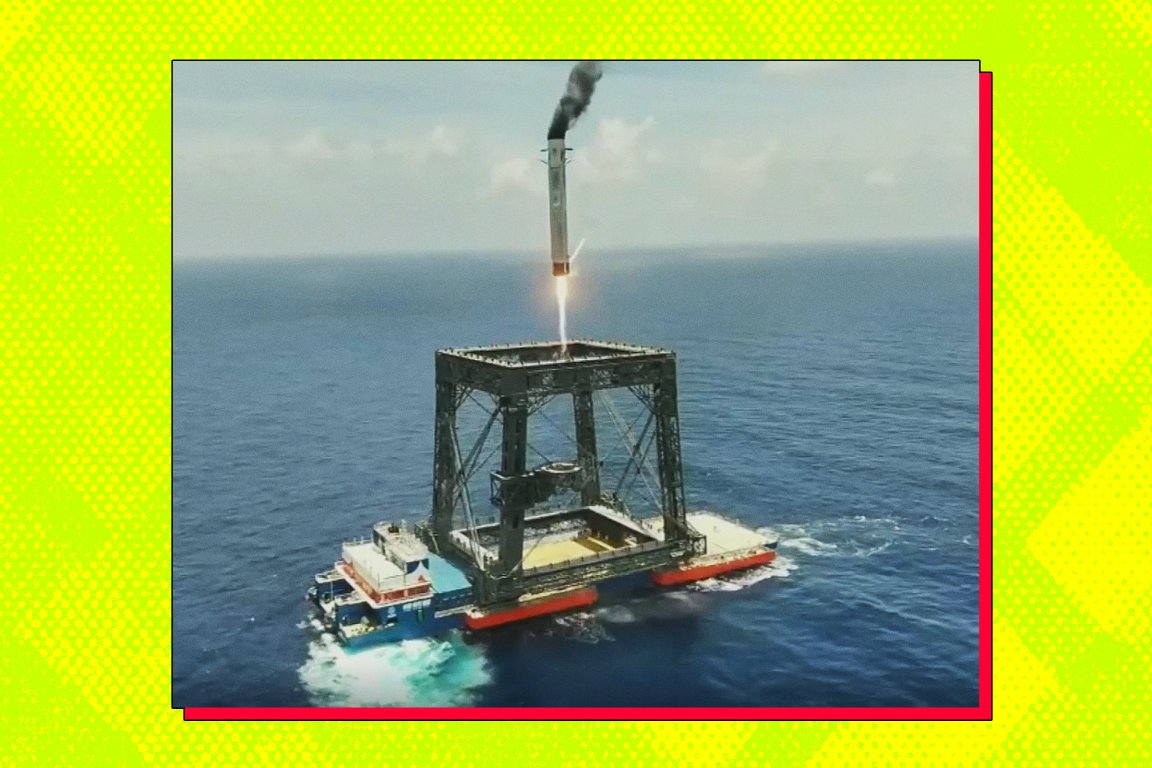
A screenshot of a rocket booster performing a successful recovery in China.

CCTV / Futurism / Shutterstock

Sign up to see the future, today

Can’t-miss innovations from the bleeding edge of science and tech

SpaceX has radically reduced the cost of reaching space thanks to its reusable rockets, a revolutionary capability that has greatly set it apart from its competitors.

But its dominance in the domain is seriously being challenged by China. Footage shared by the Chinese state-run CCTV shows a Long March 10B rocket booster being caught by an offshore recovery platform. Engineers can be heard cheering on the slowly descending rocket as it confidently sets down.

China lands reusable rocket for first time ever in net-like system thumbnail

China lands reusable rocket for first time ever in net-like system

As Engadget reports, that makes China only the second country to have pulled off such a feat, following the United States — a “historic breakthrough” that could have major implications not just for SpaceX, but for the space industry as a whole.

The rocket was developed by the China Academy of Launch Vehicle Technology (CALT), a subsidiary of the state-owned Chinese space program contractor China Aerospace Science and Technology Corporation (CASC).

The rocket has a payload capacity of 16 tons to low-Earth orbit, not far off from SpaceX’s workhorse Falcon 9, which can carry 22 tons. However, unlike the Falcon 9, which lands autonomously with the help of four deployable landing legs, CALT’s recovery platform picks the descending rocket out of the air with “landing hooks.”

Previous attempts have resulted in descending rockets missing the launch pad. Chinese competitor LandSpace is trying an even more SpaceX-like approach using a leg system. In December, the company successfully sent its Zhuque-3 rocket into orbit, but it ended up blowing up in a fireball while trying to land.

CALT is envisioning it as a new platform to launch Starlink-like internet broadband satellites and other larger commercial satellites.

By reusing the first stage, the company is hoping to dramatically reduce launch costs, much like SpaceX.

The Elon Musk-led company first successfully landed a Falcon 9 rocket following orbital flight in December 2015. Jeff Bezos’ Blue Origin became the second company to have pulled off such a feat in November, with its New Glenn booster gently touching back down in November, just under a decade later.

While CALT’s latest feat is undoubtedly a major sign of progress, China has its work cut out to reach SpaceX’s unparalleled launch cadence. The rocket company came close to launching a rocket every other day in 2025, completing an astonishing 165 orbital flights — almost twice as many as China’s entire space program.

More on China’s space program: New Report Finds That China’s Space Program Is Rapidly Outstripping NASA