









Sign up to see the future, today
Can’t-miss innovations from the bleeding edge of science and tech
NASA’s Artemis 2 mission has successfully journeyed around the far side of the Moon and is currently making its long way back to Earth.
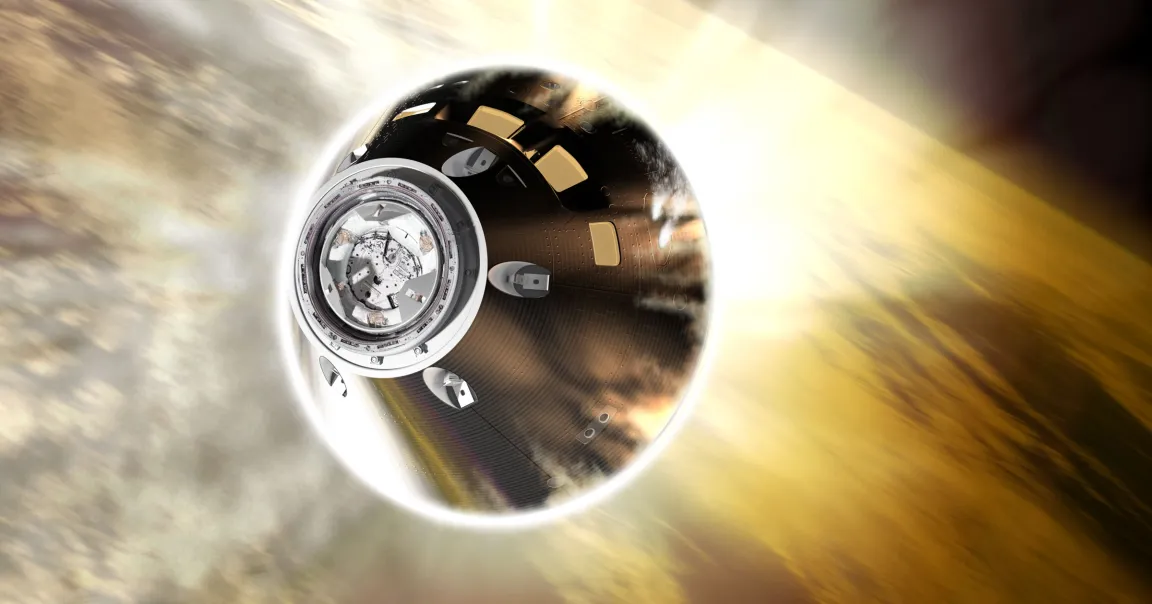
Just after 8 pm Eastern time today, the Orion spacecraft’s crew module will separate from its service module, which allowed the spacecraft to propel itself through space. Then it’ll slam into the Earth’s atmosphere at full force, at a speed of over 23,000 mph, heating it up to 5,000 degrees Fahrenheit as it slows down enough over the next 13 minutes to safely splash down in the Pacific Ocean with the help of three large chutes.
Absorbing the vast majority of these forces — and keeping the astronauts safe during reentry — is Orion’s heat shield, a thick layer of insulating material that has long been mired in controversy.
Following the conclusion of NASA’s Artemis 1 mission, scientists spotted major cracks across more than 100 locations, as outlined in a 2024 report the agency’s Office of Inspector General. Charred chunks had come loose and were missing, highlighting the violent conditions involved while careening through our planet’s atmosphere at extreme speeds.
Experts and former NASA employees continue to ring the alarm bells, warning that the heat shield could put astronauts in danger, especially following the agency’s decision to “move forward with the current Artemis II Orion capsule and heat shield,” as former NASA administrator Bill Nelson announced in December 2024 — albeit with a “modified entry trajectory.”
“What they’re talking about doing is crazy,” former NASA astronaut and heat shield expert Charlie Camarda told CNN in January. “We could have solved this problem way back when. Instead, they keep kicking the can down the road.”
NASA’s leadership maintains that it did its homework to keep the Artemis 2 crew safe during tonight’s reentry. Scientists came up with a revised and steeper “skip reentry” maneuver that will have the Orion spacecraft skip over the atmosphere like a stone, but allow for less time for the temperature to build up compared to Artemis 1.
“We have modified our reentry profile,” NASA administrator, Jared Isaacman reassured the press earlier this year. “We have regained margin to safety, and I feel very good about that with Artemis 2.”
“Every system we’ve demonstrated over the past nine days — life support, navigation, propulsion, communications — all of it depends on the final minutes of flight,” NASA associate administrator Amit Kshatriya told reporters on Thursday. “We have high confidence in the system, in the heat shield, and the parachutes and the recovery system that we’ve put together.”
The plan hasn’t convinced Camarda. He told the New York Times in the days leading up to the launch of the latest Moon mission that he’s “going to pray that nothing happens,” giving it a 95 percent chance that the astronauts will safely return to Earth.
Camarda conjured recent deadly disasters of the Space Shuttle era.
“NASA definitely does not have the data to show that it’s safe,” he added. “I realized that they were using the same flawed thinking and crude analysis tools, similar to Columbia, similar to Challenger.”
More on the heat shield: Experts Warn That There’s Something Wrong With the Moon Rocket NASA Is About to Launch With Astronauts Aboard