


惯性聚合 高效追踪和阅读你感兴趣的博客、新闻、科技资讯
阅读原文 在惯性聚合中打开

推荐订阅源

J
Java Code Geeks
Jina AI
Jina AI
小众软件
小众软件
WordPress大学
WordPress大学
Last Week in AI
Last Week in AI
美团技术团队
V
V2EX
酷 壳 – CoolShell
酷 壳 – CoolShell
奇客Solidot–传递最新科技情报
奇客Solidot–传递最新科技情报
博客园 - 聂微东
博客园 - 【当耐特】
人人都是产品经理
人人都是产品经理
雷峰网
雷峰网
博客园 - 司徒正美
量子位
freeCodeCamp Programming Tutorials: Python, JavaScript, Git & More
钛媒体:引领未来商业与生活新知
钛媒体:引领未来商业与生活新知
宝玉的分享
宝玉的分享
月光博客
月光博客
IT之家
IT之家
博客园 - 三生石上(FineUI控件)
大猫的无限游戏
大猫的无限游戏
T
Tailwind CSS Blog
博客园 - Franky

Futurism

China Deploys Rare Type of Space Junk That Pollutes Orbit for Hundreds of Years Researchers Alarmed as GPS Readings Suddenly Veer Off by 33 Feet, Enough to Crash Self-Driving Cars NASA's Powerful New Space Telescope, Just Cleared for Launch, Was Developed by an Intelligence Agency to "Spy on America's Adversaries" NASA Set Up a Major Test of Its New Strategy Under Trump by Hiring a Startup to Launch a Daring Mission to Rescue a Dying Space Telescope in Orbit. The Unfortunate Result Will Have Long-Ranging Repercussions. NASA Rescue Mission Spirals Into Crisis NASA Prepping to Launch Extremely Risky Rescue Mission Boeing's Starliner Is Such a Disaster That We Don't Even Have Words NASA Has a Major Problem Threatening Its Entire Moon Plans NASA Rover Finds "Complex Organic Matter" on Mars Experts Concerned About Plan to Destroy International Space Station Saturn's Icy Moon Is the Perfect Place to Settle, NASA Scientist Argues Tension Flared on Space Station as Russia Threatened to Drill and Saw Into Wall, Prompting NASA Astronauts to Take Shelter Elon Musk's Conflicts of Interest With the Trump Administration Regulating SpaceX Are So Profound That They Have Grim Implications for Society NASA Loads Moon Rocket onto Giant Trump-Branded Train NASA’s Next Moon Mission Is a Rube Goldberg Machine of Corporate Failure Points NASA’s James Webb Discovers That 3I/ATLAS Let One Rip as It Passed Through Solar System ISS Astronauts Ordered to Enter Evacuation Mode Jeff Bezos’ Rocket Explodes Into Mushroom Cloud, Dealing Massive Blow to NASA’s Moon Plans NASA Releases Sweeping Plans for Moon Base Sun Suddenly Blasts Powerful Radio Transmission for 19 Continuous Days Visitor Approaches From the Edge of the Solar System NASA Rover Gets Arm Stuck Inside Mars Rock, Struggles to Break Free Jeff Bezos’ Moon Lander Just Completed a Key Test Scientists and Lawmakers Horrified at Trump’s Brutal Budget for NASA NASA’s Moon Landing Schedule Slipping Horrendously Under Trump NASA Fires Up Futuristic Plasma Thruster Designed to Take Us to Mars Head of NASA Calls for Pluto to Be Made a Planet Again Video Shows NASA Astronaut Struggling to Walk After Journey Around the Moon Jeff Bezos’ Botched Space Launch Was So Bad It Could Threaten NASA’s Entire Moon Program Guess What This Creepy Underwater Thing Is That Was Photographed by US Navy Divers for NASA
The Moon Astronauts Brought Along USB Stick-Sized Living ...
2026-04-03 · via Futurism

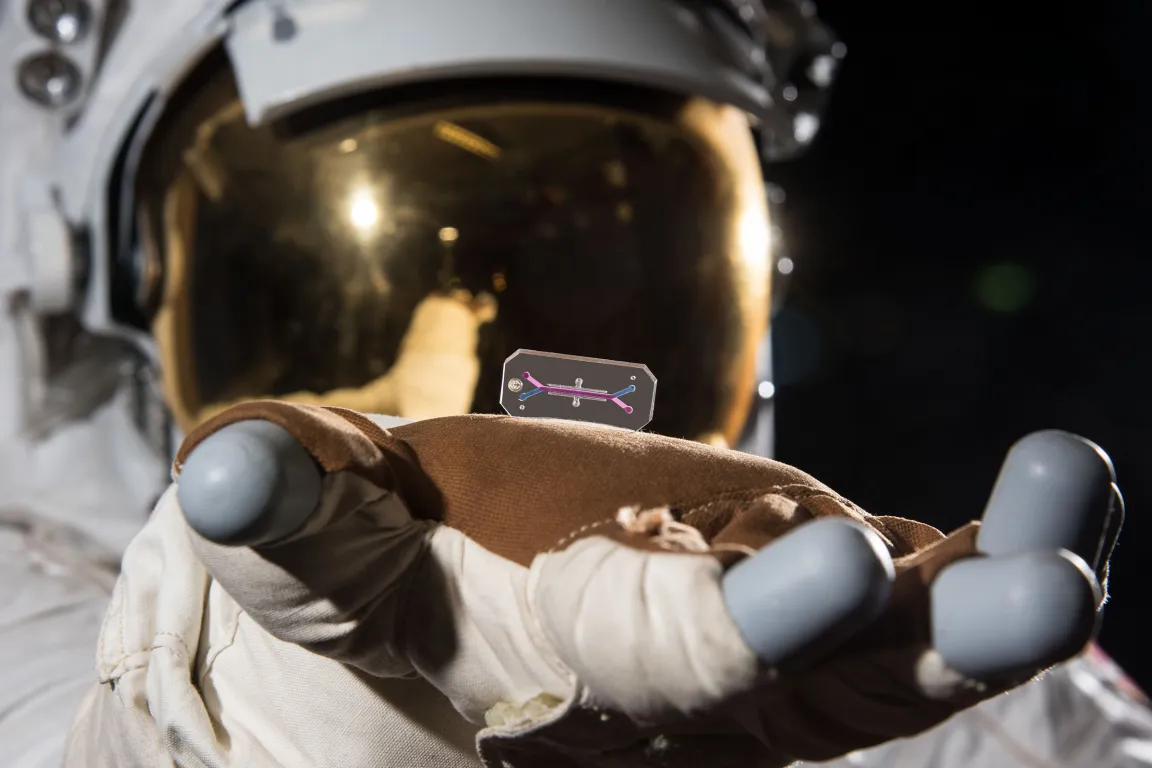
An astronaut wearing a white spacesuit and gold-tinted helmet visor is holding a small, rectangular transparent chip with colored lines and dots on it, resting on the gloved hand. The background is dark, suggesting space.

Josh Valcarcel / NASA

Sign up to see the future, today

Can’t-miss innovations from the bleeding edge of science and tech

Beyond their snazzy flight suits and mango peach smoothies, the crew of NASA’s Artemis II mission is packing something unusual: living mini-organs grown from their own bones.

That bizarre cargo is traveling alongside astronauts Reid Wiseman, Victor Glover, Christina Koch, and Jeremy Hansen, whose 10-day journey will take them around the back side of the Moon and then home again, in the process traveling farther from the Earth than any previous humans.

According to space publication Supercluster, the astronauts are carrying “completely functional” organ chips: organelles composed of bone marrow made from each astronauts’ cells.

In a highly complicated space mission, the justification for taking these organ chips is actually pretty straightforward. In leaving the protection of the Earth’s atmosphere, the four travelers expose themselves to heaps of solar and cosmic radiation. That radiation environment will present a unique window into the kind of dangers future astronauts will face in the dark reaches of space, so researchers are taking as many samples as they can get.

Mini organs aren’t new — scientists have been messing around with them since 2013 — but the decision to map them to their human counterparts in a space mission is.

“This is the first time we’re going to have crew with their matched organ chips,” David Chou, principal investigator of the chip experiment told SC. Having the humans and their micro organs side by side on the same voyage, he says, will enable scientists to compare the two biological materials against each other.

By using bone marrow cells — which are particularly vulnerable to radiation — to produce the chips, researchers are “maximizing the chance that we’ll see biologic differences, as opposed to modeling the skin or something else,” Chuo said.

For good measure, NASA also kicked duplicates of the astronauts’ organ chips up to the International Space Station, in order to compare deep space radiation with low earth orbit radiation over the same period. While they may seem small — and they are, at about the size of a USB stick — data provided by the chips could offer a major leap in our understanding of how the human body reacts to deep space, and at minimal cost, not to mention risk to human beings.

“Being able to understand how a broader representation of the public would respond to spaceflight is something you could do with organ chips much more cost-effectively,” Chou told SC. “You can make hundreds of these and send them up.”

More on NASA: Scientists Investigating Whether Object NASA Is Approaching Is Core of Destroyed Planet