
惯性聚合 高效追踪和阅读你感兴趣的博客、新闻、科技资讯
阅读原文 在惯性聚合中打开

推荐订阅源

Google DeepMind News
S
Security Affairs
阮一峰的网络日志
阮一峰的网络日志
L
LangChain Blog
Microsoft Azure Blog
雷峰网
雷峰网
Recent Announcements
WordPress大学
WordPress大学
The GitHub Blog
The GitHub Blog
博客园_首页
The Cloudflare Blog
M
MIT News - Artificial intelligence
博客园 - 【当耐特】
MyScale Blog
MyScale Blog
S
SegmentFault 最新的问题
P
Proofpoint News Feed
Y
Y Combinator Blog
Jina AI
Jina AI
博客园 - 聂微东
A
About on SuperTechFans
Blog — PlanetScale
Blog — PlanetScale
博客园 - 司徒正美
G
Google Developers Blog
云风的 BLOG
云风的 BLOG
F
Full Disclosure
CTFtime.org: upcoming CTF events
Microsoft Security Blog
爱范儿
爱范儿
T
Tailwind CSS Blog
J
Java Code Geeks
Vercel News
Vercel News
钛媒体:引领未来商业与生活新知
钛媒体:引领未来商业与生活新知
Stack Overflow Blog
Stack Overflow Blog
罗磊的独立博客
小众软件
小众软件
酷 壳 – CoolShell
酷 壳 – CoolShell
T
The Blog of Author Tim Ferriss
cs.AI updates on arXiv.org
博客园 - 三生石上(FineUI控件)
W
WeLiveSecurity
PCI Perspectives
PCI Perspectives
Attack and Defense Labs
Exploit-DB.com RSS Feed
cs.CV updates on arXiv.org
宝玉的分享
宝玉的分享
IT之家
IT之家
Hacker News: Ask HN
Hacker News: Ask HN
The Register - Security
T
The Exploit Database - CXSecurity.com
T
Threat Research - Cisco Blogs

Futurism

Astronomers Horrified by Enormous Mirror Satellite That Reflects Sunlight Back Down to Earth at Night Scientists Say They've Identified an Earth-Like Planet Right Next Door NASA Prepping to Launch Extremely Risky Rescue Mission NASA Has a Major Problem Threatening Its Entire Moon Plans NASA Rover Finds "Complex Organic Matter" on Mars Saturn's Icy Moon Is the Perfect Place to Settle, NASA Scientist Argues Scientists Building World's Most Powerful Radio Telescope Deep in the Nevada Desert NASA Loads Moon Rocket onto Giant Trump-Branded Train NASA’s Next Moon Mission Is a Rube Goldberg Machine of Corporate Failure Points Scientists Release Results After Scanning 3I/ATLAS for Alien Signals Catholic Church Boots Exorcist After He Said UFOs Are Demons NASA’s James Webb Discovers That 3I/ATLAS Let One Rip as It Passed Through Solar System Scientists Find Chunk of Lost Planet in Desert Paper Claims the “Asteroid” Japan’s Probe Is Approaching Is Actually a Derelict Spacecraft Scientists Say They’ve Cracked Mystery Behind a Dozen Strange Signals From Deep Space Scientists Say They’ve Found Fungi That Turn Dead Martian Soil Into Fertile Cropland The Blue Moon Is Fake. You Are Being Deceived Jeff Bezos’ Rocket Explodes Into Mushroom Cloud, Dealing Massive Blow to NASA’s Moon Plans NASA Releases Sweeping Plans for Moon Base SpaceX Announces Plans to Put Billionaire on First Rocket to Mars James Webb Spots Strange Structure at Core of Distant Galaxy Scientists Detect Weird Anomalies in Clouds of Venus Visitor Approaches From the Edge of the Solar System NASA Rover Gets Arm Stuck Inside Mars Rock, Struggles to Break Free Scientists Detect Atmosphere on Planet-Like Object Beyond Pluto Jeff Bezos’ Moon Lander Just Completed a Key Test Scientists Say There’s Something Huge Buried Inside Our Galaxy NASA’s Moon Landing Schedule Slipping Horrendously Under Trump NASA Fires Up Futuristic Plasma Thruster Designed to Take Us to Mars An Out of Control SpaceX Rocket Is Going to Smash Into Moon, Astronomer Says Head of NASA Calls for Pluto to Be Made a Planet Again Scientists Scan Gigantic Structure Hiding Behind Our Galaxy Video Shows NASA Astronaut Struggling to Walk After Journey Around the Moon Astronomers Discover Major Clue About 3I/ATLAS’ Origins Scientists Puzzled by Huge Shadowy Blight Spreading Across Surface of Mars Jeff Bezos’ Botched Space Launch Was So Bad It Could Threaten NASA’s Entire Moon Program Guess What This Creepy Underwater Thing Is That Was Photographed by US Navy Divers for NASA NASA’s Mars Rover Comes Across Formation That Looks Like the Scales of a Massive Cosmic Reptile Physicists Have a Major Problem With the Universe Earth Now Flying Through a Debris Field, Paper Finds There’s Something Extremely Shady About Trump’s Disastrous New NASA Budget Moon Denialists Are So Pathetic That They’re Using AI to Fake Artemis Footage Space Scientists Wince as Astronauts’ Lives Depend on Artemis 2’s Controversial Heat Shield During Plunge Back to Earth The Moon Astronauts Have Been Working Out With a NASA Rowing Machine in Space As Astronauts Visit the Moon, NASA Insider Says Agency Is in Shambles Behind the Scenes NASA Scientists Screamed With Delight When They Saw Something Smashing Into the Moon Las Vegas Sphere Turns Into Huge Moon to Celebrate NASA Mission The Moon Spacecraft’s $30 Million Toilet Has Been a Bit of a Disaster We’re In Utter Disbelief About the Photos the Moon Astronauts Just Sent Back Trump Has Call With Moon Astronauts So Awkward That They May Turn Around and Disappear Into the Void of Space Lone Jar of Nutella Drifts Around Cabin of Moon Spacecraft The Moon Astronauts Just Broke the Record for the Farthest Any Human Has Ever Traveled From Earth Moon Astronauts Forced to Do It in Bags as “Burning Odor” Emanates From Toilet Astronomers Found Something Strange In Giant “Forbidden” Planet Nearly the Size of Its Star Trump Fans Furious That NASA Is Allowing a Canadian on the Moon Mission NASA Spacecraft’s Toilet Fails Hours Into Ten-Day Journey to Moon Conspiracy Theorists Are Going to Have a Field Day as NASA Gears Up to Launch Historic Moon Mission on April Fools’ Day SpaceX Files for IPO
There’s a Hidden Shortcut to Mars, Scientific Paper Finds
Victor Tange · 2026-04-30 · via Futurism

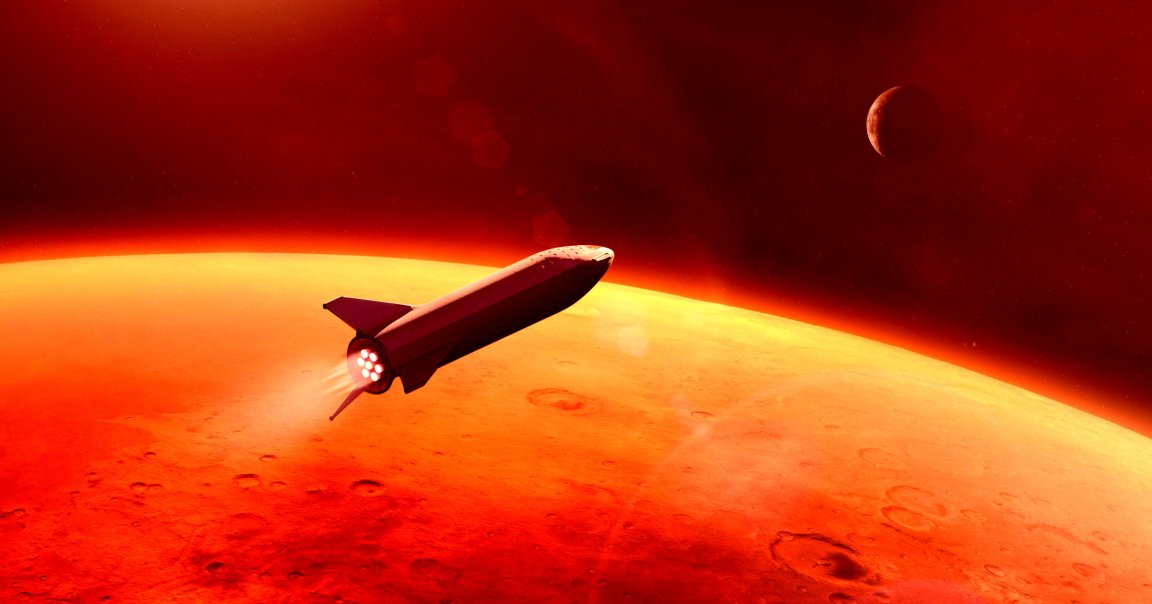
According to a new study, there might be a way to cut the journey to Mars down significantly by considering the trajectories of asteroids.

SpaceX / Futurism

Sign up to see the future, today

Can’t-miss innovations from the bleeding edge of science and tech

It takes an average of 12.5 minutes for light to cover the distance between the Earth and Mars.

Using currently available propulsion methods — and at a time when both planets’ orbits align perfectly, a “Mars opposition” that only happens every 26 months or so — traveling to the Red Planet could still take anywhere from five to 11 months.

But according to a new study published in the journal Acta Astronautica, there might be a way to cut the journey down significantly. Author Marcelo de Oliveira Souza, a cosmologist at the State University of Northern Rio de Janeiro in Brazil, considered the trajectory of asteroids, calculating a perfectly optimized route that he says could bring a round trip to Mars down to just 153 days.

He examined the flight path of asteroid 2001 CA21, which crossed the orbits of both Earth and Mars at a steady five-degree tilt. He then calculated this journey for the upcoming Mars oppositions over the next five years, concluding that in 2031, the planets align so perfectly that it “supports two complete sub-year round-trip missions consistent with the CA21-anchored plane.”

“The 2031 opposition emerges as uniquely favorable under the CA21-plane constraint, yielding two outbound Earth to Mars trajectories (33 and 56 days) and corresponding dynamically consistent return legs forming complete round-trip architectures of approximately 153 and 226 days total duration,” the paper reads.

Naturally, there are plenty of other major factors that will determine how long astronauts will have to spend to get to Mars, from propulsion methods and fuel capacity to the total mass of the payload.

Despite decades of extensive research, covering the average distance of 140 million miles — orders of magnitude farther than the Moon — with a human crew remains a distant goal. That’s not to mention the need to find shelter until the next Mars opposition, to ensure that the crew can make it back to Earth in one piece.

Yet as the latest paper suggests, even something as simple as the orbital plane of an asteroid could allow us to optimize our journeys there — a glimmer of hope that our first in-person visit isn’t quite as distant as it may seem.

More on trips to Mars: Scientists Puzzled by Huge Shadowy Blight Spreading Across Surface of Mars