
惯性聚合 高效追踪和阅读你感兴趣的博客、新闻、科技资讯
阅读原文 在惯性聚合中打开

推荐订阅源

Threat Intelligence Blog | Flashpoint
Microsoft Azure Blog
Cloudbric
Cloudbric
I
InfoQ
V
V2EX
博客园_首页
The Register - Security
cs.CV updates on arXiv.org
S
Secure Thoughts
Vercel News
Vercel News
Forbes - Security
Forbes - Security
云风的 BLOG
云风的 BLOG
PCI Perspectives
PCI Perspectives
L
LINUX DO - 最新话题
D
DataBreaches.Net
H
Hacker News: Front Page
Application and Cybersecurity Blog
B
Blog RSS Feed
A
About on SuperTechFans
N
News and Events Feed by Topic
Apple Machine Learning Research
Help Net Security
Help Net Security
Attack and Defense Labs
N
Netflix TechBlog - Medium
Spread Privacy
Spread Privacy
F
Full Disclosure
Recorded Future
Recorded Future
AWS News Blog
AWS News Blog
博客园 - 【当耐特】
The Cloudflare Blog
T
Threatpost
T
Tor Project blog
Google DeepMind News
C
CXSECURITY Database RSS Feed - CXSecurity.com
CTFtime.org: upcoming CTF events
Recent Announcements
M
MIT News - Artificial intelligence
A
Arctic Wolf
C
Check Point Blog
Stack Overflow Blog
Stack Overflow Blog
T
Threat Research - Cisco Blogs
Security Archives - TechRepublic
Hacker News - Newest:
Hacker News - Newest: "LLM"
WordPress大学
WordPress大学
Cyberwarzone
Cyberwarzone
小众软件
小众软件
C
Cyber Attacks, Cyber Crime and Cyber Security
P
Proofpoint News Feed
Security Latest
Security Latest
The Last Watchdog
The Last Watchdog

Futurism

Astronomers Horrified by Enormous Mirror Satellite That Reflects Sunlight Back Down to Earth at Night Scientists Say They've Identified an Earth-Like Planet Right Next Door NASA Prepping to Launch Extremely Risky Rescue Mission NASA Has a Major Problem Threatening Its Entire Moon Plans NASA Rover Finds "Complex Organic Matter" on Mars Saturn's Icy Moon Is the Perfect Place to Settle, NASA Scientist Argues Scientists Building World's Most Powerful Radio Telescope Deep in the Nevada Desert NASA Loads Moon Rocket onto Giant Trump-Branded Train NASA’s Next Moon Mission Is a Rube Goldberg Machine of Corporate Failure Points Scientists Release Results After Scanning 3I/ATLAS for Alien Signals Catholic Church Boots Exorcist After He Said UFOs Are Demons NASA’s James Webb Discovers That 3I/ATLAS Let One Rip as It Passed Through Solar System Scientists Find Chunk of Lost Planet in Desert Paper Claims the “Asteroid” Japan’s Probe Is Approaching Is Actually a Derelict Spacecraft Scientists Say They’ve Cracked Mystery Behind a Dozen Strange Signals From Deep Space Scientists Say They’ve Found Fungi That Turn Dead Martian Soil Into Fertile Cropland The Blue Moon Is Fake. You Are Being Deceived Jeff Bezos’ Rocket Explodes Into Mushroom Cloud, Dealing Massive Blow to NASA’s Moon Plans NASA Releases Sweeping Plans for Moon Base SpaceX Announces Plans to Put Billionaire on First Rocket to Mars James Webb Spots Strange Structure at Core of Distant Galaxy Scientists Detect Weird Anomalies in Clouds of Venus Visitor Approaches From the Edge of the Solar System NASA Rover Gets Arm Stuck Inside Mars Rock, Struggles to Break Free Scientists Detect Atmosphere on Planet-Like Object Beyond Pluto Jeff Bezos’ Moon Lander Just Completed a Key Test Scientists Say There’s Something Huge Buried Inside Our Galaxy NASA’s Moon Landing Schedule Slipping Horrendously Under Trump NASA Fires Up Futuristic Plasma Thruster Designed to Take Us to Mars An Out of Control SpaceX Rocket Is Going to Smash Into Moon, Astronomer Says There’s a Hidden Shortcut to Mars, Scientific Paper Finds Head of NASA Calls for Pluto to Be Made a Planet Again Scientists Scan Gigantic Structure Hiding Behind Our Galaxy Video Shows NASA Astronaut Struggling to Walk After Journey Around the Moon Scientists Puzzled by Huge Shadowy Blight Spreading Across Surface of Mars Jeff Bezos’ Botched Space Launch Was So Bad It Could Threaten NASA’s Entire Moon Program Guess What This Creepy Underwater Thing Is That Was Photographed by US Navy Divers for NASA NASA’s Mars Rover Comes Across Formation That Looks Like the Scales of a Massive Cosmic Reptile Physicists Have a Major Problem With the Universe Earth Now Flying Through a Debris Field, Paper Finds There’s Something Extremely Shady About Trump’s Disastrous New NASA Budget Moon Denialists Are So Pathetic That They’re Using AI to Fake Artemis Footage Space Scientists Wince as Astronauts’ Lives Depend on Artemis 2’s Controversial Heat Shield During Plunge Back to Earth The Moon Astronauts Have Been Working Out With a NASA Rowing Machine in Space As Astronauts Visit the Moon, NASA Insider Says Agency Is in Shambles Behind the Scenes NASA Scientists Screamed With Delight When They Saw Something Smashing Into the Moon Las Vegas Sphere Turns Into Huge Moon to Celebrate NASA Mission The Moon Spacecraft’s $30 Million Toilet Has Been a Bit of a Disaster We’re In Utter Disbelief About the Photos the Moon Astronauts Just Sent Back Trump Has Call With Moon Astronauts So Awkward That They May Turn Around and Disappear Into the Void of Space Lone Jar of Nutella Drifts Around Cabin of Moon Spacecraft The Moon Astronauts Just Broke the Record for the Farthest Any Human Has Ever Traveled From Earth Moon Astronauts Forced to Do It in Bags as “Burning Odor” Emanates From Toilet Astronomers Found Something Strange In Giant “Forbidden” Planet Nearly the Size of Its Star Trump Fans Furious That NASA Is Allowing a Canadian on the Moon Mission NASA Spacecraft’s Toilet Fails Hours Into Ten-Day Journey to Moon Conspiracy Theorists Are Going to Have a Field Day as NASA Gears Up to Launch Historic Moon Mission on April Fools’ Day SpaceX Files for IPO
Astronomers Discover Major Clue About 3I/ATLAS’ Origins
Frank Landym · 2026-04-25 · via Futurism

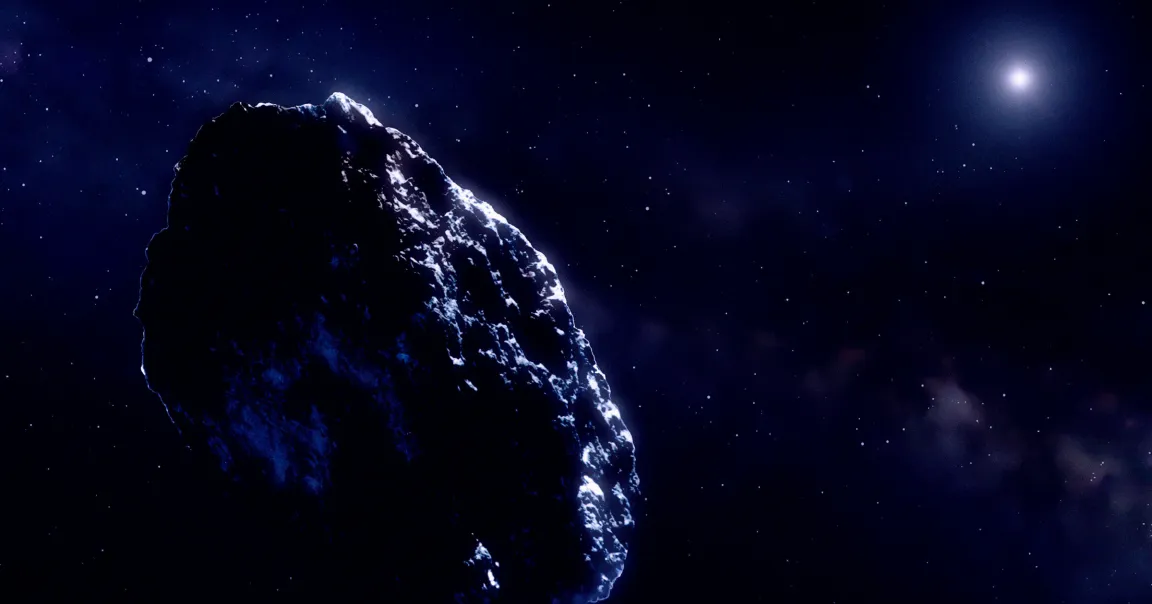
A large, rocky object illuminated by a distant light source, floating in the dark expanse of space filled with numerous small stars.

Getty / Futurism

Sign up to see the future, today

Can’t-miss innovations from the bleeding edge of science and tech

3I/ATLAS became the main character when it came hurtling into our solar system last year, so it’s only fitting it gets a dramatic backstory.

After using the ALMA observatory in Chile to closely examine the interstellar visitor — widely believed to be some type of comet — astronomers discovered that it likely fled from a cold and isolated corner of the galaxy, they report in a new study published in the journal Nature, like some sort of cosmic refugee seeking warmth.

The clues came from examining the water vapor it released while passing through. As it flew near the Sun in November and began to heat up, it vented something to the tune of seventy Olympic swimming pools of water every day, providing a chance to study what materials it was harboring in its nucleus. (Other astronomers capitalizing on the opportunity even found that it contained the ingredients for life.)

When the astronomers peered into this vapor cloud, they found high amounts of deuterium, a heavy hydrogen isotope containing one proton and one neutron. The hydrogen atoms found in water molecules typically contain only the single proton. 

Scientists call water made of deuterium “heavy water,” and 3I/ATLAS is indeed a heavy hitter. The observations showed that the ratio of heavy water in the comet is 30 times higher than any regular comet that originated here in our own solar system, and forty times higher than the water found in the Earth’s oceans. Altogether, it’s more “than anything we’ve seen before in other planetary systems and planetary comets,” lead author Luis Salazar Manzano at the University of Michigan told BBC Sky at Night.

What the preponderance of heavy water suggests is that 3I/ATLAS formed in a cold and remote region of the Milky Way with less radiation, where there were fewer neighboring stars near its home star system. At an estimated age of at least seven billion years old, it formed well before our Sun, which is around 4.5 billion years old.

In addition to fleshing out 3I/ATLAS’s lonely backstory, it’s also a clue about how other star systems form. Study coauthor Teresa Paneque-Carreño at the University of Michigan said it was “proof that whatever the conditions were that led to the creation of our solar system are not ubiquitous throughout space.”

“That may sound obvious, but it’s one of those things that you need to prove,” she told Sky at Night.

More on space: Please Resist the Urge to Drink the Melted Sludge From 3I/ATLAS