


Sign up to see the future, today
Can’t-miss innovations from the bleeding edge of science and tech
Mysteries abound on our planetary neighbor Venus, not least of all because it’s permanently shrouded in a thick and nigh-impenetrable layer of clouds.
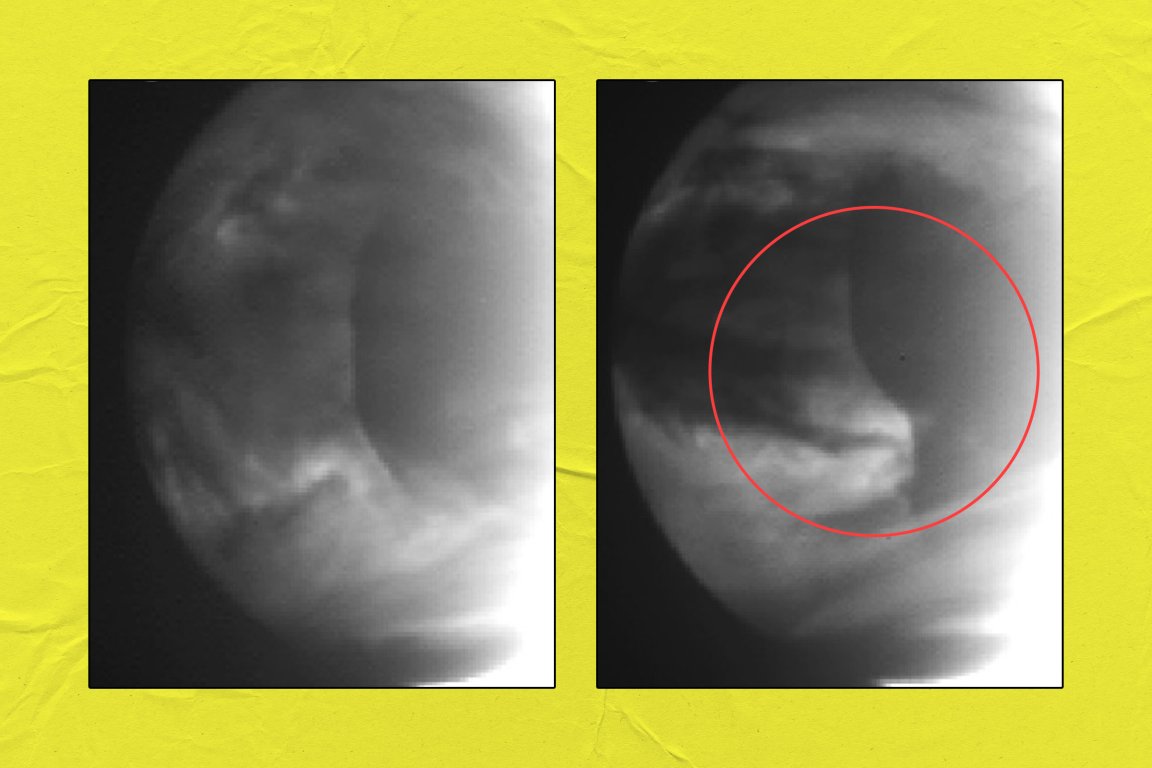
But when the Japanese Aerospace Exploration Agency’s Akatsuki space probe visited the steaming hot world in 2016, it managed to spot something anomalous in the atmospheric veil obscuring the planet’s inscrutable surface: an enormous wave tearing through the atmosphere for days at a time, creating a cloud that stretched up to 3,700 miles across. What possibly could’ve been responsible for this monstrosity was unclear.
Now, astronomers have an answer about what they glimpsed. In a new study published in Journal of Geophysical Research: Planets, a team led by researchers from the University of Tokyo suggest that the atmospheric behemoth was spawned by turmoil in a lower cloud layer, in a phenomenon known as a “hydraulic jump” that burst to the surface.
“We identified the phenomena, but for years we couldn’t understand it,” said lead author Takeshi Imamura at the University of Tokyo in a statement about the work. “However, thanks to this research, we’re now able to show that this cloud disruption is caused by the largest known hydraulic jump in the solar system.”
The Venusian atmosphere is primarily made of carbon dioxide, creating an extreme greenhouse effect that’s responsible for the planet’s hellish temperatures. Within this atmosphere are three distinct cloud layers. The clouds are composed of sulfuric acid, and their sheer celerity puts them in a class above Earth’s. Unlike the ponderous, floating balls of cotton we associate with clouds on our planet, Venus’ “superrotate,” meaning they swirl around the planet 60 times faster than the planet itself turns. To astronomers, Venus’s persistent and extreme clouds provide a way of probing fleeting atmospheric phenomena on Earth.
But even by Venus’s standards, a giant acid cloud bank thousands of miles across was extreme. Enter hydraulic jumps: you can see phenomenon in the kitchen sink, when water from the tap hits the basin and appears shallow but spreads quickly, then slows and rises in depth.
Now blow that up to a planetary scale. On Venus, an atmospheric wave in its lower cloud layers can abruptly destabilize and slow down as a result, the team found. This creates a powerful updraft that blasts sulfuric acid vapor into the topmost layer, where it condenses into a massive but lumbering cloud bank which moves slower than its surroundings, creating a distinct wave front. The astronomers say it’s the first example of a hydraulic jump seen on another planet.
“Venus has three distinct cloud layers, and the dynamics of the lower and middle layers are not so well understood,” Imamura said in the statement. “Our discovery of a hydraulic jump on Venus connecting a very large-scale horizontal process with a strong localized vertical wave is unexpected, as in fluid dynamics these are usually disconnected.”
More on space: Scientists Spot Huge Cave on Venus