


Sign up to see the future, today
Can’t-miss innovations from the bleeding edge of science and tech
Powerful winds capable of destroying entire galaxies could explain why the early universe is littered with “dead” realms when they should be growing and entering their prime, astronomers say.
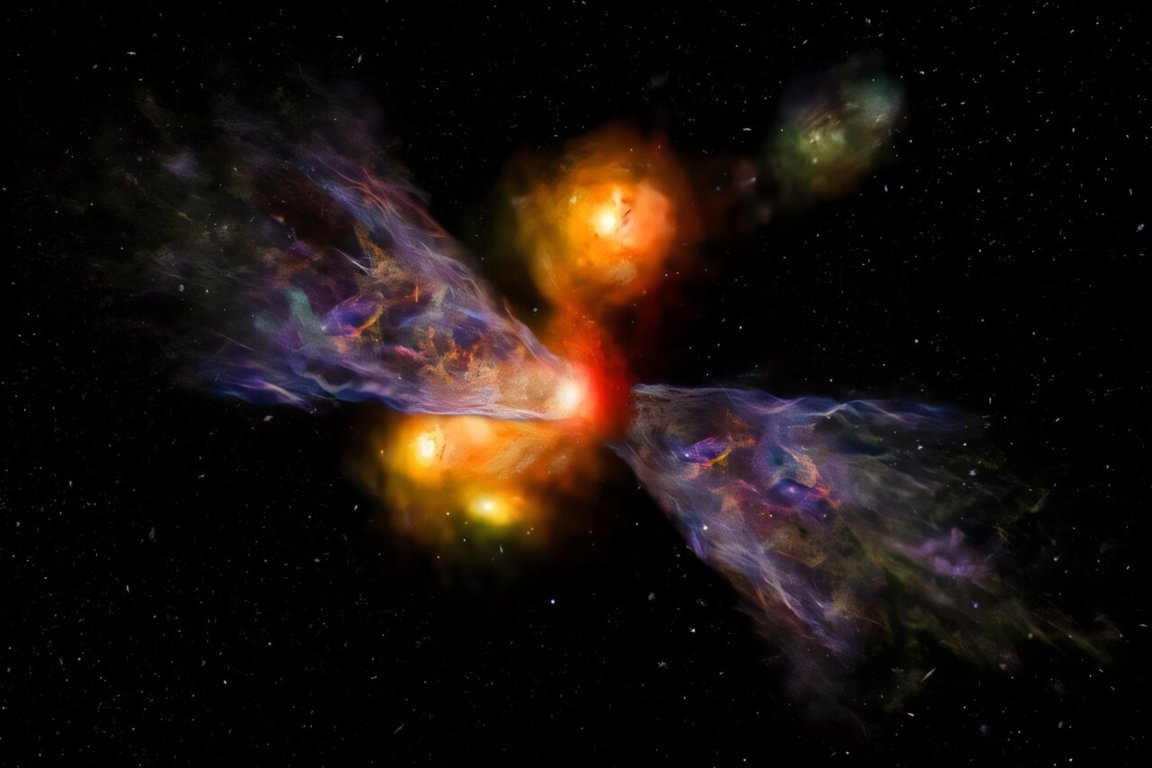
As detailed in a new study published in the Monthly Notices of the Royal Astronomical Society, the researchers used the James Webb Space Telescope to observe a galaxy dating back to just one billion years after the universe was formed. What they found was a slowly unfolding catastrophe: a huge plume of cold gas being blasted out of the galaxy, depleting it of the star-forming material that once gave it life.
The galaxy, as the authors put it in an essay for The Conversation, was “in the throes of death.” And its demise was clearly the handiwork of that fearsome galactic wind.
“If this rapid blowout continues, the galaxy could be dead in less than 50 million years, explaining the origin of the mysterious massive dead galaxies in the early universe,” lead author Rebecca Davies, an astronomer of Swinburne University of Technology in Melbourne, said in a statement about the work.
A “dead” galaxy is one that is no longer giving birth to new stars. It’s expected that an old galaxy will fizzle out over billions of years, but astronomers’ expectations were turned upside down when the James Webb came online in 2022 and observed a whole graveyard of moribund galaxies when the universe was still in its infancy. How these realms could already be “dead” when they barely had time to be alive in the first place was a mystery.
One explanation was that dark energy, the mysterious phenomenon that’s driving the universe’s expansion, was stronger in the early universe than it is today. The results of a landmark Dark Energy Spectroscopic Instrument survey suggests that dark energy may indeed be weakening, but the authors say that powerful winds provide a simpler solution where premature galaxy deaths are concerned.
Until now, the prevailing logic has been that only supermassive black holes could whip up winds powerful enough to lay waste to the largest galaxies. But these latest observations suggest that a more common mechanism could be responsible, too.
The observed galaxy, CRISTAL-02, is actually a cluster of multiple galaxies in the final stages of merging together. In the early universe, when the environment was denser, these collisions occurred far more frequently than they do today. As the constituent galaxies get shoved together, their gases are driven towards their centers, triggering bursts of star formation.
When the researchers imaged CRISTAL-02 with the James Webb and the Atacama Large Millimeter/submillimeter Array radio telescope, they found that it was forming stars twice as fast as similarly sized galaxies. And, almost paradoxically, it’s this flurry of star formation that appeared to be fueling the intense wind blasting the gases out of itself. The massive stars that emerge from this frenzy of formation quickly burn out and explode in powerful supernovas, which blow powerful winds of their own. Combined with these other cosmic blasts on a galactic scale, and you have a wind capable of toppling the very galaxy that gave birth to it..
“Almost half of early massive galaxies are interacting with other nearby galaxies, suggesting this isn’t a quirk but a widespread cosmic phenomenon,” Davies said. “If many early galaxies collide and experience rapid growth, then it may not be surprising that we see so many dead galaxies in the early universe.”
More on space: Astronomers Say Star Self-Destructed So Catastrophically That It Left Behind No Trace of Its Existence