惯性聚合 高效追踪和阅读你感兴趣的博客、新闻、科技资讯
阅读原文 在惯性聚合中打开

推荐订阅源

Latest news
Latest news
T
Troy Hunt's Blog
V
Vulnerabilities – Threatpost
L
LINUX DO - 热门话题
cs.CL updates on arXiv.org
Simon Willison's Weblog
V
V2EX
博客园 - 司徒正美
B
Blog RSS Feed
AWS News Blog
AWS News Blog
MyScale Blog
MyScale Blog
Scott Helme
Scott Helme
Cisco Talos Blog
Cisco Talos Blog
Last Week in AI
Last Week in AI
NISL@THU
NISL@THU
博客园 - Franky
P
Proofpoint News Feed
博客园_首页
C
CERT Recently Published Vulnerability Notes
雷峰网
雷峰网
S
Schneier on Security
P
Proofpoint News Feed
Hugging Face - Blog
Hugging Face - Blog
G
GRAHAM CLULEY
博客园 - 三生石上(FineUI控件)
月光博客
月光博客
WordPress大学
WordPress大学
The Hacker News
The Hacker News
T
Threatpost
阮一峰的网络日志
阮一峰的网络日志
A
Arctic Wolf
Microsoft Azure Blog
T
The Exploit Database - CXSecurity.com
Engineering at Meta
Engineering at Meta
罗磊的独立博客
T
The Blog of Author Tim Ferriss
D
Darknet – Hacking Tools, Hacker News & Cyber Security
I
Intezer
OSCHINA 社区最新新闻
OSCHINA 社区最新新闻
K
Kaspersky official blog
SecWiki News
SecWiki News
云风的 BLOG
云风的 BLOG
美团技术团队
C
Cybersecurity and Infrastructure Security Agency CISA
博客园 - 【当耐特】
freeCodeCamp Programming Tutorials: Python, JavaScript, Git & More
Security Latest
Security Latest
C
Cyber Attacks, Cyber Crime and Cyber Security
B
Blog
S
Security Affairs

博客园 - fariver

[PaperWritting] 多模态大模型架构图摘录 每日Paper - 2026-03-06 每日Paper | 2026年3月4日 [Paper Reading] Qwen3-VL-Embedding and Qwen3-VL-Reranker: A Unified Framework for State-of-the-Art Multimodal Retrieval and Ranking [PaperReading] OneSearch A Preliminary Exploration of the Unified End-to-End Generative Framework for E-commerce Search [PaperReading] OneRec Technical Report [Paper Reading] Tiger: Recommender Systems with Generative Retrieval [PaperReading] Generative Recommendation with Semantic IDs: A Practitioner’s Handbook [PaperReading] GME: Improving Universal Multimodal Retrieval by Multimodal LLMs [Paper Reading] UniME-V2: MLLM-as-a-Judge for Universal Multimodal Embedding Learning [PaperReading] Qwen2.5-VL Technical Report [PaperReading] DeepSeek-OCR: Contexts Optical Compression [PaperReading] SAIL-Embedding Technical Report: Omni-modal Embedding Foundation Model [PaperReading] VLM2Vec-V2: Advancing Multimodal Embedding for Videos, Images, and Visual Documents [PaperReading] VLM2VEC: TRAINING VISION-LANGUAGE MODELS FOR MASSIVE MULTIMODAL EMBEDDING TASKS [PaperReading] REACT: SYNERGIZING REASONING AND ACTING IN LANGUAGE MODELS [PaperReading] MemGPT: Towards LLMs as Operating Systems [PaperReading] Qwen2-VL: Enhancing Vision-Language Model’s Perception of the World at Any Resolution [PaperReading] Mind Search: Mimicking Human Minds Elicits Deep AI Searcher [PaperReading] METAGPT: META PROGRAMMING FOR A MULTI-AGENT COLLABORATIVE FRAMEWORK
[PaperReading] UniME: Breaking the Modality Barrier: Universal Embedding Learning with Multimodal LLMs
fariver · 2025-10-28 · via 博客园 - fariver

Breaking the Modality Barrier: Universal Embedding Learning with Multimodal LLMs

link
时间:25.04
单位:The University of Sydney、DeepGlint、Tongyi Lab
相关领域:MLLM
作者相关工作:Tiancheng Gu
被引次数:16
项目主页:https://garygutc.github.io/UniME/

TL;DR

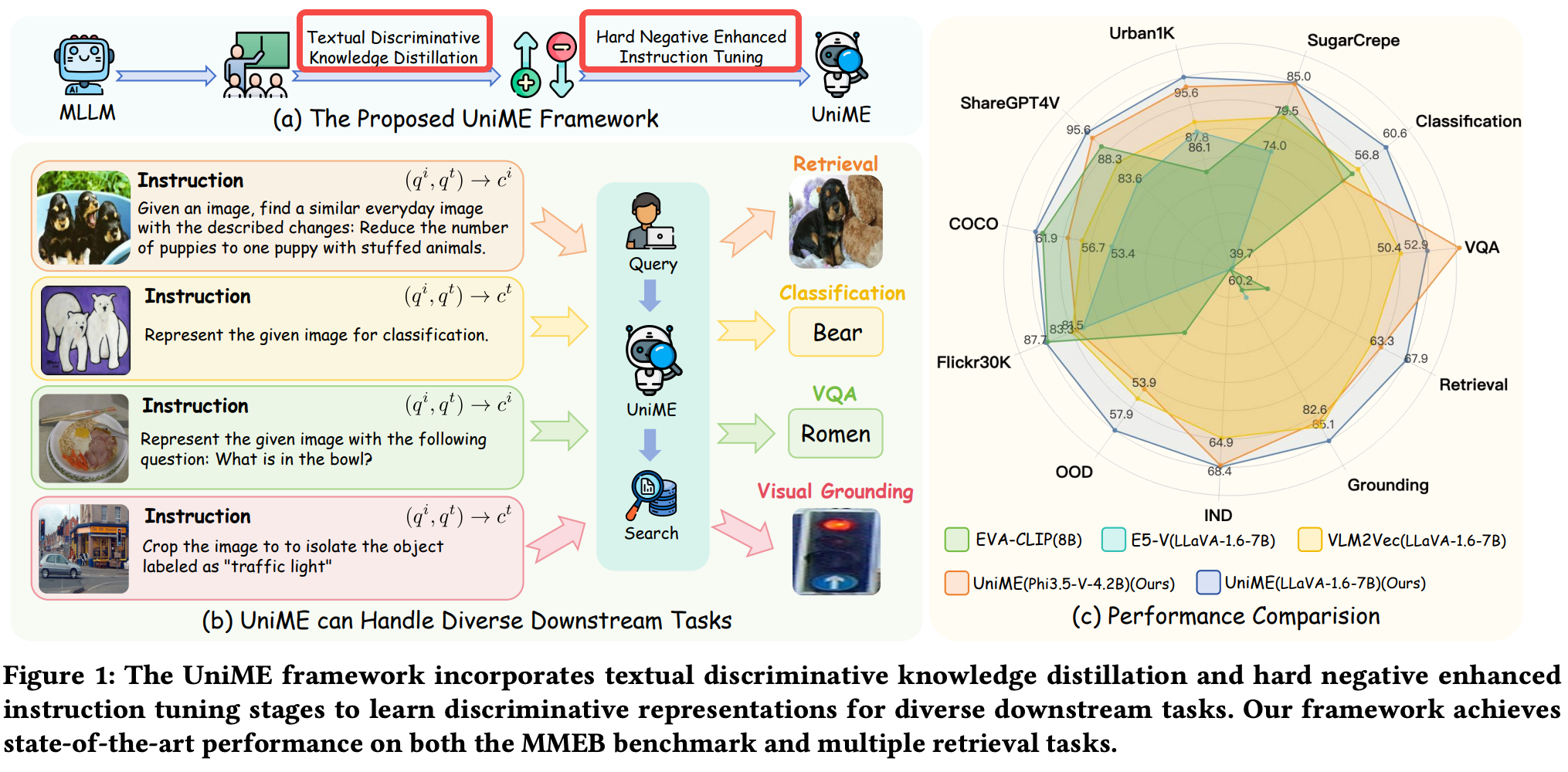
CLIP这类多模态表征方法虽然被广泛应用,但存在三个问题:(1) 文本标记截断, (2) 孤立的图像-文本编码, (3) 因词袋行为导致的组合性缺陷。本文提出UniME (Universal Multimodal Embedding),训练方法是一个两阶段训练,第一阶段用强大LLM-Teacher模型蒸馏提升MLLM的language组件的embedding表征能力,第二阶段通过难负样本指令微调进一步提升表征能力。实验结果在长短caption检索以及组合检索等多个检索任务取得好的效果。

Q:如何理解CLIP存在的上述三个问题?
(1) 文本标记截断
CLIP模型的文本编码器有最大输入长度限制(例如77个标记)。当遇到长文本(如细节丰富的图像描述)时,超出的部分会被直接截断丢弃。
(2) 孤立的图像-文本编
分别对图像和文本进行编码,然后在嵌入空间计算它们的整体相似度。这种机制是“粗粒度”的,它关注的是全局语义匹配,而​​无法精细地验证文本中的每一个具体陈述是否在图像中有对应​​。
(3) 因词袋行为导致的组合性缺陷
说CLIP的训练目标导致其文本编码器表现出“词袋”特性,是因为其​​基于对比学习的全局匹配范式​​,鼓励模型优先学习能够区分不同文本类别的​​关键词信号​​,而相对地​​弱化了对词序、语法结构和精细修饰关系的建模​​。

image

Method

阶段一:Textual Discriminative Knowledge Distillation

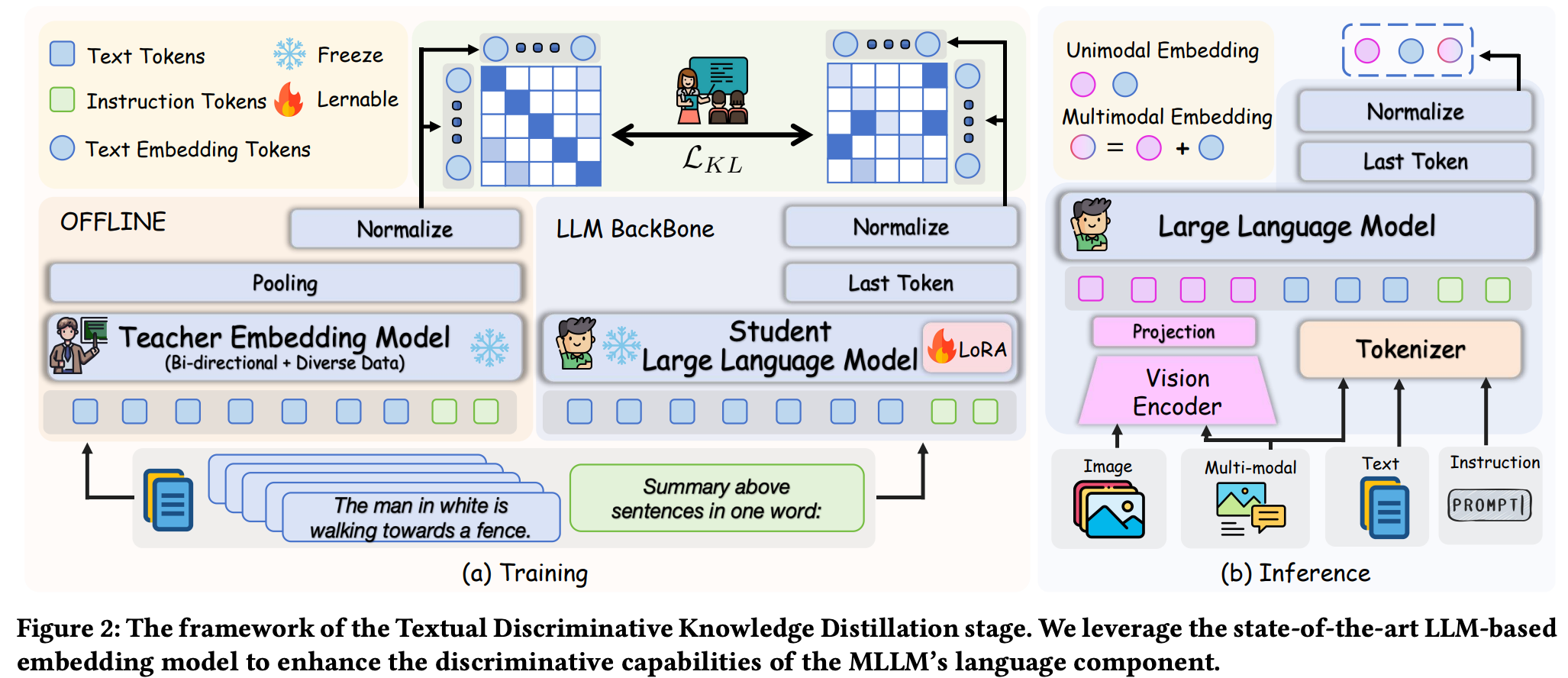
使用了一个SOTA LLM-Based嵌入模型NV-Embed V2作为Teacher模型。蒸馏方法:将text encoder从Student MLLM中解耦出来抽取text embedding,Teacher LLM模型也相应抽取embedding,通过KL散度将知识蒸馏给Student。
image
image

阶段二:Hard Negative Enhanced Instruction Tuning

过滤错误负样本

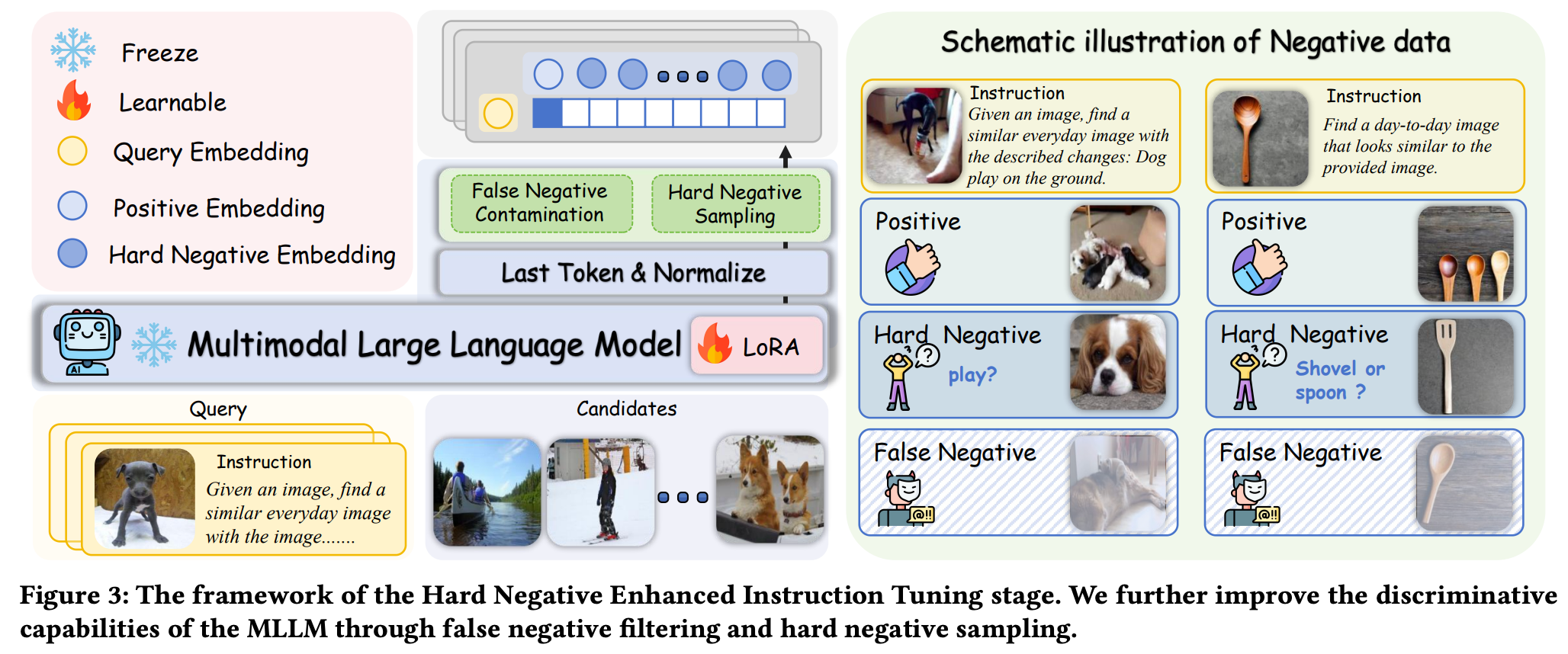
核心思想:某些样本可能与查询在语义上高度相关(即“正例”),但由于数据标注噪声或语义多样性,被错误地标记为负例,这些样本被称为“假负例”。
\(\alpha = cos(𝑒_{𝑞}, 𝑒_{𝑐}+) + \beta\)
过滤过程​​:在训练时,所有与查询的相似度超过阈值\(\alpha\)的负例样本都会被排除。这种方法可以有效清除假负例,同时保留那些具有挑战性的“真”困难负例。

困难负例采样策略

核心思想:与容易区分的“简单负例”相比,那些与正例标签不同但embedding表征非常相似的“困难负例”能为模型提供更丰富的梯度信息,从而更有效地提升其判别能力。
采样方法​​:模型自主地为每个查询识别出困难负例。具体采样公式如下:
image
其中,\(𝑒_{𝑐}*\)是经过假负例过滤后的候选样本,\(𝑒_{𝑐}+\)是正例候选,\(𝑒_𝑞\)是查询嵌入。函数\(Rank_𝑘\)会选择与查询最相似的前 k个候选作为困难负例。
​​实现细节​​:为保证批次一致性,当采样到的困难负例少于 k个时,会通过复制现有的困难负例来保持固定的数量 k。论文中默认设置 k = 8。
image

Experiment

image
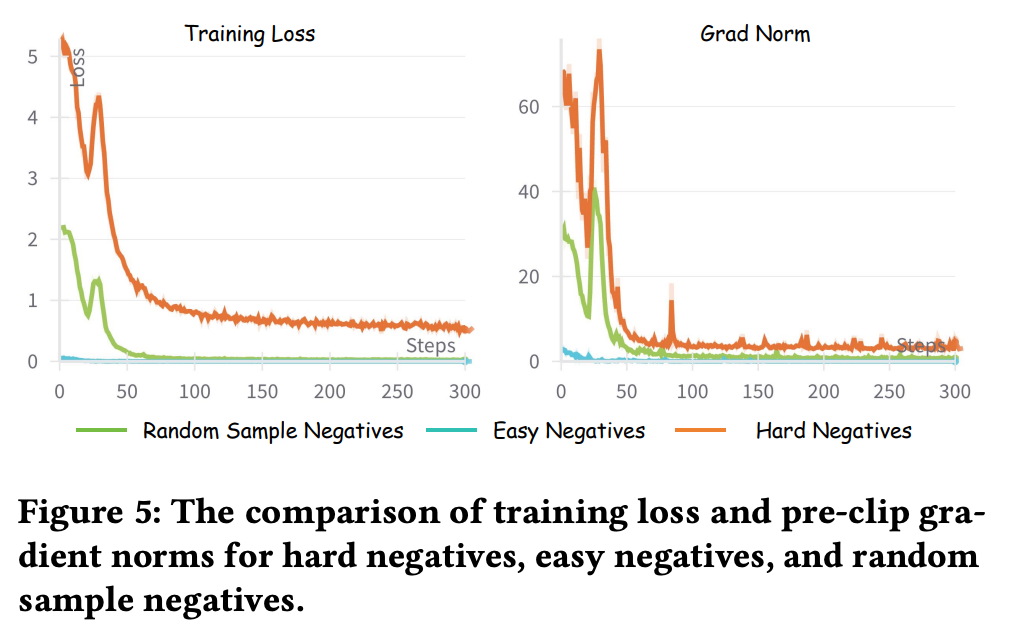
Hard Negatives对应的Loss与梯度都有更大的贡献
image
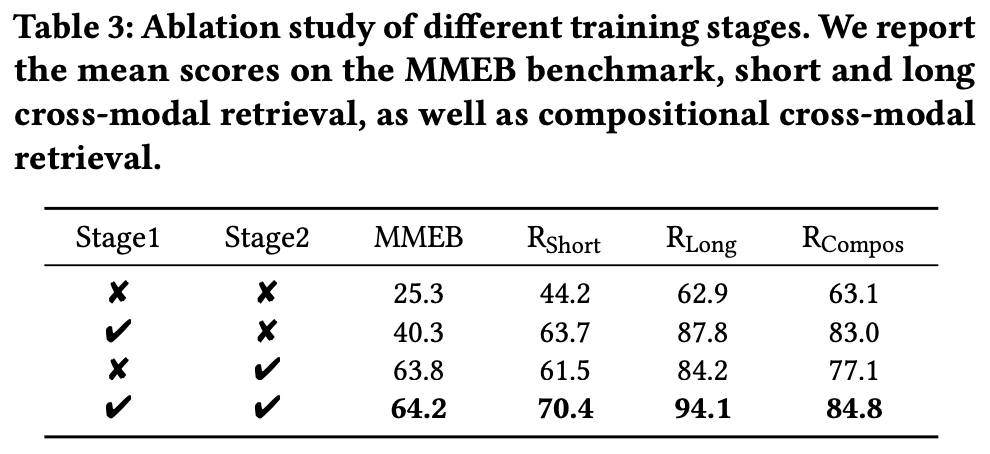
从Ablation来看,Stage1与Stage2对于MMEB指标的提升都挺明显的
image
对于\(\beta\)与top-k的k两个超参数的ablation study
image

总结与思考

负样本对于表征学习比较关键,Stage2提供了两种方法,实际应用时超参数需要根据数据集相应调整。