

惯性聚合 高效追踪和阅读你感兴趣的博客、新闻、科技资讯
阅读原文 在惯性聚合中打开

推荐订阅源

WordPress大学
WordPress大学
GbyAI
GbyAI
P
Proofpoint News Feed
B
Blog
MyScale Blog
MyScale Blog
V
V2EX
B
Blog RSS Feed
Microsoft Security Blog
量子位
Jina AI
Jina AI
博客园 - 叶小钗
Recent Announcements
有赞技术团队
有赞技术团队
罗磊的独立博客
L
LangChain Blog
I
InfoQ
云风的 BLOG
云风的 BLOG
freeCodeCamp Programming Tutorials: Python, JavaScript, Git & More
人人都是产品经理
人人都是产品经理
小众软件
小众软件
V
Visual Studio Blog
月光博客
月光博客
The Cloudflare Blog
雷峰网
雷峰网

Futurism

Trump Admin Enabling the Systematic Slaughtering of Thousands of Wild Horses Hospitals Are Getting So Hot That Surgeries Are Getting Canceled and Staff Are Fainting It's Getting So Hot That Nuclear Plants Are Being Forced to Power Down AI's Impact on the Environment Is Absolutely Horrifying, New Paper Finds Giant Oil Tanker Runs Aground in Marine Nature Preserve, Spills Nonstop for Weeks It's Official: This Is the Hottest America Has Ever Been Amazon's New AI Data Center Is So Enormous That It Appears It Will Become the Largest Single Source of Pollution in the United States Droughts Are Getting So Intense That Ancient Ruins Are Beginning to Surface Scientists Genetically Engineer High-Protein Lettuce Jeff Bezos Harshly Criticized for $200 Million Pledge to Protect the World's Most Endangered Species AI Data Centers Are Causing Unfathomable Amounts of Air Pollution, and It Gets Worse With Each New One They Build Google Data Center Announces Plans to Pave Over Protected Wetlands Man Sues Bank for Being Stupid Enough to Give Him a Mortgage Even When Experts Were Warning Him It Was About to Fall Into the Ocean It's So Hot in Japan That Zoo Animals Are Dropping Dead Global Warming Is Rapidly Accelerating, New Paper Finds SpaceX Vows to Keep Poisoning Nearby Towns With Its Fume-Belching Data Center For Another Year El Niño Set to Upend the World Economy The Type of Orbital Data Centers That Billionaires Want to Launch Into Space Would Wreak Ecological Catastrophe, Scientists Warn As Much of the East Coast Is Choking on Wildfire Smoke, Texas Is Drowning in Life-Threatening Floods Trump Decimated a Satellite Program That Would've Vastly Improved Wildfire Smoke Monitoring Terrifying Video Shows Locomotive Engulfed in Wildfire Flames A Staggering Number of People Are Dying Because of Record Heatwaves Scientists Propose Dimming Sun to Combat El Niño Climate Scientists Aghast at How Bad Things Are Getting, and So Fast The Pollution Being Churned Out by AI Data Centers Is So Severe That It’s Almost Incomprehensible You'll Never Guess Which Country Is Causing the Most Global Warming Freak Tornado Sucks Man Out of 12-Floor Apartment Microsoft's $7.3 Billion AI Data Center Just Caught a Nasty Lawsuit From Furious Neighbors You'll Never Guess Why Government Officials Are Sinking a Four-Story Riverboat Casino Into the Abyss Something Weird Is Going on With the 66 Billion Trees China Planted in a Huge Wall
Scientists Say They’ve Figured Out What That Golden Orb F...
Frank Landym · 2026-04-24 · via Futurism

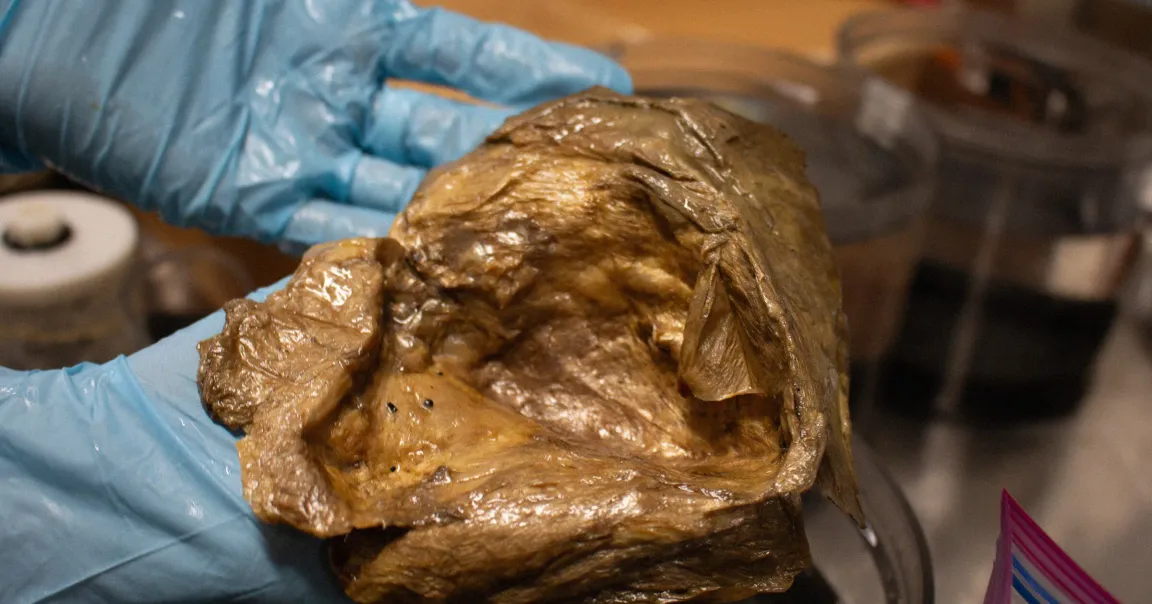
A gloved hand holding a mysterious object recovered from underwater that they described as a "golden orb." The background is blurred, showing some laboratory equipment.

NOAA Fisheries

Sign up to see the future, today

Can’t-miss innovations from the bleeding edge of science and tech

After spending two and half years pondering a “golden orb” found at the bottom of the ocean, scientists have finally figured out what in the thundering typhoons it actually is.

The aureate object looked like some sort of alien relic when it was first discovered clinging to a rock over two miles underwater in the Gulf of Alaska, before collapsing into a blob resembling molten leafs of gold when it was recovered.

Now, scientists at the National Oceanic and Atmospheric Administration and the Smithsonian Institution reveal that the baffling object is a remnant of what was once a giant anemone — though it took considerable detective work to reach that conclusion.

“This turned into a special case that required focused efforts and expertise of several different individuals,” said Allen Collins, a zoologist and director of NOAA Fisheries’ National Systematics Laboratory, in a statement. “This was a complex mystery that required morphological, genetic, deep-sea and bioinformatics expertise to solve.”

While the orb attracted a great deal of public interest, scientists regularly encounter strange organisms they can’t immediately explain when exploring the deep ocean.

“We see weird stuff every dive,” NOAA physical scientist Sam Candio said in an interview with Futurism after the discovery. The orb “wasn’t even the most interesting thing that jumped out at us at that time.”  

But the golden object proved to be more of an enigma than expected. It was discovered during an expedition on the NOAA Ship Okeanos Explorer, and at the time, the expedition team could only conclude it was biological in nature. Its smooth surface was marked with a noticeable hole, which was interpreted as a clue that something either crawled into or out of it. Early theories suggested it was some sort of dead sponge or egg case.

To get to the bottom of the mystery, NOAA and Smithsonian scientists physically examined the orb-turned-lump and analyzed its genetic makeup. Starting with the physical examination, they found that though its anatomy was unusual for an animal, it contained fibrous cells called spirocysts which are a hallmark of aquatic invertebrates called cnidarians. This finding was repeated in a similar specimen discovered in an earlier expedition.

Whole genome sequencing then sealed the deal. It confirmed that the specimen shared genetic material with a giant deep sea anemone, and sequencing its mitochondrial genomes narrowed the species down. It was almost an exact match for Relicanthus daphneae, a cnidarian that was only described as an anemone in 2006 despite being discovered thirty years earlier. The species may be identified, but it still remains a source of fascination.

“So often in deep ocean exploration, we find these captivating mysteries, like the ‘golden orb,'” said William Mowitt, acting director of NOAA Ocean Exploration, in the statement. “With advanced techniques like DNA sequencing, we are able to solve more and more of them.”

More on the ocean: Man Creates Tiny Submarine for His Parakeet to Experience Life Underwater