








Sign up to see the future, today
Can’t-miss innovations from the bleeding edge of science and tech
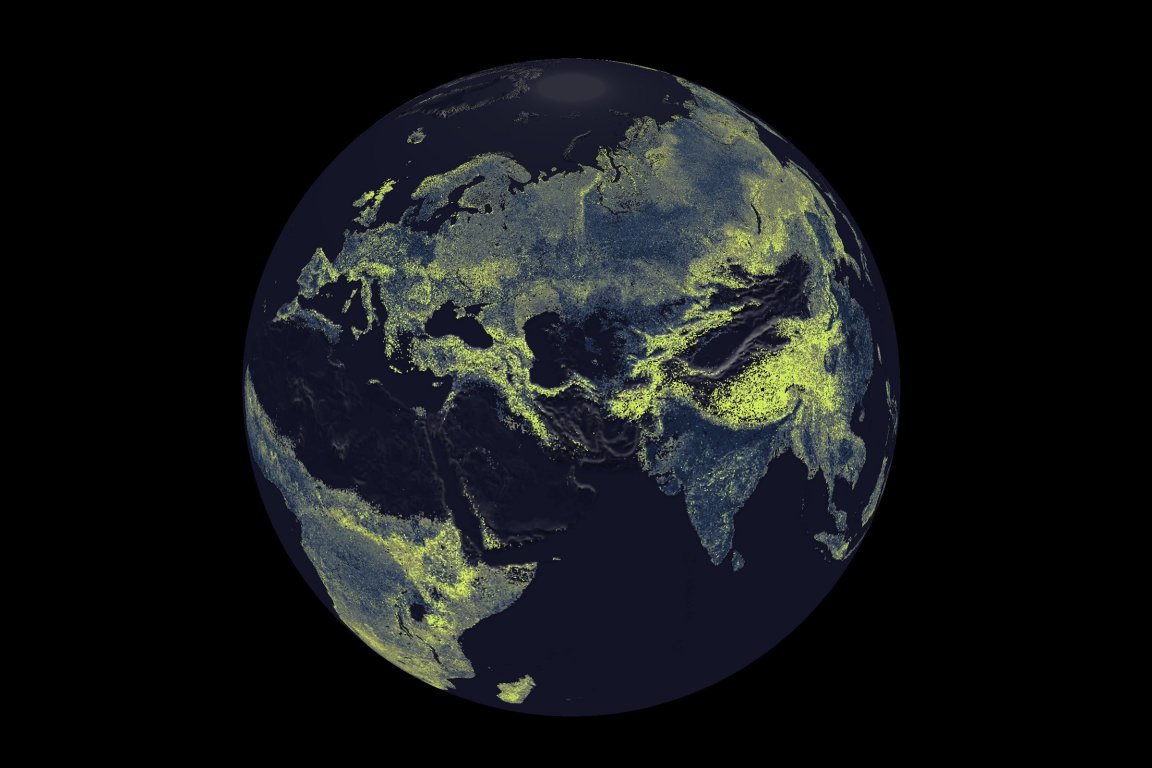
Scientists have mapped the Earth’s entire underground fungal network, showing that it’s so extensive that if it were stretched into a straight line, it would reach other star systems — and span a sizable chunk of the Milky Way galaxy, for that matter.
The groundbreaking work, published in a study in the journal Science, focused on microorganisms known as arbuscular mycorrhizal fungi. Forming the hidden backbone of our planet’s soil, they circulate water and nutrients and regulate the climate by locking away vast stores of carbon.
Altogether, the global fungal network weighs around 300 megatons, the study found, which is four to six times more than the biomass of all human beings. Around 40 percent of that fungal mass resides in high-altitude or flooded grasslands, like the Everglades in Florida.
The authors hope that their work will highlight the indispensable but overlooked role that these fungal networks play in the Earth’s ecosystems, with around 70 percent of all ground-based plant life depending on the fungi.
“People just aren’t paying attention to these ecosystems,” coauthor Toby Kiers, an evolutionary biologist at Vrije University Amsterdam and director of the Society for the Protection of Underground Networks (SPUN), told The New York Times. “What we want to do with these data is really shine a light on some of these hidden patterns underground.”
“I hope this builds into the conversation for their protection because wild grasslands are going away quite quickly,” lead author Justin Stewart, a fellow SPUN biologist, told Live Science. “These are areas that people are really ripping up because it’s much easier to rip up a grass than it is to rip up a tree.”
To unearth this subterranean network, the researchers used data from over 16,000 soil samples across 300 previous papers that calculated the local density of fungal filaments, or hyphae, across the globe. They then fed this data into a machine learning model to predict the density of these hyphal networks per square kilometer of topsoil.
The results were staggering. In all, the model found that the planet is lined with more than 110 quadrillion kilometers of hyphae, or 68 quadrillion miles, which is almost a billion times the distance between the Earth and the Sun. On a cosmic ruler, that equals nearly 12,000 light years, or about a tenth the diameter of our galaxy, which is enough to take you to the Westlund 1 super star cluster.
It’s the clearest picture yet of just how much fungal networks underpin our terrestrial ecosystems. What’s fuzzier from the model, though, is what it says about their health. The density of the fungal networks were about half as lower in soil used for growing crops, but “we don’t know where networks are very healthy and where they’re threatened,” Kiers told the NYT.
More on biology: There’s Something Living Inside Fog, Scientists Find