



惯性聚合 高效追踪和阅读你感兴趣的博客、新闻、科技资讯
阅读原文 在惯性聚合中打开

推荐订阅源

AI
AI
TaoSecurity Blog
TaoSecurity Blog
H
Heimdal Security Blog
Help Net Security
Help Net Security
cs.CV updates on arXiv.org
Microsoft Azure Blog
www.infosecurity-magazine.com
Google DeepMind News
爱范儿
爱范儿
The Cloudflare Blog
OSCHINA 社区最新新闻
OSCHINA 社区最新新闻
人人都是产品经理
人人都是产品经理
大猫的无限游戏
大猫的无限游戏
N
News | PayPal Newsroom
V2EX - 技术
V2EX - 技术
博客园 - 【当耐特】
D
Darknet – Hacking Tools, Hacker News & Cyber Security
S
Secure Thoughts
C
CERT Recently Published Vulnerability Notes
罗磊的独立博客
Exploit-DB.com RSS Feed
钛媒体:引领未来商业与生活新知
钛媒体:引领未来商业与生活新知
P
Privacy & Cybersecurity Law Blog
有赞技术团队
有赞技术团队
S
Schneier on Security
S
SegmentFault 最新的问题
Google Online Security Blog
H
Hacker News: Front Page
The Last Watchdog
The Last Watchdog
Schneier on Security
PCI Perspectives
PCI Perspectives
IT之家
IT之家
Project Zero
Project Zero
博客园 - 司徒正美
P
Privacy International News Feed
Recent Commits to openclaw:main
Jina AI
Jina AI
Security Latest
Security Latest
Hacker News - Newest:
Hacker News - Newest: "LLM"
腾讯CDC
C
CXSECURITY Database RSS Feed - CXSecurity.com
阮一峰的网络日志
阮一峰的网络日志
C
Check Point Blog
aimingoo的专栏
aimingoo的专栏
V
Vulnerabilities – Threatpost
W
WeLiveSecurity
NISL@THU
NISL@THU
Webroot Blog
Webroot Blog
N
Netflix TechBlog - Medium
L
Lohrmann on Cybersecurity

Futurism

Scientists Publish Extremely Serious Research About Whether Tickling Apes Makes Them Giggle Light Pollution is Causing Fish to Live Miserable, Bitter Lives, Researchers Find Earth's Underground Fungus Network Is So Gigantic That If You Stretched It Out, It Would Reach to Other Star Systems We Are Intrigued by This Man Taking His Pet Octopus for a Walk Around His Neighborhood There’s Something Living Inside Fog, Scientists Find Scientists Intrigued by Chunk of Flesh That Refuses to Die After Several Years Scientists Rush to Save One of the World’s Rarest Trees as It Literally Falls Off a Cliff China Launches Synthetic Human Embryos to Space Station NASA Satellite Images Show Huge Colored Plumes Staining the Ocean Frontier AI Models Giving Specific, Actionable Instructions to Perpetrate Bioterror Attack Scientists Say They’ve Figured Out What That Golden Orb Found at the Bottom of the Pacific Ocean Actually Was Man Creates Tiny Submarine for His Parakeet to Experience Life Underwater AI-Powered Tractor Startup Burns Through a Quarter Billion Dollars, Fires All Employees in Epic Implosion JONATHAN THE 193-YEAR-OLD TORTOISE IS STILL ALIVE, REPEAT HE HAS NOT DIED
The Moon Astronauts Brought Along USB Stick-Sized Living Samples of Their Own Tissue
2026-04-03 · via Futurism

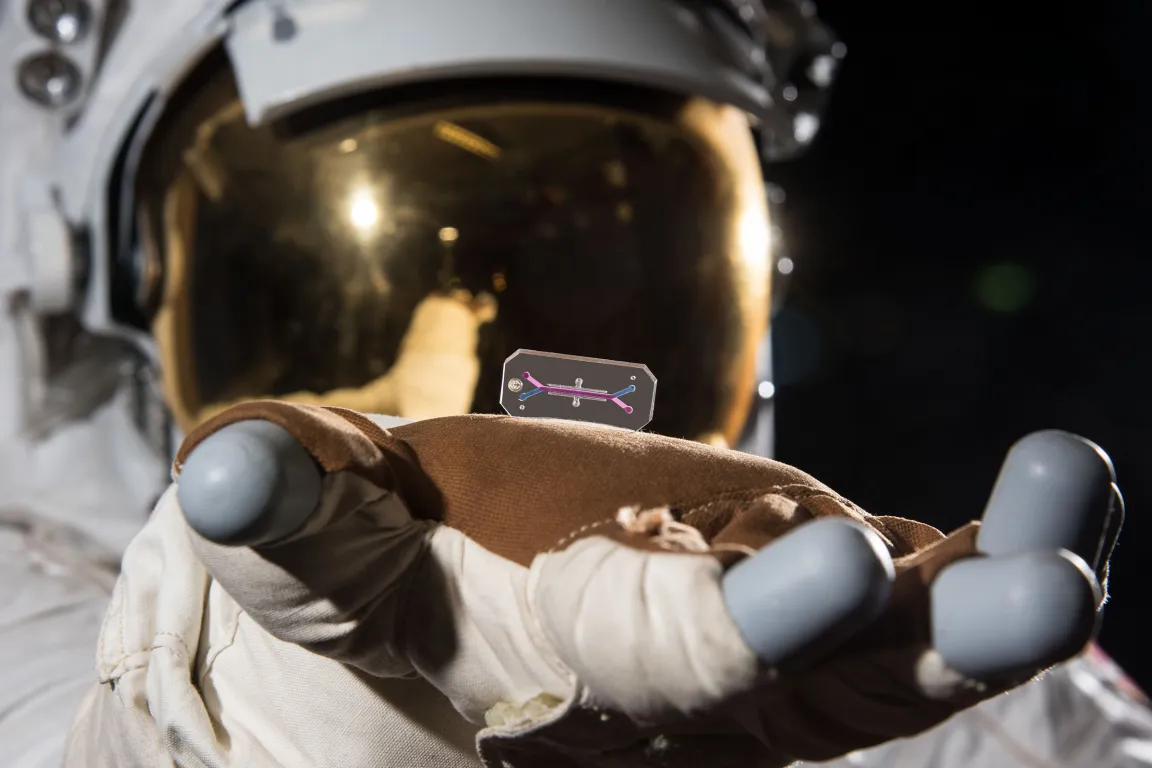
An astronaut wearing a white spacesuit and gold-tinted helmet visor is holding a small, rectangular transparent chip with colored lines and dots on it, resting on the gloved hand. The background is dark, suggesting space.

Josh Valcarcel / NASA

Sign up to see the future, today

Can’t-miss innovations from the bleeding edge of science and tech

Beyond their snazzy flight suits and mango peach smoothies, the crew of NASA’s Artemis II mission is packing something unusual: living mini-organs grown from their own bones.

That bizarre cargo is traveling alongside astronauts Reid Wiseman, Victor Glover, Christina Koch, and Jeremy Hansen, whose 10-day journey will take them around the back side of the Moon and then home again, in the process traveling farther from the Earth than any previous humans.

According to space publication Supercluster, the astronauts are carrying “completely functional” organ chips: organelles composed of bone marrow made from each astronauts’ cells.

In a highly complicated space mission, the justification for taking these organ chips is actually pretty straightforward. In leaving the protection of the Earth’s atmosphere, the four travelers expose themselves to heaps of solar and cosmic radiation. That radiation environment will present a unique window into the kind of dangers future astronauts will face in the dark reaches of space, so researchers are taking as many samples as they can get.

Mini organs aren’t new — scientists have been messing around with them since 2013 — but the decision to map them to their human counterparts in a space mission is.

“This is the first time we’re going to have crew with their matched organ chips,” David Chou, principal investigator of the chip experiment told SC. Having the humans and their micro organs side by side on the same voyage, he says, will enable scientists to compare the two biological materials against each other.

By using bone marrow cells — which are particularly vulnerable to radiation — to produce the chips, researchers are “maximizing the chance that we’ll see biologic differences, as opposed to modeling the skin or something else,” Chuo said.

For good measure, NASA also kicked duplicates of the astronauts’ organ chips up to the International Space Station, in order to compare deep space radiation with low earth orbit radiation over the same period. While they may seem small — and they are, at about the size of a USB stick — data provided by the chips could offer a major leap in our understanding of how the human body reacts to deep space, and at minimal cost, not to mention risk to human beings.

“Being able to understand how a broader representation of the public would respond to spaceflight is something you could do with organ chips much more cost-effectively,” Chou told SC. “You can make hundreds of these and send them up.”

More on NASA: Scientists Investigating Whether Object NASA Is Approaching Is Core of Destroyed Planet