


Sign up to see the future, today
Can’t-miss innovations from the bleeding edge of science and tech
NASA scientists have long been fascinated by how fire behaves in the microgravity of space. They’ve even lit small controlled flames inside Northrop Grumman Cygnus spacecraft to study various flame retardant materials and how fire can spread in the absence of Earth’s gravity.
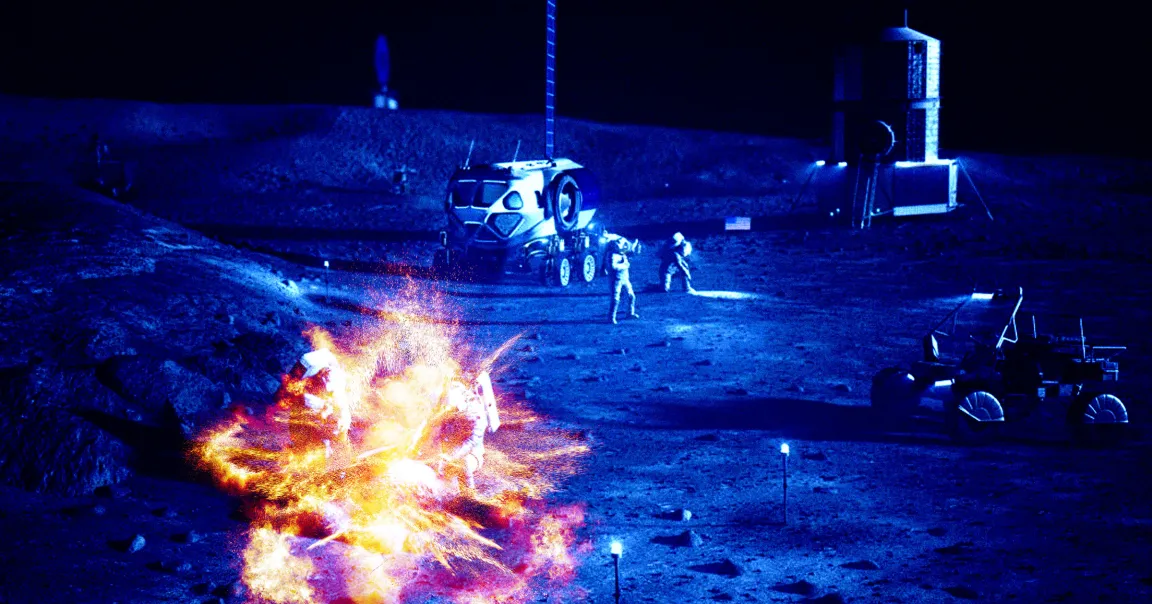
Now, they’re looking to take the potentially lifesaving research a step further. In anticipation of the space agency’s eventual establishment of a permanent presence on the Moon, scientists at NASA revealed plans to test the flammability of materials on the lunar surface, as detailed in a document presented at a recent planetary science conference that was spotted by Universe Today.
As part of an experiment appropriately dubbed Flammability of Materials on the Moon (FM2), the researchers are looking to challenge a standardized test, known as NASA-STD-6001B, which involves holding a six-inch flame to a material to evaluate its safety. If it burns more than six inches up or drips burning debris, it fails the test. The standard is required for the “evaluation, testing, and selection of materials that are intended for use in space vehicles and associated Ground Support Equipment,” according to NASA.
But there’s one glaring problem, as the scientists point out in their latest mission outline: the test is “conducted in normal Earth gravity, with the assumption that if a material passes the 1G test, then it is considered safe for spaceflight.”
However, the partial gravity on the lunar surface could throw our understanding of fire for a loop once again — a crucial question scientists are racing to understand, as an open fire inside a lunar habitat, let alone the tight confines of a spacecraft, could easily prove disastrous.
The scientists suggest that a “material that is marginally non-flammable on Earth” may be “flammable at a lower gravity level.” That’s because a natural phenomenon called blowoff, which is caused by the circular reintroduction of fresh oxygen to sustain the flame sputtering out on Earth, may slow down in partial gravity. In other words, the chemical reactions of the flame may be able to “keep up” in a lunar environment, making a material more flammable there than it is on Earth.
Previous research involving drop towers — essentially letting payloads go from a tower to simulate the effects of weightlessness — and sounding rockets, which are suborbital research vehicles that carry scientific instruments high into the atmosphere, have shown that some partial gravity environments are “expected to increase the flammability limits for some materials,” the researchers noted.
That’s not to mention the oxygen-enriched environments future space explorers on the Moon or Mars may live in, a mix that may help astronauts to breathe, but could help feed fires as well.
To study the phenomenon first-hand — and over a longer period than during a drop tower or sounding rocket test — the researcher propose burning four sold fuel samples inside small, habitable atmospheres on the Moon, with a “planned launch date of late 2026.” Cameras, radiometers, and an oxygen sensor will measure how the fire behaves.
“The tests will provide benchmark data and are part of the larger effort to understand how lunar gravity will affect material flammability,” the researchers noted.
Until we have the chance to establish an extensive presence on the Moon, the scientists argue that a “limited series of tests would enable a comparison between fires on the Moon and Earth.”
The results of the experiment could prove critical for the safety of future space explorers, who may not have the option to evacuate their lunar habitat shelter Moon in case of a fire. Besides, it certainly wouldn’t bode well if it turned out their clothing were to be made out of a material that may not be flammable on Earth — but is on the Moon.
More on space fires: NASA Experiment With Fire in Space Ends When Entire Spacecraft Burns Up