


惯性聚合 高效追踪和阅读你感兴趣的博客、新闻、科技资讯
阅读原文 在惯性聚合中打开

推荐订阅源

The GitHub Blog
The GitHub Blog
K
Kaspersky official blog
Stack Overflow Blog
Stack Overflow Blog
Blog — PlanetScale
Blog — PlanetScale
Recorded Future
Recorded Future
Engineering at Meta
Engineering at Meta
U
Unit 42
D
Docker
I
InfoQ
D
DataBreaches.Net
Google DeepMind News
N
Netflix TechBlog - Medium
C
Check Point Blog
The Cloudflare Blog
美团技术团队
V
Vulnerabilities – Threatpost
博客园_首页
T
Threat Research - Cisco Blogs
Google DeepMind News
Attack and Defense Labs
A
Arctic Wolf
IT之家
IT之家
让小产品的独立变现更简单 - ezindie.com
Exploit-DB.com RSS Feed
T
Troy Hunt's Blog
cs.CL updates on arXiv.org
人人都是产品经理
人人都是产品经理
C
Cyber Attacks, Cyber Crime and Cyber Security
钛媒体:引领未来商业与生活新知
钛媒体:引领未来商业与生活新知
Security Archives - TechRepublic
S
Schneier on Security
Apple Machine Learning Research
MyScale Blog
MyScale Blog
P
Privacy International News Feed
云风的 BLOG
云风的 BLOG
Recent Commits to openclaw:main
T
The Blog of Author Tim Ferriss
GbyAI
GbyAI
The Last Watchdog
The Last Watchdog
D
Darknet – Hacking Tools, Hacker News & Cyber Security
aimingoo的专栏
aimingoo的专栏
P
Proofpoint News Feed
The Register - Security
博客园 - 三生石上(FineUI控件)
Forbes - Security
Forbes - Security
NISL@THU
NISL@THU
Y
Y Combinator Blog
T
Threatpost
Microsoft Azure Blog
L
Lohrmann on Cybersecurity

博客园 - 嘉禾世兴

OpenShift+ArgoCD+Azure Devops 量化交易 PyTorch 循环神经网络(RNN) PyTorch 卷积神经网络 PyTorch神经网络 PyTorch基础 Metplotlib库 集成学习算法 K 近邻算法 决策树算法 逻辑回归算法 线性回归算法 机器学习算法 机器学习 kafka 阿里云Clouder 使用MaxKB和Ollama搭建一个自己的AI大模型 Linux-Prometheus Linux-公有云架构
支持向量机算法
嘉禾世兴 · 2025-07-28 · via 博客园 - 嘉禾世兴

支持向量机(Support Vector Machine,简称 SVM)是一种监督学习算法,主要用于分类和回归问题。

SVM 的核心思想是找到一个最优的超平面,将不同类别的数据分开。这个超平面不仅要能够正确分类数据,还要使得两个类别之间的间隔(margin)最大化。

超平面

  • 在二维空间中,超平面是一个直线。
  • 在三维空间中,超平面是一个平面。
  • 在更高维空间中,超平面是一个分割空间的超平面。

支持向量

  • 支持向量是离超平面最近的样本点。这些支持向量对于定义超平面至关重要。
  • 支持向量机通过最大化支持向量到超平面的距离(即最大化间隔)来选择最佳的超平面。

最大间隔

  • SVM的目标是最大化分类间隔,使得分类边界尽可能远离两类数据点。这可以有效地减少模型的泛化误差。

核技巧(Kernel Trick)

  • 对于非线性可分的数据,SVM使用核函数将数据映射到更高维的空间,在这个空间中,数据可能是线性可分的。
  • 常用的核函数有:线性核、多项式核、径向基函数(RBF)核等。

SVM 分类流程

  1. 选择一个超平面:找到一个能够最大化分类边界的超平面。
  2. 训练支持向量:通过支持向量机算法,选择离超平面最近的样本点作为支持向量。
  3. 通过最大化间隔来找到最优超平面:选择一个最优超平面,使得间隔最大化。
  4. 使用核函数处理非线性问题:通过核函数将数据映射到高维空间来解决非线性可分问题。

使用 Python 中的 scikit-learn 库来实现一个简单的 SVM 分类器

import numpy as np
import matplotlib.pyplot as plt
from sklearn import svm, datasets
from sklearn.model_selection import train_test_split
from sklearn.metrics import accuracy_score

# 加载鸢尾花数据集
iris = datasets.load_iris()
X = iris.data[:, :2]  # 只使用前两个特征
y = iris.target

# 将数据集划分为训练集和测试集
X_train, X_test, y_train, y_test = train_test_split(X, y, test_size=0.3, random_state=42)

# 创建SVM分类器
clf = svm.SVC(kernel='linear')  # 使用线性核函数

# 训练模型
clf.fit(X_train, y_train)

# 在测试集上进行预测
y_pred = clf.predict(X_test)

# 计算准确率
accuracy = accuracy_score(y_test, y_pred)
print(f"模型准确率: {accuracy:.2f}")

# 绘制决策边界
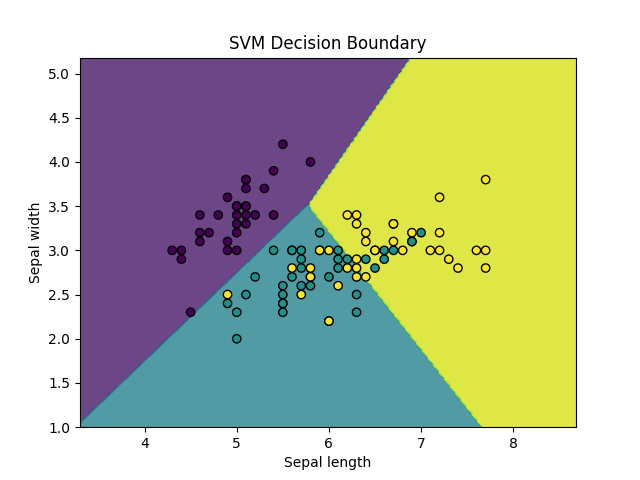
def plot_decision_boundary(X, y, model):
    h = .02  # 网格步长
    x_min, x_max = X[:, 0].min() - 1, X[:, 0].max() + 1
    y_min, y_max = X[:, 1].min() - 1, X[:, 1].max() + 1
    xx, yy = np.meshgrid(np.arange(x_min, x_max, h),
                         np.arange(y_min, y_max, h))
    Z = model.predict(np.c_[xx.ravel(), yy.ravel()])
    Z = Z.reshape(xx.shape)
    plt.contourf(xx, yy, Z, alpha=0.8)
    plt.scatter(X[:, 0], X[:, 1], c=y, edgecolors='k', marker='o')
    plt.xlabel('Sepal length')
    plt.ylabel('Sepal width')
    plt.title('SVM Decision Boundary')
    plt.show()

plot_decision_boundary(X_train, y_train, clf)
image