










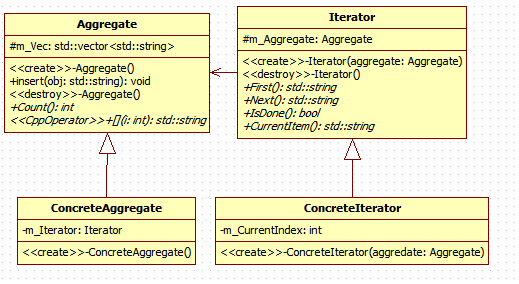
迭代器模式(Iterator),提供一种方法顺序访问一个聚合对象中各个元素,而又不暴露该对象的内部表示。
#include <string>
#include <vector>

class Aggregate
{
public:
    Aggregate();
    void insert(std::string obj);
    virtual ~Aggregate();
    virtual int Count() = 0;
    virtual std::string& operator[](int i) = 0;

protected:
    std::vector<std::string>        m_Vec;
};
#include "aggregate.h"

Aggregate::Aggregate()
{

}

Aggregate::~Aggregate()
{

}

void Aggregate::insert(std::string obj)
{
    m_Vec.push_back(obj);
}
#include "aggregate.h"

class Iterator
{
public:
    Iterator(Aggregate* aggregate);
    virtual ~Iterator();
    virtual std::string First() = 0;
    virtual std::string Next() = 0;
    virtual bool IsDone() = 0;
    virtual std::string CurrentItem() = 0;

protected:
    Aggregate*      m_Aggregate;
};
#include "iterator.h"
#include "aggregate.h"

class ConcreteIterator : public Iterator
{
public:
    ConcreteIterator(Aggregate* aggredate);
    std::string First() override;
    std::string Next() override;
    bool IsDone() override;
    std::string CurrentItem() override;

private:
    int     m_CurrentIndex;
};
#include <iostream>
#include "concreteiterator.h"

ConcreteIterator::ConcreteIterator(Aggregate* aggredate)
    :Iterator(aggredate)
{
    m_CurrentIndex = 0;
}

std::string ConcreteIterator::First()
{
    return (*m_Aggregate)[0];
}

std::string ConcreteIterator::Next()
{
    m_CurrentIndex++;
    if(m_CurrentIndex < m_Aggregate->Count())
        return (*m_Aggregate)[m_CurrentIndex];
    else
        return "";
}

bool ConcreteIterator::IsDone()
{
    return m_CurrentIndex >= m_Aggregate->Count() ? true : false;
}

std::string ConcreteIterator::CurrentItem()
{
    return (*m_Aggregate)[m_CurrentIndex];
}
#include <aggregate.h>
#include <string>
#include "iterator.h"

class ConcreteAggregate : public Aggregate
{
public:
    ConcreteAggregate();
    int Count() override;
    std::string &operator[](int i) override;

private:
    Iterator*       m_Iterator;
};
#include "concreteaggregate.h"

ConcreteAggregate::ConcreteAggregate()
{
}

int ConcreteAggregate::Count()
{
    return static_cast<int>(m_Vec.size());
}

std::string& ConcreteAggregate::operator[](int i)
{
    return m_Vec[size_t(i)];
}
#include <iostream>
#include "concreteaggregate.h"
#include "concreteiterator.h"
using namespace std;

int main()
{
    Aggregate* agt =  new ConcreteAggregate();
    agt->insert("王二麻子");
    agt->insert("张二蛋子");
    agt->insert("李二狗子");
    agt->insert("王小花儿");

    Iterator* i = new ConcreteIterator(agt);
    while(!i->IsDone())
    {
        std::cout << i->CurrentItem() << " 请出示您的车票!" << std::endl;
        i->Next();
    }
    return 0;
}
王二麻子 请出示您的车票!
张二蛋子 请出示您的车票!
李二狗子 请出示您的车票!
王小花儿 请出示您的车票!
迭代器模式的优点
模式的缺点
此内容由惯性聚合(RSS阅读器)自动聚合整理,仅供阅读参考。 原文来自 — 版权归原作者所有。