






atomic_int id;
atomic_fetch_add(&id, 1)
atomic_uint id;
atomic_fetch_add(&id, 1)
以上是两种原子自增简单非常常见用法. 但和业务联动时候存在潜在问题. 例如第一段代码中 atomic_fetch_add(&id, 1) 这种 id++
加到最后会溢出, 需要看业务能否接受了. 第二种死板一点, 也是一样看业务取舍, 例如杂糅一些特殊业务值非常困难.
https://github.com/cloudwu/skynet/blob/master/skynet-src/socket_server.c#L345-L371
static int
reserve_id(struct socket_server *ss) {
    int i;
    for (i=0;i<MAX_SOCKET;i++) {
        int id = ATOM_FINC(&(ss->alloc_id))+1;
        if (id < 0) {
            id = ATOM_FAND(&(ss->alloc_id), 0x7fffffff) & 0x7fffffff;
        }
        struct socket *s = &ss->slot[HASH_ID(id)];
        int type_invalid = ATOM_LOAD(&s->type);
        if (type_invalid == SOCKET_TYPE_INVALID) {
            if (ATOM_CAS(&s->type, type_invalid, SOCKET_TYPE_RESERVE)) {
                s->id = id;
                s->protocol = PROTOCOL_UNKNOWN;
                // socket_server_udp_connect may inc s->udpconncting directly (from other thread, before new_fd),
                // so reset it to 0 here rather than in new_fd.
                ATOM_INIT(&s->udpconnecting, 0);
                s->fd = -1;
                return id;
            } else {
                // retry
                --i;
            }
        }
    }
    return -1;
}
其中 ATOM_FINC, ATOM_FAND 设计如下
https://github.com/cloudwu/skynet/blob/master/skynet-src/atomic.h
#else

#include <stdatomic.h>

#define ATOM_INT atomic_int
#define ATOM_POINTER atomic_uintptr_t
#define ATOM_SIZET atomic_size_t
#define ATOM_ULONG atomic_ulong
#define ATOM_INIT(ref, v) atomic_init(ref, v)
#define ATOM_LOAD(ptr) atomic_load(ptr)
#define ATOM_STORE(ptr, v) atomic_store(ptr, v)
#define ATOM_CAS(ptr, oval, nval) atomic_compare_exchange_weak(ptr, &(oval), nval)
#define ATOM_CAS_POINTER(ptr, oval, nval) atomic_compare_exchange_weak(ptr, &(oval), nval)
#define ATOM_FINC(ptr) atomic_fetch_add(ptr, 1)
#define ATOM_FDEC(ptr) atomic_fetch_sub(ptr, 1)
#define ATOM_FADD(ptr,n) atomic_fetch_add(ptr, n)
#define ATOM_FSUB(ptr,n) atomic_fetch_sub(ptr, n)
#define ATOM_FAND(ptr,n) atomic_fetch_and(ptr, n)

#endif
他的思路是, 通过 atomic_fetch_and 来避免 atomic_fetch_add 溢出问题. 但也存在一个问题, 就是 atomic_fetch_and 存在返回相同值情况,
所以返回的 id 会重复. 这里他借助 atomic_compare_exchange_weak + 业务判断 让重复 id 再次重试.
这里还有个小彩蛋 if (ATOM_CAS(&s->type, type_invalid, SOCKET_TYPE_RESERVE)) 使用 weak 版本而不是 strong 版本讨论
https://github.com/cloudwu/skynet/discussions/1532
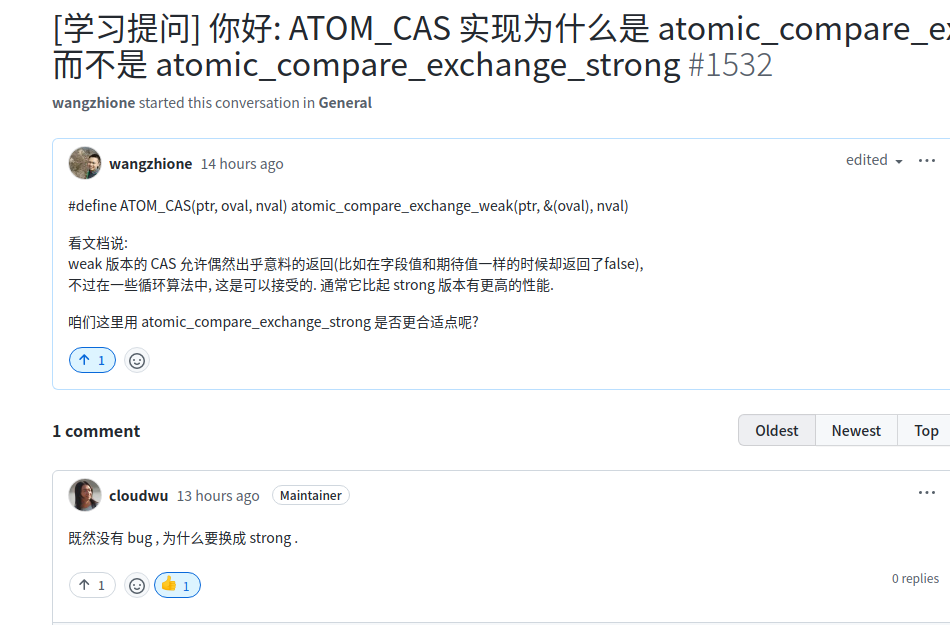
业务上自己推荐 atomic_compare_exchange_strong 心里更稳一点. 我们再简单观察 glibc 和 gcc 中二者实现.
#define atomic_compare_exchange_strong_explicit(PTR, VAL, DES, SUC, FAIL) \
  __extension__                                \
  ({                                    \
    __auto_type __atomic_compare_exchange_ptr = (PTR);            \
    __typeof__ (*__atomic_compare_exchange_ptr) __atomic_compare_exchange_tmp \
      = (DES);                                \
    __atomic_compare_exchange (__atomic_compare_exchange_ptr, (VAL),    \
                   &__atomic_compare_exchange_tmp, 0,    \
                   (SUC), (FAIL));                \
  })

#define atomic_compare_exchange_strong(PTR, VAL, DES)                \
  atomic_compare_exchange_strong_explicit (PTR, VAL, DES, __ATOMIC_SEQ_CST, \
                       __ATOMIC_SEQ_CST)

#define atomic_compare_exchange_weak_explicit(PTR, VAL, DES, SUC, FAIL) \
  __extension__                                \
  ({                                    \
    __auto_type __atomic_compare_exchange_ptr = (PTR);            \
    __typeof__ (*__atomic_compare_exchange_ptr) __atomic_compare_exchange_tmp \
      = (DES);                                \
    __atomic_compare_exchange (__atomic_compare_exchange_ptr, (VAL),    \
                   &__atomic_compare_exchange_tmp, 1,    \
                   (SUC), (FAIL));                \
  })

#define atomic_compare_exchange_weak(PTR, VAL, DES)            \
  atomic_compare_exchange_weak_explicit (PTR, VAL, DES, __ATOMIC_SEQ_CST, \
                     __ATOMIC_SEQ_CST)
区别在于 __atomic_compare_exchange 的 第 4 个参数上面, 用 1 标识 weak 调用, 0 默认 strong 调用.
例如 gcc 一种实现
https://code.woboq.org/gcc/libgcc/config/tilepro/atomic.c.html#164
#define __atomic_exchange_methods(type, size) \
bool
_atomic_compare_exchange##size(volatile type* ptr, type* oldvalp,
type newval, bool weak __unused,
int models, int modelf __unused)
weak 是 unused 未被使用的. 所以有些平台最终殊途同归, 类似 PF_INET 和 AF_INET 茴香豆几种写法.
https://github.com/wangzhione/structc/blob/master/modular/test/timer.c.h#L28-L56
// timer_list 链表对象管理器
struct timer_list {
    atomic_int id;            // 当前 timer node id
    atomic_flag lock;         // 自旋锁
    volatile bool status;     // true is thread loop, false is stop
    struct timer_node * list; // timer list list
};

// 定时器管理单例对象
static struct timer_list timer = { .id = 1, .lock = ATOMIC_FLAG_INIT };

// get atomic int 1 -> INT_MAX -> 1
static inline int timer_list_id() {
    // 0 -> INT_MAX -> INT_MIN -> 0
    int id = atomic_fetch_add(&timer.id, 1) + 1;
    if (id < 0) {
        // INT_MAX + 1 -> INT_MIN
        // 0x7F FF FF FF + 1 -> 0x80 00 00 00

        // INT_MIN & INT_MAX => 0x80 00 00 00 & 0x7F FF FF FF => 0x00 00 00 00
        // id = atomic_fetch_and(&timer.id, INT_MAX) & INT_MAX;
        // Multiple operations atomic_fetch_and can ensure timer.id >= 0
        atomic_fetch_and(&timer.id, INT_MAX);

        // again can ensure id >= 1
        id = atomic_fetch_add(&timer.id, 1) + 1;
    }
    return id;
}
这个设计把 id 分为三段, < 0 , 0, 还有 > 0 . timer_list_id 函数返回 >= 1 id. 这里利用二次 atomic_fetch_add 原子自增同时继续保持不重复性.
技巧多为想法和需求服务, 欢迎补充更多原子操作用法.

此内容由惯性聚合(RSS阅读器)自动聚合整理,仅供阅读参考。 原文来自 — 版权归原作者所有。