



惯性聚合 高效追踪和阅读你感兴趣的博客、新闻、科技资讯
阅读原文 在惯性聚合中打开

推荐订阅源

美团技术团队
W
WeLiveSecurity
Stack Overflow Blog
Stack Overflow Blog
L
LangChain Blog
S
SegmentFault 最新的问题
Apple Machine Learning Research
Google DeepMind News
F
Full Disclosure
奇客Solidot–传递最新科技情报
奇客Solidot–传递最新科技情报
The Register - Security
G
Google Developers Blog
C
Check Point Blog
GbyAI
GbyAI
A
About on SuperTechFans
V
Vulnerabilities – Threatpost
T
The Blog of Author Tim Ferriss
T
Tor Project blog
AWS News Blog
AWS News Blog
Cyberwarzone
Cyberwarzone
C
CERT Recently Published Vulnerability Notes
MongoDB | Blog
MongoDB | Blog
Latest news
Latest news
aimingoo的专栏
aimingoo的专栏
U
Unit 42
Y
Y Combinator Blog
P
Privacy International News Feed
Cisco Talos Blog
Cisco Talos Blog
S
Securelist
S
Schneier on Security
雷峰网
雷峰网
cs.CV updates on arXiv.org
Attack and Defense Labs
P
Proofpoint News Feed
C
Cisco Blogs
Webroot Blog
Webroot Blog
T
Troy Hunt's Blog
Google Online Security Blog
月光博客
月光博客
P
Privacy & Cybersecurity Law Blog
Security Archives - TechRepublic
罗磊的独立博客
Cloudbric
Cloudbric
钛媒体:引领未来商业与生活新知
钛媒体:引领未来商业与生活新知
Recent Commits to openclaw:main
Application and Cybersecurity Blog
Hacker News: Ask HN
Hacker News: Ask HN
H
Hackread – Cybersecurity News, Data Breaches, AI and More
博客园 - 司徒正美
freeCodeCamp Programming Tutorials: Python, JavaScript, Git & More
Microsoft Security Blog

Blog — PlanetScale

Keeping a Postgres queue healthy — PlanetScale Patterns for Postgres Traffic Control — PlanetScale Graceful degradation in Postgres — PlanetScale High memory usage in Postgres is good, actually — PlanetScale Stripe Projects partnership: Provision PlanetScale Postgres and MySQL databases from the Stripe CLI — PlanetScale Enhanced tagging in Postgres Query Insights — PlanetScale Behind the scenes: How Database Traffic Control works — PlanetScale Introducing Database Traffic Control — PlanetScale Scaling Postgres connections with PgBouncer — PlanetScale Drizzle joins PlanetScale — PlanetScale Video Conferencing with Postgres — PlanetScale Faster PlanetScale Postgres connections with Cloudflare Hyperdrive — PlanetScale Introducing the PlanetScale MCP server — PlanetScale Database Transactions — PlanetScale Automating our changelog with Cursor commands — PlanetScale Postgres 18 is now available — PlanetScale Using MotherDuck with PlanetScale — PlanetScale $50 PlanetScale Metal is GA for Postgres — PlanetScale AI-Powered Postgres index suggestions — PlanetScale $5 PlanetScale is live — PlanetScale Announcing Vitess 23 — PlanetScale $50 PlanetScale Metal — PlanetScale Report on our investigation of the 2025-10-20 incident in AWS us-east-1 — PlanetScale $5 PlanetScale — PlanetScale Benchmarking Postgres 17 vs 18 — PlanetScale Larger than RAM Vector Indexes for Relational Databases — PlanetScale Partnering with Cloudflare to bring you the fastest globally distributed applications — PlanetScale Processes and Threads — PlanetScale PlanetScale for Postgres is now GA — PlanetScale Postgres High Availability with CDC — PlanetScale Announcing Neki — PlanetScale Caching — PlanetScale The principles of extreme fault tolerance — PlanetScale Announcing PlanetScale for Postgres — PlanetScale Benchmarking Postgres — PlanetScale Announcing Vitess 22 — PlanetScale The Real Failure Rate of EBS — PlanetScale IO devices and latency — PlanetScale Announcing PlanetScale Metal — PlanetScale PlanetScale Metal: There’s no replacement for displacement — PlanetScale Upgrading Query Insights to Metal — PlanetScale Automating cherry-picks between OSS and private forks — PlanetScale Database Sharding — PlanetScale Anatomy of a Throttler, part 3 — PlanetScale Introducing sharding on PlanetScale with workflows — PlanetScale Announcing Vitess 21 — PlanetScale Announcing the PlanetScale vectors public beta — PlanetScale Anatomy of a Throttler, part 2 — PlanetScale Instant deploy requests — PlanetScale Anatomy of a Throttler, part 1 — PlanetScale Increase IOPS and throughput with sharding — PlanetScale Tracking index usage with Insights — PlanetScale Faster backups with sharding — PlanetScale Building data pipelines with Vitess — PlanetScale The State of Online Schema Migrations in MySQL — PlanetScale Optimizing aggregation in the Vitess query planner — PlanetScale Dealing with large tables — PlanetScale Announcing Vitess 20 — PlanetScale Self-managed Vitess vs Managed Vitess with PlanetScale — PlanetScale Achieving data consistency with the consistent lookup Vindex — PlanetScale The MySQL adaptive hash index — PlanetScale Introducing global replica credentials — PlanetScale Profiling memory usage in MySQL — PlanetScale Summer 2023: Fuzzing Vitess at PlanetScale — PlanetScale How PlanetScale makes schema changes — PlanetScale Identifying and profiling problematic MySQL queries — PlanetScale The Problem with Using a UUID Primary Key in MySQL — PlanetScale Announcing Vitess 19 — PlanetScale PlanetScale forever — PlanetScale Introducing schema recommendations — PlanetScale Amazon Aurora Pricing: The many surprising costs of running an Aurora database — PlanetScale Three common MySQL database design mistakes — PlanetScale OAuth applications are now available to everyone — PlanetScale Deprecating the Scaler plan — PlanetScale PlanetScale branching vs. Amazon Aurora blue/green deployments — PlanetScale Databases at scale — PlanetScale Considerations for building a database disaster recovery plan — PlanetScale Working with Geospatial Features in MySQL — PlanetScale PlanetScale vs Amazon Aurora replication — PlanetScale Introducing the Vantage and PlanetScale integration — PlanetScale MySQL isolation levels and how they work — PlanetScale Introducing the schemadiff command line tool — PlanetScale $ pscale ping — PlanetScale Announcing foreign key constraints support — PlanetScale The challenges of supporting foreign key constraints — PlanetScale What is HTAP? — PlanetScale Introducing Insights Anomalies — PlanetScale Webhook security: a hands-on guide — PlanetScale Announcing the Fivetran integration — PlanetScale Introducing webhooks — PlanetScale What is MySQL replication and when should you use it? — PlanetScale Sync user data between Clerk and a PlanetScale MySQL database — PlanetScale Introducing database reports — PlanetScale Distributed caching systems and MySQL — PlanetScale What is MySQL partitioning? — PlanetScale MySQL High Availability: Connection handling and concurrency — PlanetScale Personalizing your onboarding with Markdoc — PlanetScale PlanetScale vs. Amazon Aurora — PlanetScale PlanetScale vs. Amazon RDS — PlanetScale PlanetScale is bringing vector search and storage to MySQL — PlanetScale
Sharding strategies: directory-based, range-based, and hash-based — PlanetScale
Holly Guevar · 2024-07-08 · via Blog — PlanetScale

Holly Guevara [@hollylawly] |

In the past, sharding was often a last resort for scaling a growing a database. With solutions like Vitess and PlanetScale, it's much less intimidating to shard your database. However, even with our in-dashboard sharding options, it's still not exactly as simple as clicking a button.

When it's time to shard, you'll still have to come up with a sharding strategy — the procedure the database uses to distribute incoming data across shards. There's a lot that goes into this, and which we'll cover in a short series of posts.

In this article, we'll start by covering some of the different types of sharding you can do: directory or lookup-based, range-based, and hash-based.

Note

For a condensed overview of sharding strategies, you should also check out the Sharding Strategies lesson in our Database Scaling course.

Directory-based sharding

With directory-based sharding, also known as lookup-based sharding, you map your shards with something called a lookup table.

For example, if you want to shard a table based on region so that all rows in a certain region end up on the same shard, you can set up a lookup table that maps that region to the specific shard.

Let’s say we have this members table here that has name and court columns. In this example, court is essentially the region that the member is from. We want to split them up by court, so we create a lookup table that maps each court to a shard.
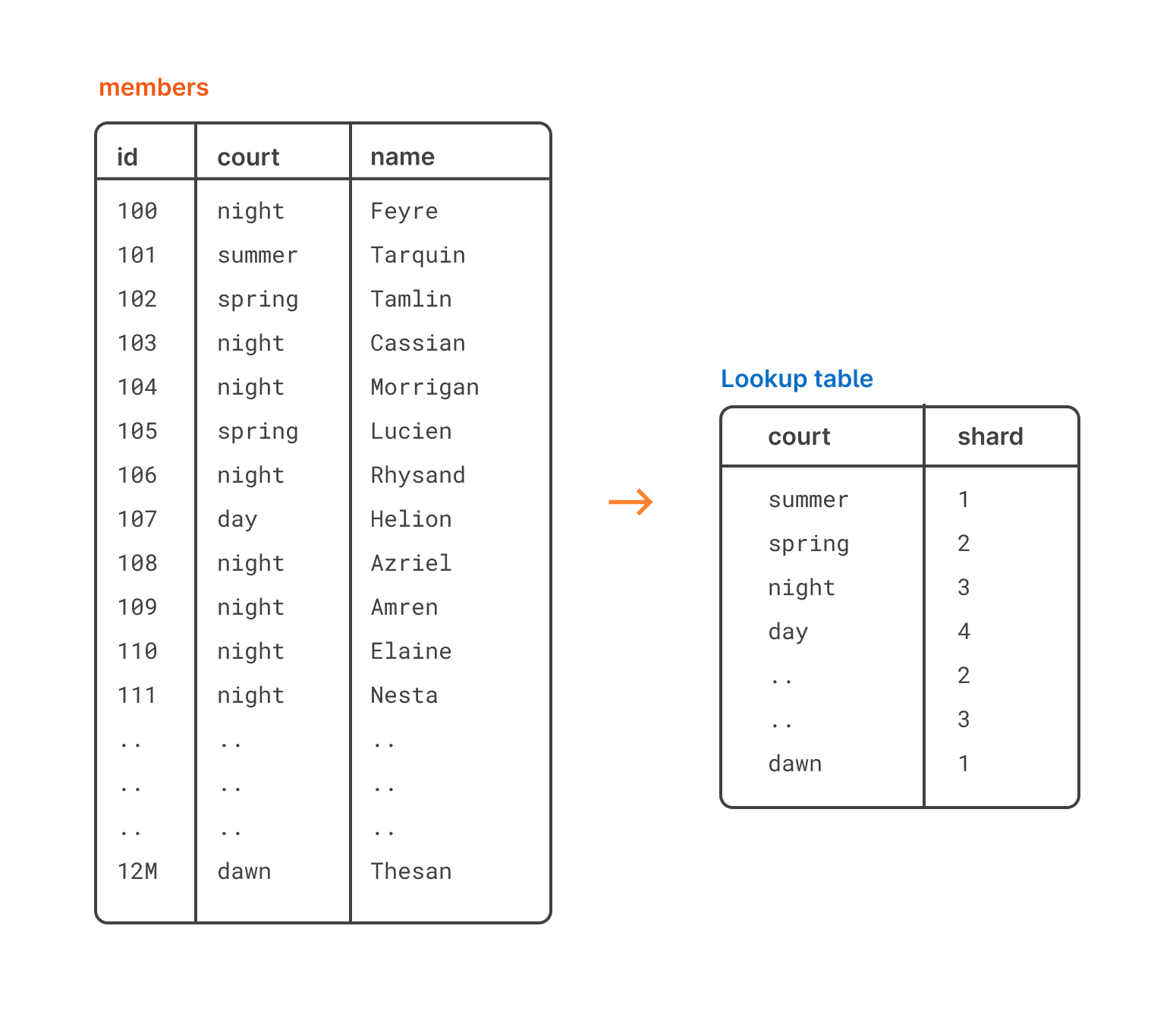
Lookup-based sharding table to lookup table

In this case, we’re using the court column as our shard key. The shard key is the chosen column that will be used as the basis for sharding the table.

After sharding using this technique, the data will be distributed like this:
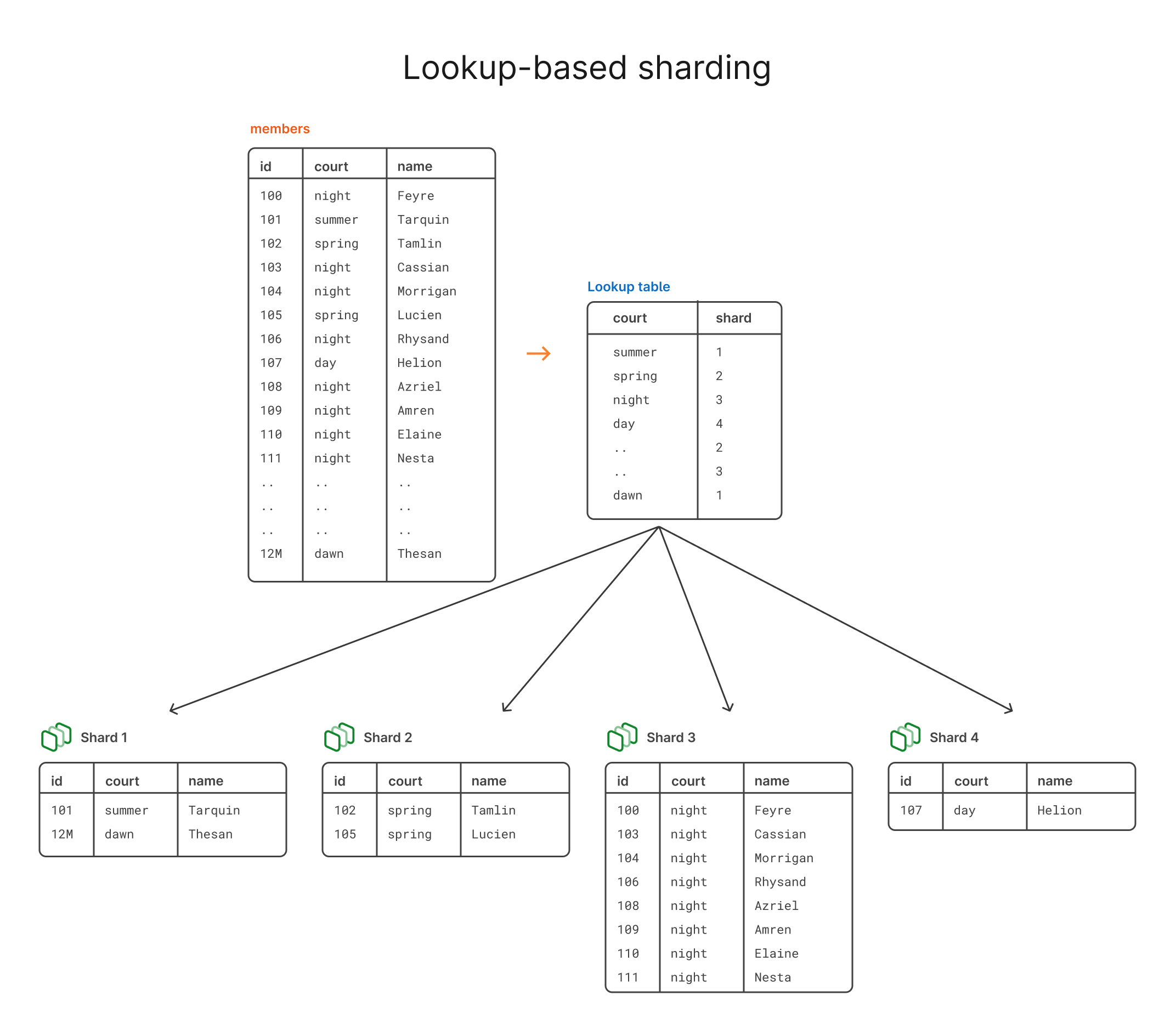
Lookup-based sharding example

Pros and cons of directory-based sharding

This can be a great option if you have very specific criteria for separating your data onto different shards. It also makes it pretty simple to add new courts, if needed. If we suddenly have 4 new courts join, we can just spin up 4 new shards if the dataset is large enough or if we want to stay on 4 shards, we can assign the new courts to one of the existing shards by throwing them in the lookup table.

There are, however, some downsides to this method. As you can imagine, if one court has significantly more members than another, you risk having one shard that’s much larger than the others. Additionally, if one court has one or several members that are much more active in whatever you’re doing, you can create a hotspot where that shard is being accessed much more frequently than the others. In short, data distribution can become a problem.

You also have the added factor of the lookup table itself, which results in an extra query every time you need to read or write a row. Before you do anything, you have to first consult the lookup table to see where something lives. In practice, you’d want to heavily cache the lookup table to make it faster, but you’ll still have that extra step regardless.

Range-based sharding

Range-based sharding is another type of sharding strategy that involves splitting up your shard mapping based on a range of values. This is a silly example, but let's say we wanted to shard based on the name column in that members table — so using name as the shard key.

We want any name where the first letter starts with A-G to go to shard 1, H-N to go to shard 2, and so on.

With this sharding strategy, the rows of the table would be distributed like this:
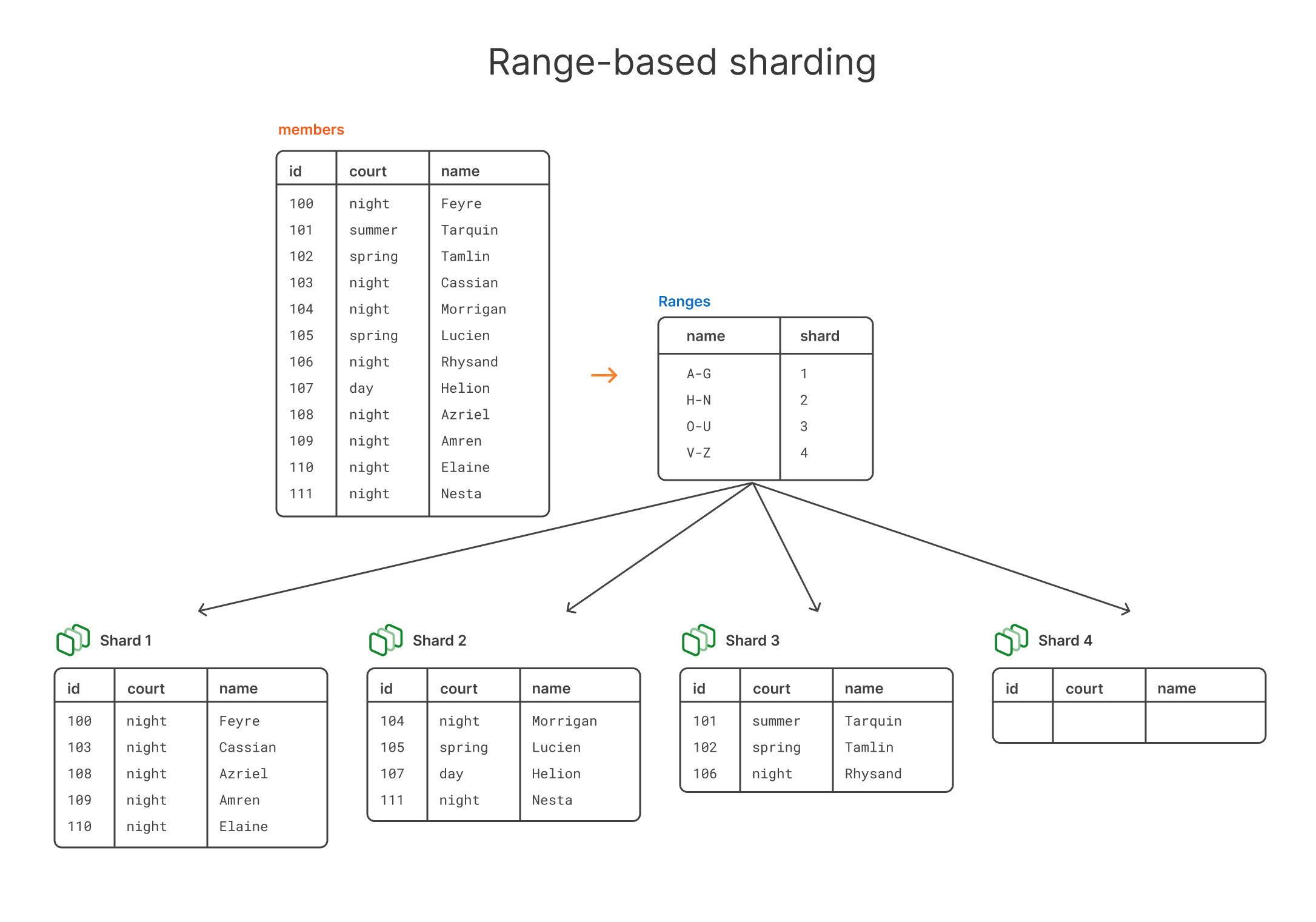
Range-based sharding example

Pros and cons of range-based sharding

The problem with this setup should be immediately clear. Depending on how you’re picking these ranges, you can easily overload shards. In this case, shard 1 has 5 records in it while shard 4 has 0. This is of course because certain letters occur much more frequently as the first letter in a name.

This is one of the downsides of range-based sharding, but there are definitely ways to avoid it. For example, if we started with this method for mapping the ranges, but then quickly noticed that shard 1 was growing much faster than the others, we may decide to break shard 1 up into multiple shards with a reshard operation. We can also make the range for the last shard larger since those letters happen less frequently.
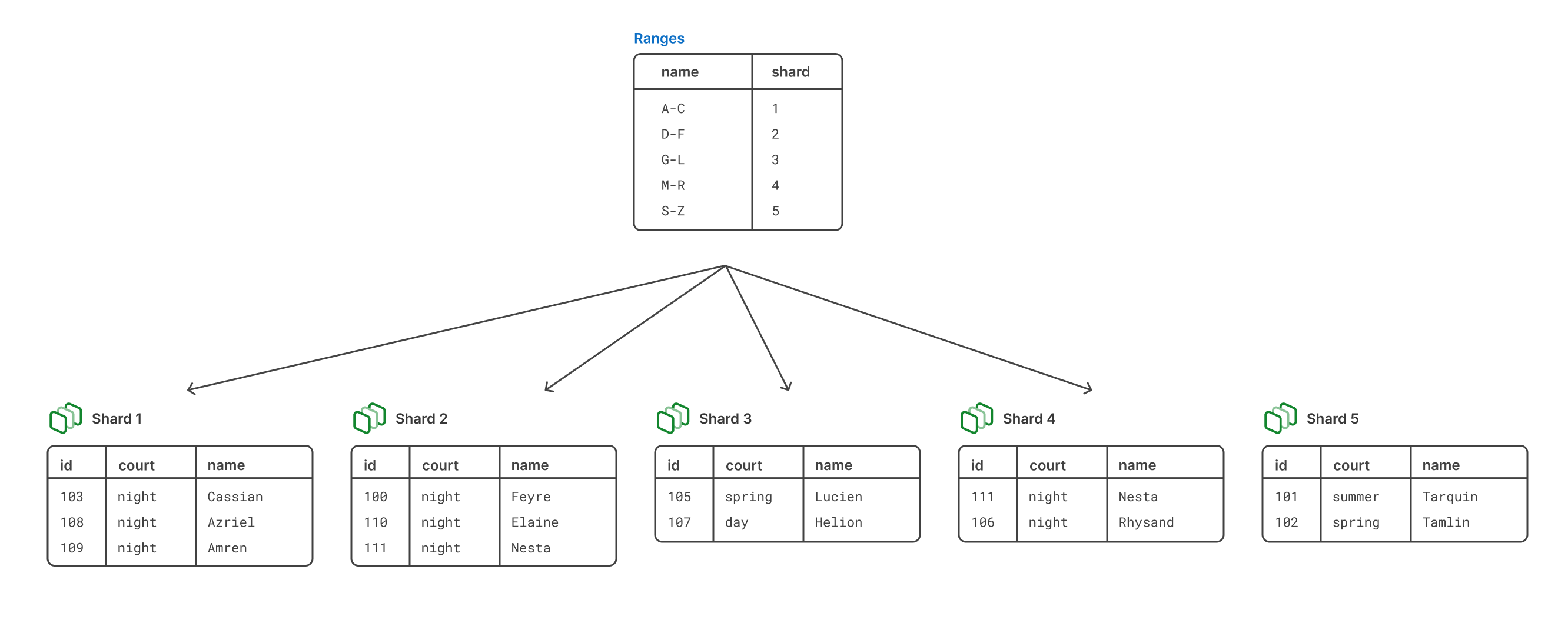
Range-based sharding example resharded

Overall, it’s a relatively simple approach for sharding and gives you a meaningful way to map data to shards.

Hash-based sharding

The final type of sharding we’re going to discuss is hash-based sharding. With this method, you decide which shard key you want to use, then run that value through a hash function. You then shard based on the output of the hash function.

It’s similar in a way to range-based sharding, but this time, we’re using an alphanumeric range instead of say letter-based in the previous example.

For this example, let’s say we have an id for each court member in our members table, and we want to use this id as our shard key. We’re going to run that id through an md5 hash function, and then distribute the output across 4 shards.
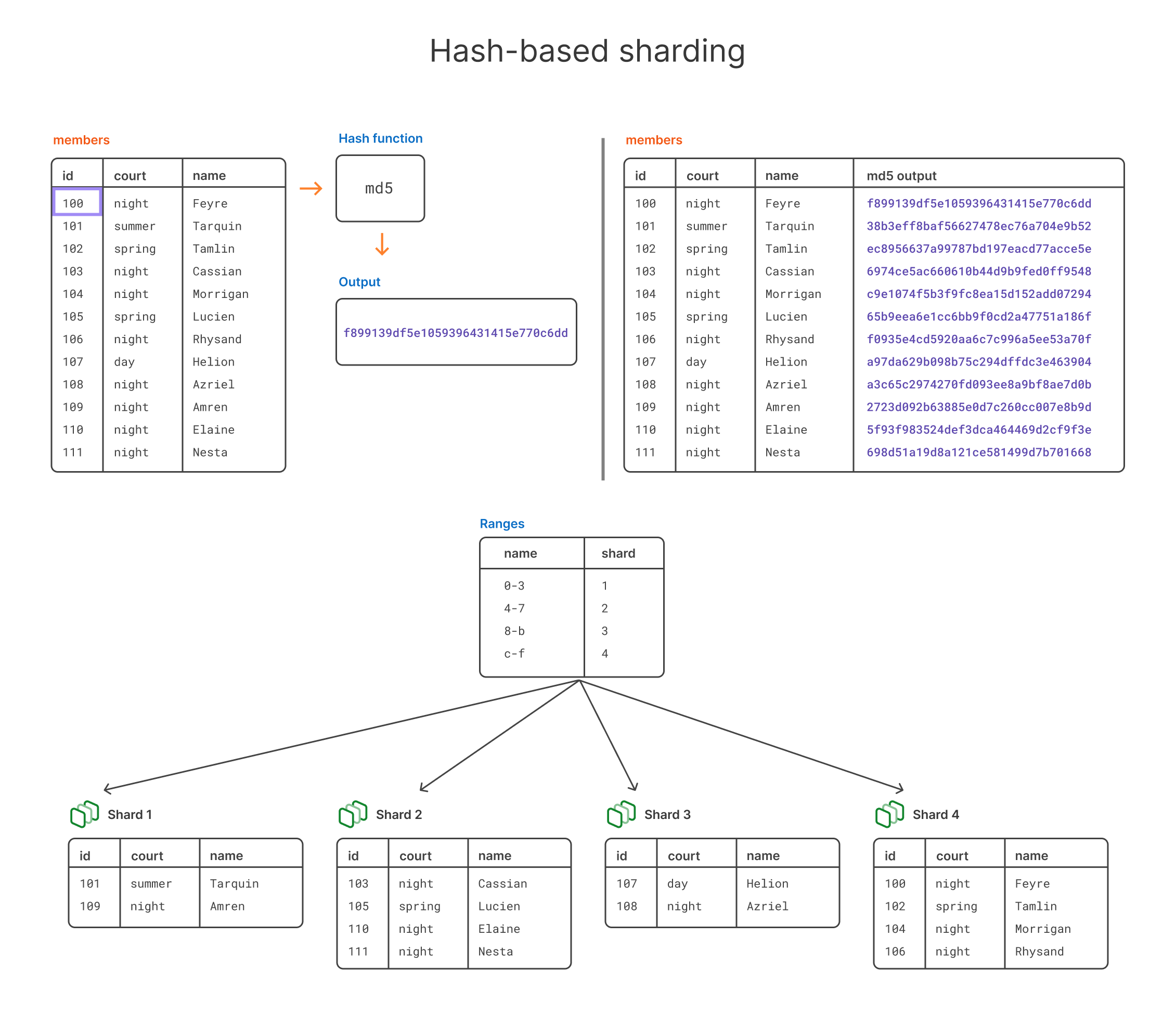
Hash-based sharding example

Pros and cons of hash-based sharding

One of the pros of this method are that you’re taking human guesswork out of the equation. Rather than relying on a human to guess at how much data will fall into each range, the hash will keep the data evenly distributed, so long as the shard key has high cardinality. There’s less chance of overloading a shard because you’re distributing the data based on a well-proven hash function. However, you still have to put some thought into what shard key you choose here, as you want it to work well with the data access patterns of your application.

With this method, it’s also a bit easier to reshard if you find that certain shards are taking more of a hit than others. The main downside is having the extra hashing step, but in practice, this isn't usually a huge deal.

Comparison of sharding types

You may be wondering how you can decide which type of sharding to go with. At PlanetScale, we typically steer customers toward hash-based sharding as the default. It generally gives you the most even distribution and isn't overly complicated.

The diagram below shows what the distribution looked like in our small example. In this case, hash-based sharding resulted in the most even distribution. Of course, this is a tiny example and not a realistic sharding scenario given the size, but in general this holds true in larger datasets as well.
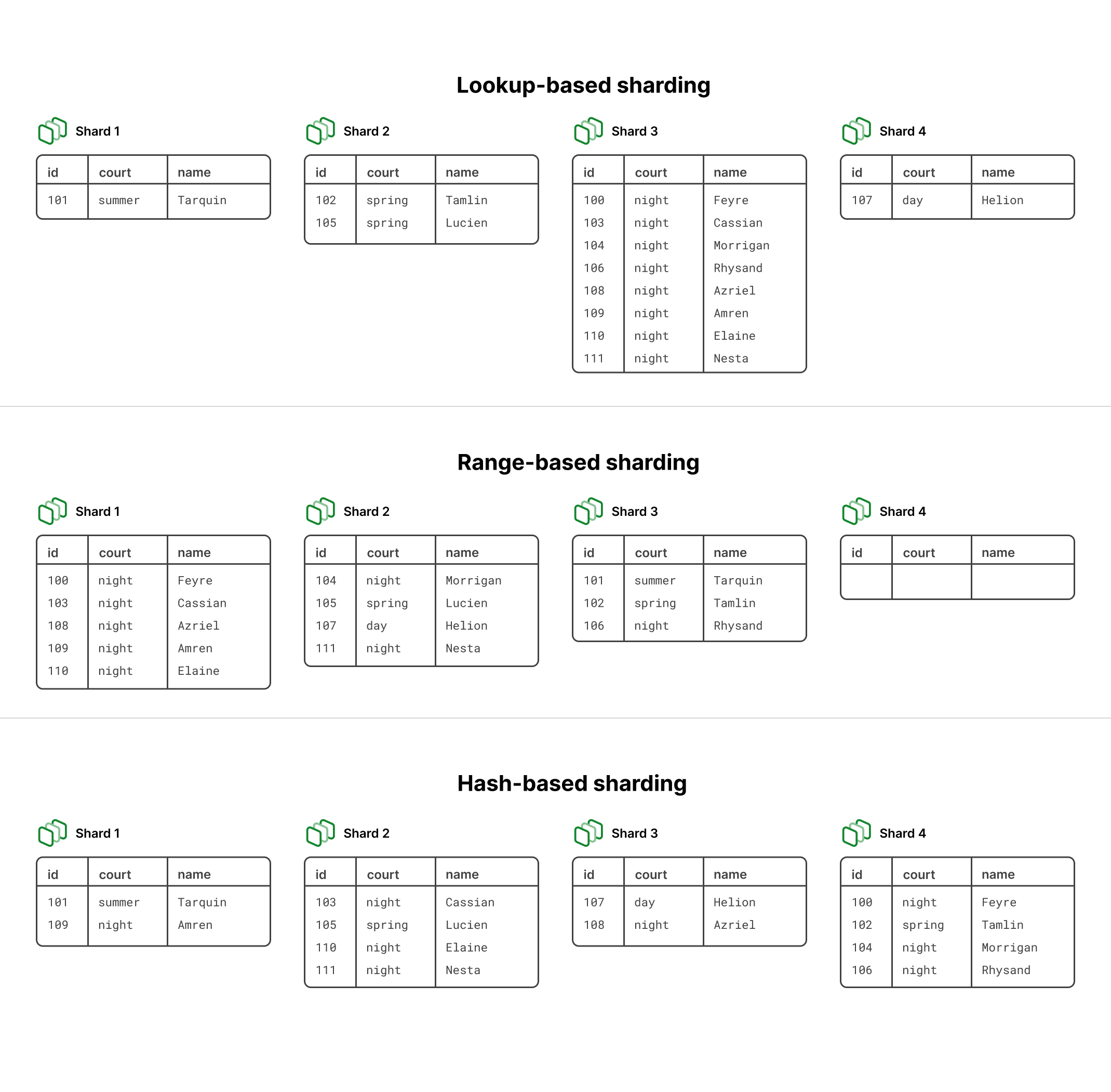
Comparison of hash, range, and directory sharding

If you have a database that you think is ready to shard and are curious if PlanetScale is the right solution for you, fill out our contact form, and we'll be in touch.