


惯性聚合 高效追踪和阅读你感兴趣的博客、新闻、科技资讯
阅读原文 在惯性聚合中打开

推荐订阅源

AI
AI
O
OpenAI News
Engineering at Meta
Engineering at Meta
F
Fortinet All Blogs
Jina AI
Jina AI
D
Docker
N
News and Events Feed by Topic
TaoSecurity Blog
TaoSecurity Blog
雷峰网
雷峰网
V
V2EX
小众软件
小众软件
N
News | PayPal Newsroom
GbyAI
GbyAI
Recorded Future
Recorded Future
SecWiki News
SecWiki News
WordPress大学
WordPress大学
钛媒体:引领未来商业与生活新知
钛媒体:引领未来商业与生活新知
酷 壳 – CoolShell
酷 壳 – CoolShell
Security Latest
Security Latest
Google DeepMind News
cs.AI updates on arXiv.org
Hacker News: Ask HN
Hacker News: Ask HN
Project Zero
Project Zero
Cyberwarzone
Cyberwarzone
MyScale Blog
MyScale Blog
T
The Blog of Author Tim Ferriss
U
Unit 42
The Last Watchdog
The Last Watchdog
V
Visual Studio Blog
C
Cisco Blogs
T
Tor Project blog
Google Online Security Blog
I
InfoQ
Attack and Defense Labs
Y
Y Combinator Blog
博客园 - 聂微东
L
LangChain Blog
Blog — PlanetScale
Blog — PlanetScale
Apple Machine Learning Research
S
Schneier on Security
S
Securelist
博客园_首页
W
WeLiveSecurity
P
Privacy International News Feed
S
SegmentFault 最新的问题
博客园 - 【当耐特】
L
LINUX DO - 热门话题
Latest news
Latest news
大猫的无限游戏
大猫的无限游戏
M
MIT News - Artificial intelligence

Blog — PlanetScale

Keeping a Postgres queue healthy — PlanetScale Patterns for Postgres Traffic Control — PlanetScale Graceful degradation in Postgres — PlanetScale High memory usage in Postgres is good, actually — PlanetScale Stripe Projects partnership: Provision PlanetScale Postgres and MySQL databases from the Stripe CLI — PlanetScale Enhanced tagging in Postgres Query Insights — PlanetScale Behind the scenes: How Database Traffic Control works — PlanetScale Introducing Database Traffic Control — PlanetScale Scaling Postgres connections with PgBouncer — PlanetScale Drizzle joins PlanetScale — PlanetScale Video Conferencing with Postgres — PlanetScale Faster PlanetScale Postgres connections with Cloudflare Hyperdrive — PlanetScale Introducing the PlanetScale MCP server — PlanetScale Database Transactions — PlanetScale Automating our changelog with Cursor commands — PlanetScale Postgres 18 is now available — PlanetScale Using MotherDuck with PlanetScale — PlanetScale $50 PlanetScale Metal is GA for Postgres — PlanetScale $5 PlanetScale is live — PlanetScale Announcing Vitess 23 — PlanetScale $50 PlanetScale Metal — PlanetScale Report on our investigation of the 2025-10-20 incident in AWS us-east-1 — PlanetScale $5 PlanetScale — PlanetScale Benchmarking Postgres 17 vs 18 — PlanetScale Larger than RAM Vector Indexes for Relational Databases — PlanetScale Partnering with Cloudflare to bring you the fastest globally distributed applications — PlanetScale Processes and Threads — PlanetScale PlanetScale for Postgres is now GA — PlanetScale Postgres High Availability with CDC — PlanetScale Announcing Neki — PlanetScale Caching — PlanetScale The principles of extreme fault tolerance — PlanetScale Announcing PlanetScale for Postgres — PlanetScale Benchmarking Postgres — PlanetScale Announcing Vitess 22 — PlanetScale The Real Failure Rate of EBS — PlanetScale IO devices and latency — PlanetScale Announcing PlanetScale Metal — PlanetScale PlanetScale Metal: There’s no replacement for displacement — PlanetScale Upgrading Query Insights to Metal — PlanetScale Automating cherry-picks between OSS and private forks — PlanetScale Database Sharding — PlanetScale Anatomy of a Throttler, part 3 — PlanetScale Introducing sharding on PlanetScale with workflows — PlanetScale Announcing Vitess 21 — PlanetScale Announcing the PlanetScale vectors public beta — PlanetScale Anatomy of a Throttler, part 2 — PlanetScale Instant deploy requests — PlanetScale Anatomy of a Throttler, part 1 — PlanetScale Increase IOPS and throughput with sharding — PlanetScale Tracking index usage with Insights — PlanetScale Faster backups with sharding — PlanetScale Building data pipelines with Vitess — PlanetScale The State of Online Schema Migrations in MySQL — PlanetScale Optimizing aggregation in the Vitess query planner — PlanetScale Dealing with large tables — PlanetScale Announcing Vitess 20 — PlanetScale Self-managed Vitess vs Managed Vitess with PlanetScale — PlanetScale Achieving data consistency with the consistent lookup Vindex — PlanetScale The MySQL adaptive hash index — PlanetScale Introducing global replica credentials — PlanetScale Profiling memory usage in MySQL — PlanetScale Summer 2023: Fuzzing Vitess at PlanetScale — PlanetScale How PlanetScale makes schema changes — PlanetScale Identifying and profiling problematic MySQL queries — PlanetScale The Problem with Using a UUID Primary Key in MySQL — PlanetScale Announcing Vitess 19 — PlanetScale PlanetScale forever — PlanetScale Introducing schema recommendations — PlanetScale Amazon Aurora Pricing: The many surprising costs of running an Aurora database — PlanetScale Three common MySQL database design mistakes — PlanetScale OAuth applications are now available to everyone — PlanetScale Deprecating the Scaler plan — PlanetScale PlanetScale branching vs. Amazon Aurora blue/green deployments — PlanetScale Databases at scale — PlanetScale Considerations for building a database disaster recovery plan — PlanetScale Working with Geospatial Features in MySQL — PlanetScale PlanetScale vs Amazon Aurora replication — PlanetScale Introducing the Vantage and PlanetScale integration — PlanetScale MySQL isolation levels and how they work — PlanetScale Introducing the schemadiff command line tool — PlanetScale $ pscale ping — PlanetScale Announcing foreign key constraints support — PlanetScale The challenges of supporting foreign key constraints — PlanetScale What is HTAP? — PlanetScale Introducing Insights Anomalies — PlanetScale Webhook security: a hands-on guide — PlanetScale Announcing the Fivetran integration — PlanetScale Introducing webhooks — PlanetScale What is MySQL replication and when should you use it? — PlanetScale Sync user data between Clerk and a PlanetScale MySQL database — PlanetScale Introducing database reports — PlanetScale Distributed caching systems and MySQL — PlanetScale What is MySQL partitioning? — PlanetScale MySQL High Availability: Connection handling and concurrency — PlanetScale Personalizing your onboarding with Markdoc — PlanetScale PlanetScale vs. Amazon Aurora — PlanetScale PlanetScale vs. Amazon RDS — PlanetScale PlanetScale is bringing vector search and storage to MySQL — PlanetScale PlanetScale Managed is now PCI compliant — PlanetScale
AI-Powered Postgres index suggestions — PlanetScale
Rafer Hazen · 2025-11-21 · via Blog — PlanetScale

Rafer Hazen |

Today we're releasing a new feature in PlanetScale Insights: AI-powered index suggestions for PostgreSQL databases. This feature monitors your database workload and periodically suggests new indexes to improve query execution speed and overall database performance. This blog post describes how we used LLMs (large language models) combined with robust validation to generate high quality index suggestions.

Overview

Finding the right indexes for your database is one of the most common and critical operations in maintaining database health. It's also something that needs to be done not just when tables are created, but consistently revisited as an application evolves and query patterns change.

Our experience using LLM chat tools made it clear that LLMs are capable of finding indexes to improve query performance. Given the right set of queries to improve, LLMs frequently find an optimal index. There were two issues we needed to solve, though.

First, LLMs are not always great at deciding when something needs to be modified. Given a problem, LLMs are great at finding an answer but can't always be trusted to decide if maybe nothing needs to change at all. We are well positioned to solve this issue by using the query performance data Insights collects to only ask for index recommendations after first verifying that there are queries present that are likely to need an index.

Second, sometimes LLMs produce inaccurate results. As anyone who's used LLM tools for software development can tell you, it's crucially important to validate LLM generated solutions before shipping them to production. Before we suggest that a customer make changes to their production database, we need to make sure that our suggestions will actually have the desired effect. To accomplish this we measure the estimated performance of the relevant queries with and without each suggested index, and only show suggestions that result in a substantial improvement.

Our goal with Postgres index suggestions is not just to save you the trouble of asking LLMs for suggestions on your own, but to use the unique data and capabilities available in Insights to produce the best overall results.

Asking the right question

Two things determine the right set of indexes for a given database:

  1. The database schema
  2. The workload (i.e. what queries are being run)

LLMs, like humans, produce better answers if they are asked better questions. Our first task, then, was to filter down the list of query patterns to those that were most likely to actually benefit from an index. When we manually examine a database to find queries that might benefit from an index, we typically look for query patterns with a high ratio of rows read to rows returned. If a query is reading a much larger set of rows than it is returning, it's an indication that an index (or a more selective index) could improve response times.

We also filter the set of query patterns to those are using significant resources. In particular we require that the query pattern is responsible for at least 0.1% of the aggregated runtime of all queries, and that it has been run a minimum number of times. Since indexes incur storage, memory and write overhead, we want to avoid suggesting indexes for ad-hoc or infrequently run queries.

Once we have a set of candidate queries, we filter the schema down to the tables referenced by the query. This keeps the prompt smaller and more focused.

The final component of our prompt is that we ask the LLM to include a reference to the queries that each new index is designed to improve. This data is used in the validation step.

Validation

Now that we have a list of candidate indexes, we can perform the most crucial step: validation. Asking users to create indexes on their production database is an inherently high-stakes activity, and we want to be certain about the quality of the underlying suggestions.

To this end, we perform 2 validation steps:

  1. Parse the generated CREATE INDEX statements to ensure that they are syntactically valid and of the correct form.
  2. Evaluate each candidate query with and without the related index, and ignore any index suggestion that doesn't improve at least one candidate query.

To evaluate the effect of each index, we use the HypoPG extension. HypoPG lets us create hypothetical indexes that do not actually exist (and therefore have no overhead) but which the planner can use in the context of EXPLAIN commands. This allows us to find an estimated cost using the actual Postgres planner, and determine if the predicted cost improvement is substantial enough to justify recommending a new index.

If an index suggestion passes both phases of validation, Insights generates a new index recommendation. Insights shows index suggestions with a table of the queries they are designed to improve, including the estimated reduction in query cost.
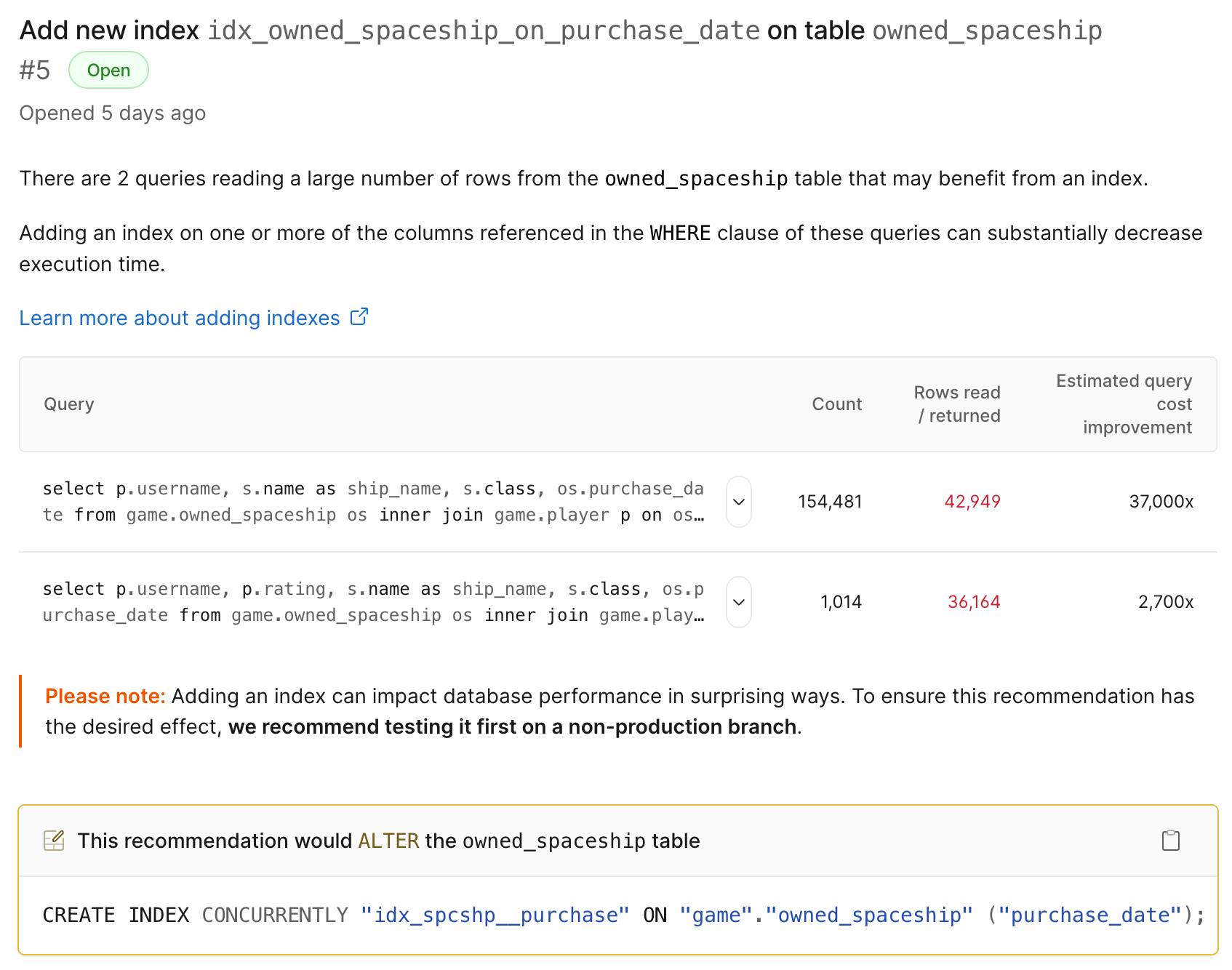
Postgres new index recommendation