


惯性聚合 高效追踪和阅读你感兴趣的博客、新闻、科技资讯
阅读原文 在惯性聚合中打开

推荐订阅源

WordPress大学
WordPress大学
Stack Overflow Blog
Stack Overflow Blog
Latest news
Latest news
T
The Blog of Author Tim Ferriss
D
DataBreaches.Net
C
Check Point Blog
钛媒体:引领未来商业与生活新知
钛媒体:引领未来商业与生活新知
Security Latest
Security Latest
宝玉的分享
宝玉的分享
S
Schneier on Security
Blog — PlanetScale
Blog — PlanetScale
OSCHINA 社区最新新闻
OSCHINA 社区最新新闻
Cisco Talos Blog
Cisco Talos Blog
MyScale Blog
MyScale Blog
B
Blog RSS Feed
N
Netflix TechBlog - Medium
P
Privacy & Cybersecurity Law Blog
L
LINUX DO - 热门话题
Apple Machine Learning Research
T
Tenable Blog
Threat Intelligence Blog | Flashpoint
NISL@THU
NISL@THU
Google DeepMind News
Hacker News: Ask HN
Hacker News: Ask HN
Schneier on Security
博客园 - Franky
cs.CV updates on arXiv.org
S
Secure Thoughts
T
Threat Research - Cisco Blogs
D
Docker
Exploit-DB.com RSS Feed
人人都是产品经理
人人都是产品经理
G
GRAHAM CLULEY
Application and Cybersecurity Blog
博客园 - 【当耐特】
PCI Perspectives
PCI Perspectives
GbyAI
GbyAI
酷 壳 – CoolShell
酷 壳 – CoolShell
Cyberwarzone
Cyberwarzone
V
Vulnerabilities – Threatpost
F
Fortinet All Blogs
罗磊的独立博客
Engineering at Meta
Engineering at Meta
Y
Y Combinator Blog
SecWiki News
SecWiki News
A
Arctic Wolf
小众软件
小众软件
T
Troy Hunt's Blog
博客园 - 三生石上(FineUI控件)
Know Your Adversary
Know Your Adversary

Blog — PlanetScale

Keeping a Postgres queue healthy — PlanetScale Patterns for Postgres Traffic Control — PlanetScale Graceful degradation in Postgres — PlanetScale High memory usage in Postgres is good, actually — PlanetScale Stripe Projects partnership: Provision PlanetScale Postgres and MySQL databases from the Stripe CLI — PlanetScale Enhanced tagging in Postgres Query Insights — PlanetScale Behind the scenes: How Database Traffic Control works — PlanetScale Introducing Database Traffic Control — PlanetScale Scaling Postgres connections with PgBouncer — PlanetScale Drizzle joins PlanetScale — PlanetScale Video Conferencing with Postgres — PlanetScale Faster PlanetScale Postgres connections with Cloudflare Hyperdrive — PlanetScale Introducing the PlanetScale MCP server — PlanetScale Database Transactions — PlanetScale Automating our changelog with Cursor commands — PlanetScale Postgres 18 is now available — PlanetScale $50 PlanetScale Metal is GA for Postgres — PlanetScale AI-Powered Postgres index suggestions — PlanetScale $5 PlanetScale is live — PlanetScale Announcing Vitess 23 — PlanetScale $50 PlanetScale Metal — PlanetScale Report on our investigation of the 2025-10-20 incident in AWS us-east-1 — PlanetScale $5 PlanetScale — PlanetScale Benchmarking Postgres 17 vs 18 — PlanetScale Larger than RAM Vector Indexes for Relational Databases — PlanetScale Partnering with Cloudflare to bring you the fastest globally distributed applications — PlanetScale Processes and Threads — PlanetScale PlanetScale for Postgres is now GA — PlanetScale Postgres High Availability with CDC — PlanetScale Announcing Neki — PlanetScale Caching — PlanetScale The principles of extreme fault tolerance — PlanetScale Announcing PlanetScale for Postgres — PlanetScale Benchmarking Postgres — PlanetScale Announcing Vitess 22 — PlanetScale The Real Failure Rate of EBS — PlanetScale IO devices and latency — PlanetScale Announcing PlanetScale Metal — PlanetScale PlanetScale Metal: There’s no replacement for displacement — PlanetScale Upgrading Query Insights to Metal — PlanetScale Automating cherry-picks between OSS and private forks — PlanetScale Database Sharding — PlanetScale Anatomy of a Throttler, part 3 — PlanetScale Introducing sharding on PlanetScale with workflows — PlanetScale Announcing Vitess 21 — PlanetScale Announcing the PlanetScale vectors public beta — PlanetScale Anatomy of a Throttler, part 2 — PlanetScale Instant deploy requests — PlanetScale Anatomy of a Throttler, part 1 — PlanetScale Increase IOPS and throughput with sharding — PlanetScale Tracking index usage with Insights — PlanetScale Faster backups with sharding — PlanetScale Building data pipelines with Vitess — PlanetScale The State of Online Schema Migrations in MySQL — PlanetScale Optimizing aggregation in the Vitess query planner — PlanetScale Dealing with large tables — PlanetScale Announcing Vitess 20 — PlanetScale Self-managed Vitess vs Managed Vitess with PlanetScale — PlanetScale Achieving data consistency with the consistent lookup Vindex — PlanetScale The MySQL adaptive hash index — PlanetScale Introducing global replica credentials — PlanetScale Profiling memory usage in MySQL — PlanetScale Summer 2023: Fuzzing Vitess at PlanetScale — PlanetScale How PlanetScale makes schema changes — PlanetScale Identifying and profiling problematic MySQL queries — PlanetScale The Problem with Using a UUID Primary Key in MySQL — PlanetScale Announcing Vitess 19 — PlanetScale PlanetScale forever — PlanetScale Introducing schema recommendations — PlanetScale Amazon Aurora Pricing: The many surprising costs of running an Aurora database — PlanetScale Three common MySQL database design mistakes — PlanetScale OAuth applications are now available to everyone — PlanetScale Deprecating the Scaler plan — PlanetScale PlanetScale branching vs. Amazon Aurora blue/green deployments — PlanetScale Databases at scale — PlanetScale Considerations for building a database disaster recovery plan — PlanetScale Working with Geospatial Features in MySQL — PlanetScale PlanetScale vs Amazon Aurora replication — PlanetScale Introducing the Vantage and PlanetScale integration — PlanetScale MySQL isolation levels and how they work — PlanetScale Introducing the schemadiff command line tool — PlanetScale $ pscale ping — PlanetScale Announcing foreign key constraints support — PlanetScale The challenges of supporting foreign key constraints — PlanetScale What is HTAP? — PlanetScale Introducing Insights Anomalies — PlanetScale Webhook security: a hands-on guide — PlanetScale Announcing the Fivetran integration — PlanetScale Introducing webhooks — PlanetScale What is MySQL replication and when should you use it? — PlanetScale Sync user data between Clerk and a PlanetScale MySQL database — PlanetScale Introducing database reports — PlanetScale Distributed caching systems and MySQL — PlanetScale What is MySQL partitioning? — PlanetScale MySQL High Availability: Connection handling and concurrency — PlanetScale Personalizing your onboarding with Markdoc — PlanetScale PlanetScale vs. Amazon Aurora — PlanetScale PlanetScale vs. Amazon RDS — PlanetScale PlanetScale is bringing vector search and storage to MySQL — PlanetScale PlanetScale Managed is now PCI compliant — PlanetScale
Using MotherDuck with PlanetScale — PlanetScale
Ben Dicken · 2025-12-16 · via Blog — PlanetScale

Ben Dicken [@BenjDicken] |

DuckDB has gained significant traction for OLAP workloads. It's powerful, flexible, and has a feature-rich SQL dialect, making it perfect to use for analytics alongside OLTP-oriented relational databases.

Today, we're excited to announce support for the pg_duckdb extension for Postgres databases on PlanetScale alongside our partnership with MotherDuck.

DuckDB in Postgres

DuckDB can be run as a standalone OLAP database, but also alongside Postgres via the pg_duckdb extension. The extension integrates DuckDB's column-store analytics engine right inside of Postgres, allowing you to seamlessly combine OLTP and OLAP queries over Postgres connections.

When enabled, tables can be created either using the standard Postgres table format or temporary tables in the DuckDB vectorized column format. Queries can then be selectively executed either using the Postgres engine or DuckDB. pg_duckdb can also be used to work with and query external datasources in popular formats like Apache Parquet and Iceberg.

Having DuckDB as a built-in extension makes data movement between Postgres and DuckDB formats simpler, and unifies the experience of combining analytics results with the rest of your relational data.

MotherDuck

Though DuckDB is extremely powerful, many prefer to separate analytical compute from OLTP compute. This is useful to ensure that heavy analytics queries don't negatively impact application performance, and vice-versa.

MotherDuck is a cloud data warehouse with deep integration and support for DuckDB, and is a perfect solution to this problem. The pg_duckdb extension supports offloading analytics queries to the MotherDuck cloud. Analytics queries can be executed from within your PlanetScale Postgres database, but the analytics query execution can be offloaded to your data sets stored in the MotherDuck cloud. The results can then be returned to Postgres for further processing.

To use DuckDB and MotherDuck together with your PlanetScale database:

  • Enable pg_duckdb via the "Extensions" table on the "Clusters" page of your database.
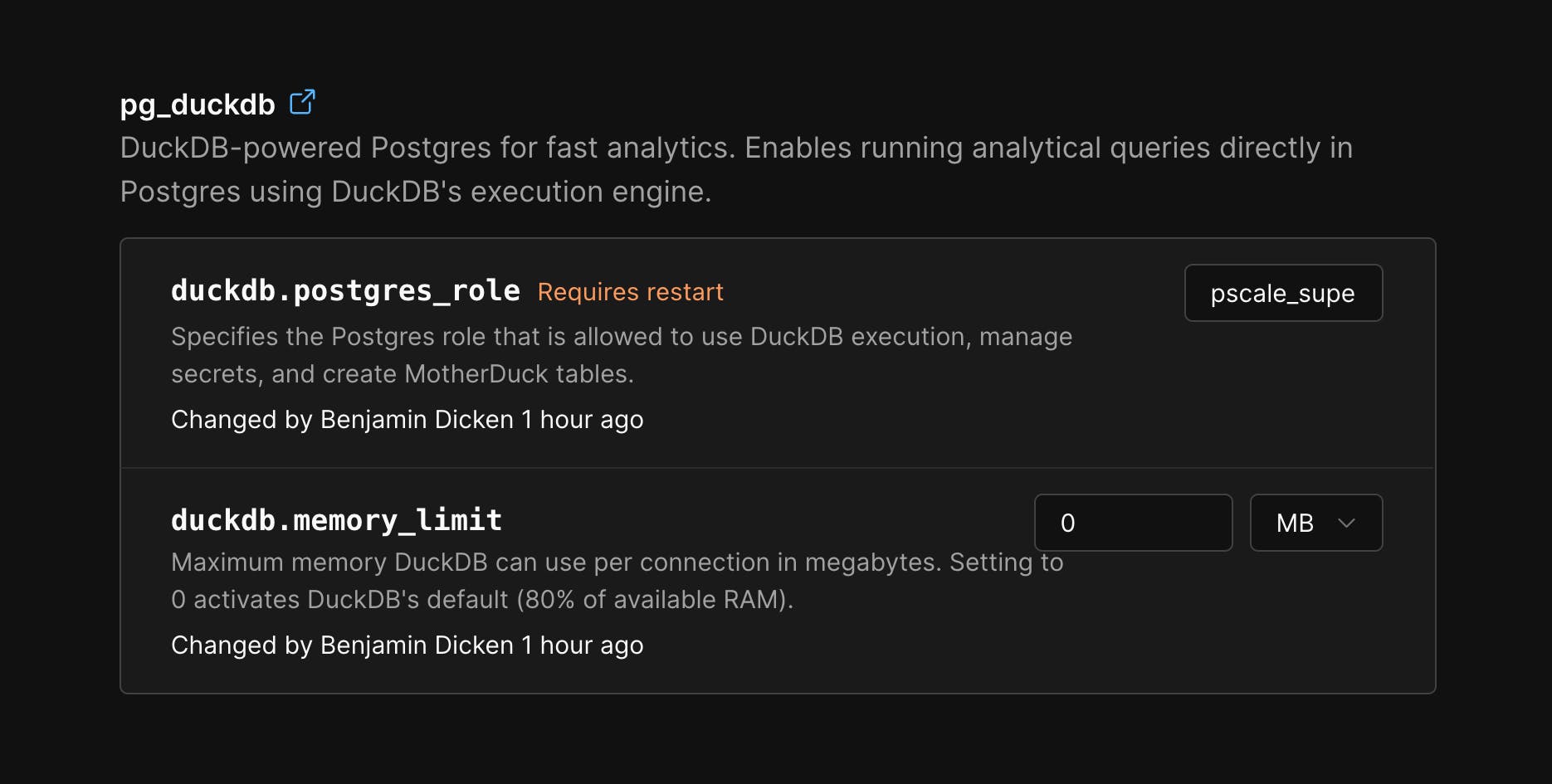
Enable pg_duckdb

  • Connect to your Postgres database and run GRANT CREATE ON SCHEMA public to pscale_superuser; to allow the addition of the MotherDuck catalog in Postgres and CREATE EXTENSION pg_duckdb; to create the extension.

  • Add your MotherDuck token with CALL duckdb.enable_motherduck('YOUR_TOKEN');

  • Start running your analytics queries!

Check out our docs and the MotherDuck docs for more information on how to use pg_duckdb with MotherDuck.