


惯性聚合 高效追踪和阅读你感兴趣的博客、新闻、科技资讯
阅读原文 在惯性聚合中打开

推荐订阅源

H
Heimdal Security Blog
小众软件
小众软件
钛媒体:引领未来商业与生活新知
钛媒体:引领未来商业与生活新知
罗磊的独立博客
Google DeepMind News
大猫的无限游戏
大猫的无限游戏
奇客Solidot–传递最新科技情报
奇客Solidot–传递最新科技情报
Hugging Face - Blog
Hugging Face - Blog
阮一峰的网络日志
阮一峰的网络日志
A
About on SuperTechFans
宝玉的分享
宝玉的分享
博客园 - 聂微东
月光博客
月光博客
Cyberwarzone
Cyberwarzone
Microsoft Security Blog
V
Visual Studio Blog
Project Zero
Project Zero
T
Tor Project blog
freeCodeCamp Programming Tutorials: Python, JavaScript, Git & More
L
LINUX DO - 最新话题
博客园 - 叶小钗
Recent Commits to openclaw:main
Attack and Defense Labs
Spread Privacy
Spread Privacy
Forbes - Security
Forbes - Security
Simon Willison's Weblog
N
Netflix TechBlog - Medium
P
Proofpoint News Feed
Engineering at Meta
Engineering at Meta
Hacker News: Ask HN
Hacker News: Ask HN
I
InfoQ
M
MIT News - Artificial intelligence
AI
AI
博客园 - 三生石上(FineUI控件)
W
WeLiveSecurity
C
Check Point Blog
The Hacker News
The Hacker News
C
Cyber Attacks, Cyber Crime and Cyber Security
Application and Cybersecurity Blog
T
Tenable Blog
让小产品的独立变现更简单 - ezindie.com
Threat Intelligence Blog | Flashpoint
The Cloudflare Blog
Blog — PlanetScale
Blog — PlanetScale
美团技术团队
D
Darknet – Hacking Tools, Hacker News & Cyber Security
GbyAI
GbyAI
Hacker News - Newest:
Hacker News - Newest: "LLM"
腾讯CDC
K
Kaspersky official blog

Blog — PlanetScale

Keeping a Postgres queue healthy — PlanetScale Patterns for Postgres Traffic Control — PlanetScale Graceful degradation in Postgres — PlanetScale High memory usage in Postgres is good, actually — PlanetScale Stripe Projects partnership: Provision PlanetScale Postgres and MySQL databases from the Stripe CLI — PlanetScale Enhanced tagging in Postgres Query Insights — PlanetScale Behind the scenes: How Database Traffic Control works — PlanetScale Introducing Database Traffic Control — PlanetScale Scaling Postgres connections with PgBouncer — PlanetScale Drizzle joins PlanetScale — PlanetScale Video Conferencing with Postgres — PlanetScale Faster PlanetScale Postgres connections with Cloudflare Hyperdrive — PlanetScale Introducing the PlanetScale MCP server — PlanetScale Database Transactions — PlanetScale Automating our changelog with Cursor commands — PlanetScale Postgres 18 is now available — PlanetScale Using MotherDuck with PlanetScale — PlanetScale $50 PlanetScale Metal is GA for Postgres — PlanetScale AI-Powered Postgres index suggestions — PlanetScale $5 PlanetScale is live — PlanetScale Announcing Vitess 23 — PlanetScale $50 PlanetScale Metal — PlanetScale Report on our investigation of the 2025-10-20 incident in AWS us-east-1 — PlanetScale $5 PlanetScale — PlanetScale Benchmarking Postgres 17 vs 18 — PlanetScale Larger than RAM Vector Indexes for Relational Databases — PlanetScale Partnering with Cloudflare to bring you the fastest globally distributed applications — PlanetScale Processes and Threads — PlanetScale PlanetScale for Postgres is now GA — PlanetScale Postgres High Availability with CDC — PlanetScale Announcing Neki — PlanetScale Caching — PlanetScale The principles of extreme fault tolerance — PlanetScale Announcing PlanetScale for Postgres — PlanetScale Benchmarking Postgres — PlanetScale Announcing Vitess 22 — PlanetScale The Real Failure Rate of EBS — PlanetScale IO devices and latency — PlanetScale Announcing PlanetScale Metal — PlanetScale PlanetScale Metal: There’s no replacement for displacement — PlanetScale Upgrading Query Insights to Metal — PlanetScale Automating cherry-picks between OSS and private forks — PlanetScale Database Sharding — PlanetScale Anatomy of a Throttler, part 3 — PlanetScale Introducing sharding on PlanetScale with workflows — PlanetScale Announcing Vitess 21 — PlanetScale Announcing the PlanetScale vectors public beta — PlanetScale Anatomy of a Throttler, part 2 — PlanetScale Instant deploy requests — PlanetScale Anatomy of a Throttler, part 1 — PlanetScale Increase IOPS and throughput with sharding — PlanetScale Tracking index usage with Insights — PlanetScale Faster backups with sharding — PlanetScale Building data pipelines with Vitess — PlanetScale The State of Online Schema Migrations in MySQL — PlanetScale Optimizing aggregation in the Vitess query planner — PlanetScale Dealing with large tables — PlanetScale Announcing Vitess 20 — PlanetScale Self-managed Vitess vs Managed Vitess with PlanetScale — PlanetScale Achieving data consistency with the consistent lookup Vindex — PlanetScale The MySQL adaptive hash index — PlanetScale Introducing global replica credentials — PlanetScale Profiling memory usage in MySQL — PlanetScale Summer 2023: Fuzzing Vitess at PlanetScale — PlanetScale How PlanetScale makes schema changes — PlanetScale Identifying and profiling problematic MySQL queries — PlanetScale The Problem with Using a UUID Primary Key in MySQL — PlanetScale Announcing Vitess 19 — PlanetScale PlanetScale forever — PlanetScale Introducing schema recommendations — PlanetScale Amazon Aurora Pricing: The many surprising costs of running an Aurora database — PlanetScale Three common MySQL database design mistakes — PlanetScale OAuth applications are now available to everyone — PlanetScale Deprecating the Scaler plan — PlanetScale PlanetScale branching vs. Amazon Aurora blue/green deployments — PlanetScale Databases at scale — PlanetScale Considerations for building a database disaster recovery plan — PlanetScale Working with Geospatial Features in MySQL — PlanetScale PlanetScale vs Amazon Aurora replication — PlanetScale Introducing the Vantage and PlanetScale integration — PlanetScale MySQL isolation levels and how they work — PlanetScale Introducing the schemadiff command line tool — PlanetScale $ pscale ping — PlanetScale Announcing foreign key constraints support — PlanetScale The challenges of supporting foreign key constraints — PlanetScale What is HTAP? — PlanetScale Introducing Insights Anomalies — PlanetScale Webhook security: a hands-on guide — PlanetScale MySQL replication: Best practices and considerations — PlanetScale A guide to HTML email with Ruby on Rails and Tailwind CSS — PlanetScale Sharding for cost-effective database management — PlanetScale PlanetScale ranks 188th in Deloitte’s top 500 fastest-growing companies — PlanetScale Announcing the Fivetran integration — PlanetScale Introducing webhooks — PlanetScale What is MySQL replication and when should you use it? — PlanetScale Sync user data between Clerk and a PlanetScale MySQL database — PlanetScale Introducing database reports — PlanetScale Distributed caching systems and MySQL — PlanetScale What is MySQL partitioning? — PlanetScale MySQL High Availability: Connection handling and concurrency — PlanetScale
Optimizing query planning in Vitess: a step-by-step approach — PlanetScale
Andres Taylor · 2023-06-01 · via Blog — PlanetScale

Andres Taylor |

Introduction

In this blog post, we will discuss an example of a change to the Vitess query planner and how it enhances the optimization process. The new model focuses on making every step in the optimization pipeline a runnable plan. This approach offers several benefits, including simpler understanding and reasoning, ease of testing, and the ability to use arbitrary expressions in ordering, grouping, and aggregations.

Vitess distributed query planner

VTGate is the proxy component of Vitess. It accepts queries from users and plans how to spread the query across multiple shards and/or keyspaces. The leaf level of the VTGate query plans are "routes," which are operators that will send a query to one or more shards.

When something can be pushed into the route, it means that MySQL will do the work, and we don't have to do much work on the VTGate side. The aim is always to push as much as possible down to the much faster MySQL process. This approach helps to offload processing to MySQL and keep the VTGate layer efficient. This also reduces the risk of compatibility differences between Vitess and plain MySQL, since MySQL is doing most of the work.
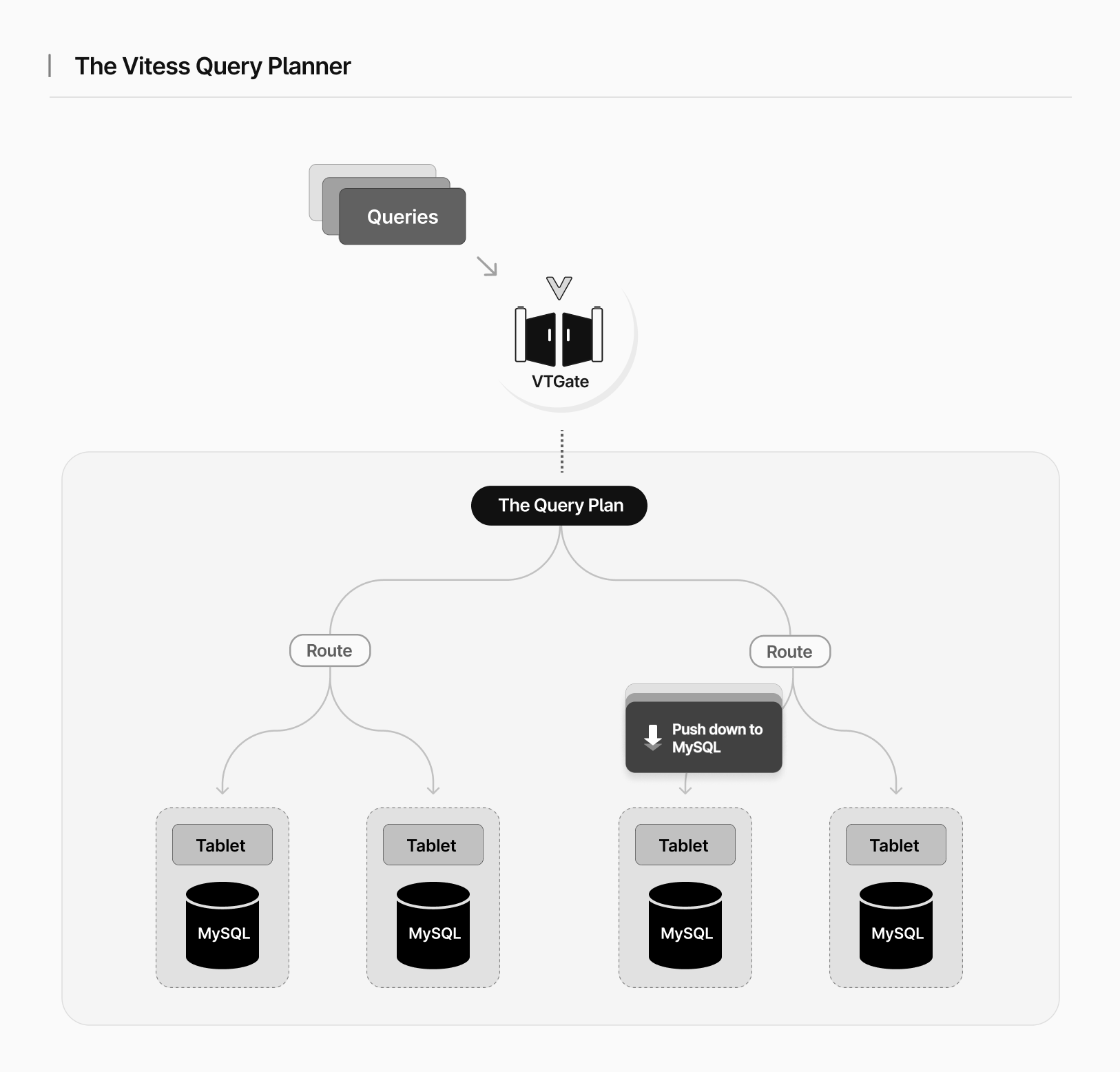
The Vitess Query planner diagram: The illustration begins with an icon depicting VTGate (a gate-like structure) with queries (represented by documents) entering it. The VTGate icon is linked with an arrow to a tree diagram symbolizing the query plan. The tree branches out towards the bottom, culminating in leaf nodes. Each leaf node is labeled as a "Route." From these leaf nodes, arrows lead to several tablets each represented by a database symbol (cylinder) labeled "MySQL". A leaf node to a tablet states "Push down to MySQL" to emphasize the point that most of the work is being done by MySQL.

Changes in the query planning model

In our query planning model, the optimization process began by determining the join order between the tables. The "join order" refers to the sequence in which tables are joined to form the final result set.

Once the join order is established, the planner proceeds with horizon planning. A “horizon” operator contains the SELECT expressions, aggregations, ORDER BY, GROUP BY, and LIMIT. If we can push the entire operator to MySQL, we don’t need to plan this at all. If we can’t delegate it to MySQL in a single piece, we have to plan these components separately.

In a database query planner where everything is evaluated locally, this part of query planning is straightforward — we add the necessary Sort/GroupBy/Limit/Project operators and we are pretty much done. Naturally, there are additional optimizations one could perform, but these would typically yield only marginal improvements to the performance of the query plan. In a distributed query planner, the cost of transmitting data means that it's essential to push down as much of these operations as possible to the data.

You can read more about how we plan grouping and aggregations while pushing down work in our Grouping and Aggregations on Vitess blog post.

In this new model for our planner, we are still performing the same optimizations as before, but we are going about it in a very different way.

In the old model, we performed the optimization more in a top-down approach — we planned the full aggregation, and all ordering needed to support it, in one go. We would start with the join order tree, and do a lot of logic, and then output a new tree that performed the correct aggregations. In between the two, most of the current state was kept in arguments, local variables, and in the stack.
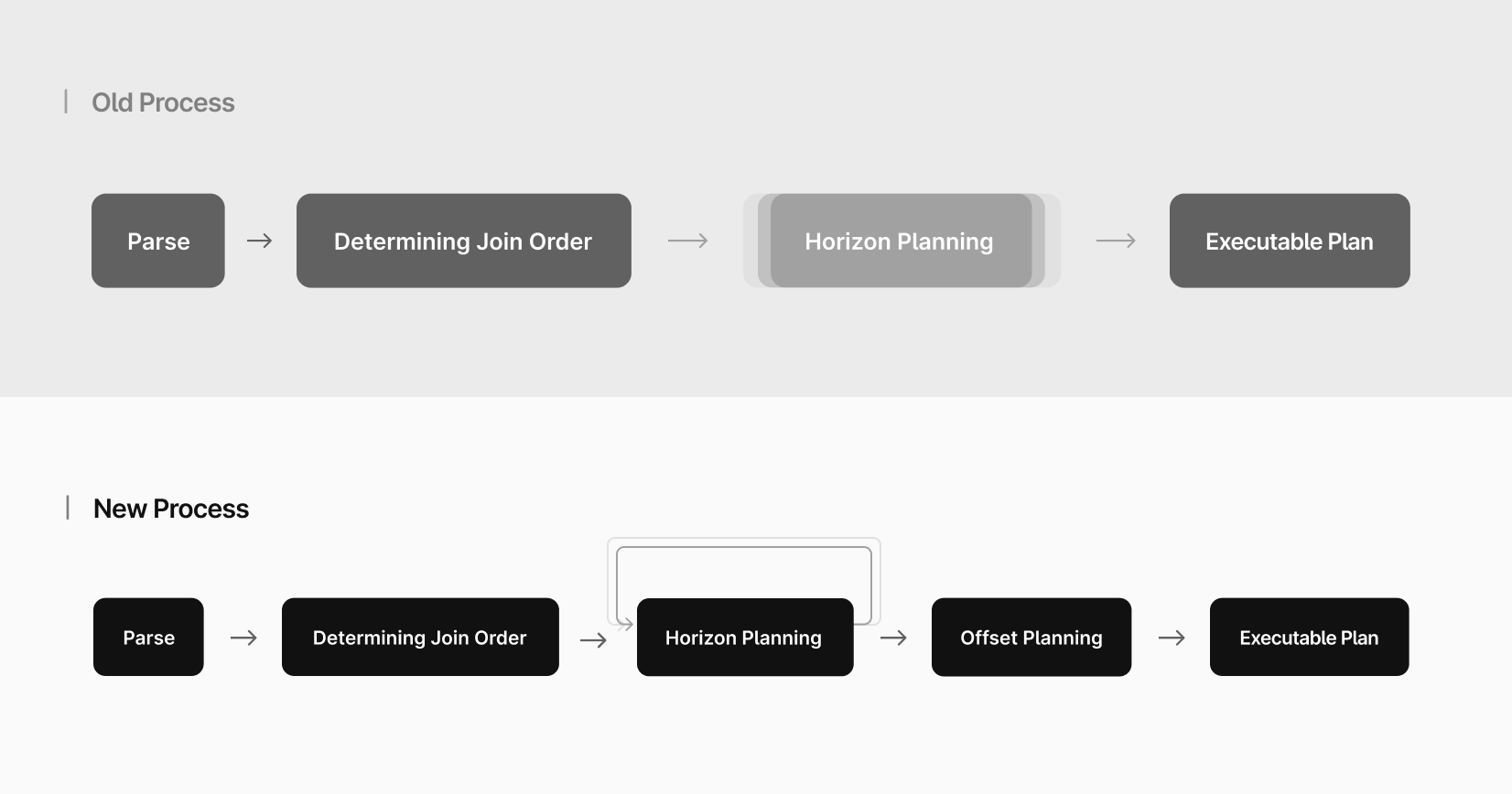
an image showing two diagrams, one title Old Process and the other titled New Process. Both diagrams are a number of steps, each one pointing to the next in line. The Old Process has the steps Parse, Determining Join Order, Horizon Planning and Executable Plan, with Horizon Planning a little blurred, to show that it's difficult to inspect. In the new process, the Horizon Planning is not blurred, and has an arrow pointing back to itself to show that it's a recursive step. Finally, the New Process also has one new step, "Offset Planning", that is between Horizon Planning and Executable Plan

In the new query planning model, every step in the optimization pipeline results in a runnable plan. This means that developers working on the planner can inspect the plan at any stage, allowing for a better understanding of the optimization process at each step. By having runnable plans at every step, it becomes easier to identify potential issues, inefficiencies, or areas where further optimization is possible.

Each step is also simpler — it's a tree transformation taking two operators as input, one being the input of the other, and producing a new subtree that replaces the two inputs.

This improvement not only simplifies the optimization process but also enhances the ability to reason about the impact of each optimization step.

Other benefits of the new process

Visualization improvements

Compared to the old model, the new query planning model offers better visualization of the optimization steps. In the old model, the current optimization state was kept in the stack and local variables, making it harder to visualize and understand the process. With the new model, each step is represented as a full query plan, which provides a clearer picture of the optimization process.

Testability

Another benefit of this model is the possibility of running both the unoptimized plan and the optimized version and comparing their results. It should not matter if we have to evaluate a WHERE predicate on the VTGate side with our excellent evalengine support for most MySQL expressions, or if we can delegate it to the underlying database. The result should be the same.

Flexibility with expressions

The new query planning model allows for arbitrary expressions to be used for ordering, grouping, and aggregations. This provides greater flexibility when crafting complex queries and enables developers to write more efficient and optimized queries. In comparison, the old model had limitations in terms of the expressions that could be used in these operations.

Example query and optimization steps

To illustrate the benefits of the new query planning model, let's examine the optimization steps while planning a query. This is done using a so-called fixed point rewriter — the planner will continue rewriting the plan tree until it stops changing.

Let’s look at an example query:

SELECT u.foo, ue.bar
FROM user u JOIN user_extra ue ON u.uid = ue.uid
ORDER BY u.baz

Step 1

In the first step of planning, we have an operator tree that looks like this:

Horizon
└── ApplyJoin (u.uid = ue.uid)
   ├── Route (Scatter on user)
   │   └── Table (user.user)
   └── Route (Scatter on user)
       └── Filter (:u_uid = ue.uid)
           └── Table (user.user_extra)

Everything under a route will be turned into SQL and sent to MySQL.

Step 2

In the next step, we decided that we can't push the Horizon and instead need to expand it into its components.

Ordering (u.baz asc)
└── Projection (u.foo, ue.bar)
   └── ApplyJoin (u.uid = ue.uid)
       ├── Route (Scatter on user)
       │   └── Table (user.user)
       └── Route (Scatter on user)
           └── Filter (:u_uid = ue.uid)
               └── Table (user.user_extra)

The Horizon is split into an Ordering and a Projection operator.

Step 3

We continue to push things down — the Projection is split and pushed to both sides of the join, and the Ordering is sent to the left side of the join.

ApplyJoin (u.uid = ue.uid)
├── Ordering (u.baz asc)
│   └── Projection (u.foo)
│       └── Route (Scatter on user)
│           └── Table (user.user)
└── Projection (ue.bar)
   └── Route (Scatter on user)
       └── Filter (:u_uid = ue.uid)
           └── Table (user.user_extra)

Step 4

Finally, we are able to push both Projection and Ordering into the Route on the LHS of the join.

ApplyJoin (u.uid = ue.uid)
├── Route (Scatter on user)
│   └── Ordering (u.baz asc)
│       └── Projection (u.foo)
│           └── Table (user.user)
└── Route (Scatter on user)
   └── Projection (ue.bar)
       └── Filter (:u_uid = ue.uid)
           └── Table (user.user_extra)

So the VTGate plan is ultimately just a join. One query will be sent to the left-hand side, and for each row we get from those results, we will issue a query on the right-hand side of the join.

The two queries are:

-- LHS
SELECT u.foo, u.uid, u.baz, weight_string(u.baz)
FROM `user` AS u
ORDER BY u.baz ASC


-- RHS
SELECT ue.bar
FROM user_extra AS ue WHERE ue.uid = :u_uid

Conclusion

The new query planning model in Vitess brings several advantages over the previous model, making it easier for us to understand and work with one of the most complicated parts of Vitess. With runnable plans at every step, improved visualization, and increased flexibility with expressions, we hope that this will form a design that we can grow with.

As Vitess continues to evolve, we can expect even more enhancements and optimizations to its query planning capabilities.