



惯性聚合 高效追踪和阅读你感兴趣的博客、新闻、科技资讯
阅读原文 在惯性聚合中打开

推荐订阅源

爱范儿
爱范儿
B
Blog RSS Feed
奇客Solidot–传递最新科技情报
奇客Solidot–传递最新科技情报
量子位
博客园 - 三生石上(FineUI控件)
博客园 - 【当耐特】
Attack and Defense Labs
让小产品的独立变现更简单 - ezindie.com
人人都是产品经理
人人都是产品经理
酷 壳 – CoolShell
酷 壳 – CoolShell
Apple Machine Learning Research
阮一峰的网络日志
阮一峰的网络日志
大猫的无限游戏
大猫的无限游戏
T
Tailwind CSS Blog
钛媒体:引领未来商业与生活新知
钛媒体:引领未来商业与生活新知
罗磊的独立博客
V
Visual Studio Blog
博客园 - Franky
博客园 - 叶小钗
有赞技术团队
有赞技术团队
IT之家
IT之家
freeCodeCamp Programming Tutorials: Python, JavaScript, Git & More
博客园_首页
J
Java Code Geeks
S
SegmentFault 最新的问题
Last Week in AI
Last Week in AI
月光博客
月光博客
博客园 - 司徒正美
小众软件
小众软件
The Cloudflare Blog
宝玉的分享
宝玉的分享
博客园 - 聂微东
WordPress大学
WordPress大学
雷峰网
雷峰网
V
V2EX
Engineering at Meta
Engineering at Meta
OSCHINA 社区最新新闻
OSCHINA 社区最新新闻
L
LangChain Blog
Jina AI
Jina AI
Hugging Face - Blog
Hugging Face - Blog
The Register - Security
腾讯CDC
Microsoft Azure Blog
Recent Announcements
D
Docker
F
Fortinet All Blogs
美团技术团队
H
Help Net Security
U
Unit 42
MyScale Blog
MyScale Blog

Blog — PlanetScale

Keeping a Postgres queue healthy — PlanetScale Patterns for Postgres Traffic Control — PlanetScale Graceful degradation in Postgres — PlanetScale High memory usage in Postgres is good, actually — PlanetScale Stripe Projects partnership: Provision PlanetScale Postgres and MySQL databases from the Stripe CLI — PlanetScale Enhanced tagging in Postgres Query Insights — PlanetScale Behind the scenes: How Database Traffic Control works — PlanetScale Introducing Database Traffic Control — PlanetScale Scaling Postgres connections with PgBouncer — PlanetScale Drizzle joins PlanetScale — PlanetScale Video Conferencing with Postgres — PlanetScale Faster PlanetScale Postgres connections with Cloudflare Hyperdrive — PlanetScale Introducing the PlanetScale MCP server — PlanetScale Database Transactions — PlanetScale Automating our changelog with Cursor commands — PlanetScale Postgres 18 is now available — PlanetScale Using MotherDuck with PlanetScale — PlanetScale $50 PlanetScale Metal is GA for Postgres — PlanetScale AI-Powered Postgres index suggestions — PlanetScale $5 PlanetScale is live — PlanetScale Announcing Vitess 23 — PlanetScale $50 PlanetScale Metal — PlanetScale Report on our investigation of the 2025-10-20 incident in AWS us-east-1 — PlanetScale $5 PlanetScale — PlanetScale Benchmarking Postgres 17 vs 18 — PlanetScale Larger than RAM Vector Indexes for Relational Databases — PlanetScale Partnering with Cloudflare to bring you the fastest globally distributed applications — PlanetScale Processes and Threads — PlanetScale PlanetScale for Postgres is now GA — PlanetScale Postgres High Availability with CDC — PlanetScale Announcing Neki — PlanetScale Caching — PlanetScale The principles of extreme fault tolerance — PlanetScale Announcing PlanetScale for Postgres — PlanetScale Benchmarking Postgres — PlanetScale Announcing Vitess 22 — PlanetScale The Real Failure Rate of EBS — PlanetScale IO devices and latency — PlanetScale Announcing PlanetScale Metal — PlanetScale PlanetScale Metal: There’s no replacement for displacement — PlanetScale Upgrading Query Insights to Metal — PlanetScale Automating cherry-picks between OSS and private forks — PlanetScale Database Sharding — PlanetScale Anatomy of a Throttler, part 3 — PlanetScale Introducing sharding on PlanetScale with workflows — PlanetScale Announcing Vitess 21 — PlanetScale Anatomy of a Throttler, part 2 — PlanetScale Instant deploy requests — PlanetScale Anatomy of a Throttler, part 1 — PlanetScale Increase IOPS and throughput with sharding — PlanetScale Tracking index usage with Insights — PlanetScale Faster backups with sharding — PlanetScale Building data pipelines with Vitess — PlanetScale The State of Online Schema Migrations in MySQL — PlanetScale Optimizing aggregation in the Vitess query planner — PlanetScale Dealing with large tables — PlanetScale Announcing Vitess 20 — PlanetScale Self-managed Vitess vs Managed Vitess with PlanetScale — PlanetScale Achieving data consistency with the consistent lookup Vindex — PlanetScale The MySQL adaptive hash index — PlanetScale Introducing global replica credentials — PlanetScale Profiling memory usage in MySQL — PlanetScale Summer 2023: Fuzzing Vitess at PlanetScale — PlanetScale How PlanetScale makes schema changes — PlanetScale Identifying and profiling problematic MySQL queries — PlanetScale The Problem with Using a UUID Primary Key in MySQL — PlanetScale Announcing Vitess 19 — PlanetScale PlanetScale forever — PlanetScale Introducing schema recommendations — PlanetScale Amazon Aurora Pricing: The many surprising costs of running an Aurora database — PlanetScale Three common MySQL database design mistakes — PlanetScale OAuth applications are now available to everyone — PlanetScale Deprecating the Scaler plan — PlanetScale PlanetScale branching vs. Amazon Aurora blue/green deployments — PlanetScale Databases at scale — PlanetScale Considerations for building a database disaster recovery plan — PlanetScale Working with Geospatial Features in MySQL — PlanetScale PlanetScale vs Amazon Aurora replication — PlanetScale Introducing the Vantage and PlanetScale integration — PlanetScale MySQL isolation levels and how they work — PlanetScale Introducing the schemadiff command line tool — PlanetScale $ pscale ping — PlanetScale Announcing foreign key constraints support — PlanetScale The challenges of supporting foreign key constraints — PlanetScale What is HTAP? — PlanetScale Introducing Insights Anomalies — PlanetScale Webhook security: a hands-on guide — PlanetScale Announcing the Fivetran integration — PlanetScale Introducing webhooks — PlanetScale What is MySQL replication and when should you use it? — PlanetScale Sync user data between Clerk and a PlanetScale MySQL database — PlanetScale Introducing database reports — PlanetScale Distributed caching systems and MySQL — PlanetScale What is MySQL partitioning? — PlanetScale MySQL High Availability: Connection handling and concurrency — PlanetScale Personalizing your onboarding with Markdoc — PlanetScale PlanetScale vs. Amazon Aurora — PlanetScale PlanetScale vs. Amazon RDS — PlanetScale PlanetScale is bringing vector search and storage to MySQL — PlanetScale PlanetScale Managed is now PCI compliant — PlanetScale
Announcing the PlanetScale vectors public beta — PlanetScale
Holly Guevara · 2024-10-21 · via Blog — PlanetScale

Holly Guevara [@hollylawly] |

We're excited to announce that PlanetScale vector search and storage is now available in open beta! With PlanetScale vector support, you can store your vector data alongside your application's relational MySQL data — eliminating the need for a separate specialized vector database.

What sets PlanetScale vector search and storage apart?

When we decided to add vector support to PlanetScale's MySQL fork, we knew it would be a long journey to ensure the solution met our high standards for performance and scalability.

A crucial piece of this was architecting a search algorithm that allows for both fast performance and large scale. PlanetScale's vector search is based on two innovative research papers from Microsoft Research: SPANN (Space-Partitioned Approximate Nearest Neighbors) and SPFresh. We did additional work to fully integrate our solution with InnoDB and Vitess, which allows us to support transactional operations, ensure data consistency, and efficiently manage vector indexes at terabyte-scale. This makes our vector search solution ideal for large-scale databases.

On top of that, we wanted to make sure our implementation supports the following:

  • Pre-filtering and post-filtering
  • Full SQL syntax — including JOIN, WHERE, and subqueries
  • ACID compliance

Our base implementation checks all of these boxes, and we will continue to improve performance leading up to GA.

Choosing a vector search algorithm

There are a few different algorithms commonly used to implement vector search: Hierarchical Navigable Small Worlds (HNSW) and DiskANN being two of the most popular. These algorithms, however, make technical trade-offs that we deemed inadequate for our implementation.

HNSW has very good query performance, but struggles to scale because it needs to fit its whole dataset in RAM. Most importantly, HNSW indexes cannot be updated incrementally, so they require periodically re-building the index with the underlying vector data. This is just not a good fit for a relational database. DiskANN scales well, but suffers from worse query performance, and while it can be modified to allow incremental updates, these are not particularly efficient and are hard to map to transactional SQL semantics.

Because PlanetScale is designed to support incredible performance for databases at massive scale, we knew these implementations wouldn't work for us. So we set out to find a better solution.

PlanetScale vector search is based on a novel implementation of two state-of-the-art papers from Microsoft Research: SPANN (Space-Partitioned Approximate Nearest Neighbors) and SPFresh. SPANN is a hybrid vector indexing and search algorithm that uses both graph and tree structures, and was specifically designed to work well for larger-than-RAM indexes that require SSD usage. SPFresh extends the design of SPANN with a set of concurrent background maintenance operations that allow the index to be continuously updated without losing recall or query performance.

For our implementation, we have extended SPFresh by adding transactional support to all its operations and fully integrating it inside InnoDB, MySQL's default storage engine. This means that inserts, updates, and deletes of vector data are immediately reflected in the vector index as part of committing your SQL transaction, and follow the same transactional semantics, including support for batch commits and rollbacks.

Since the indexes are fully managed and stored on-disk by InnoDB, they are always in-sync with the vector data in your tables, they survive process crashes with strong consistency guarantees, they do not need to be periodically rebuilt, and they scale all the way into terabytes, just like any other MySQL table. Together with Vitess, PlanetScale's sharding layer, this allows the construction and efficient querying of huge vector indexes that are fully integrated with all the relational data in your database and can be used with JOINs and WHERE clauses while the underlying vector data is continuously updated.

How to enable vector support

To get started, go to your database settings page, click "Beta features", find Vectors and click "Enroll". Vector support is enabled at the branch level, so choose the branch you wish to enroll into the vectors beta. Click the gear icon on the branches page, and click the toggle next to "Enable vectors".
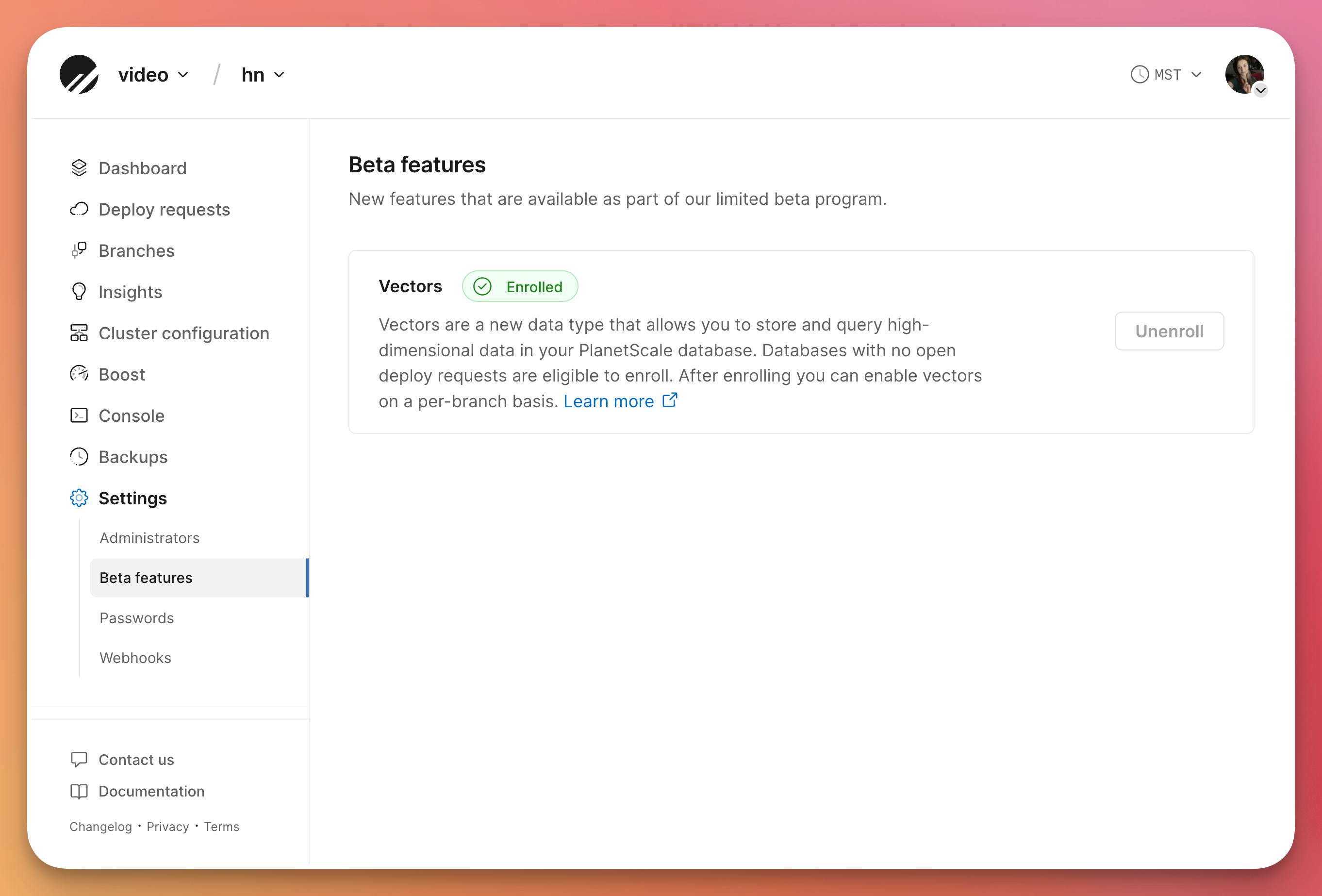
PlanetScale dashboard - vectors beta enrollment

More resources

To learn more about vector embeddings, check out our YouTube video:

You can check out the following documentation:

Your feedback is extremely valuable during this beta period, so don’t hesitate to reach out. You can submit a support ticket to relay any feedback or issues. We also have a vectors channel in our Discord where you can ask questions, share feedback, or chat about use cases.