
惯性聚合 高效追踪和阅读你感兴趣的博客、新闻、科技资讯
阅读原文 在惯性聚合中打开

推荐订阅源

aimingoo的专栏
aimingoo的专栏
Google DeepMind News
S
SegmentFault 最新的问题
Project Zero
Project Zero
D
DataBreaches.Net
I
InfoQ
L
Lohrmann on Cybersecurity
OSCHINA 社区最新新闻
OSCHINA 社区最新新闻
酷 壳 – CoolShell
酷 壳 – CoolShell
Stack Overflow Blog
Stack Overflow Blog
The Register - Security
Recorded Future
Recorded Future
Vercel News
Vercel News
博客园 - 司徒正美
freeCodeCamp Programming Tutorials: Python, JavaScript, Git & More
I
Intezer
The Hacker News
The Hacker News
F
Fortinet All Blogs
Microsoft Azure Blog
P
Proofpoint News Feed
Help Net Security
Help Net Security
cs.CV updates on arXiv.org
Application and Cybersecurity Blog
Scott Helme
Scott Helme
T
Threatpost
爱范儿
爱范儿
N
Netflix TechBlog - Medium
D
Docker
云风的 BLOG
云风的 BLOG
C
Cisco Blogs
K
Kaspersky official blog
H
Help Net Security
S
Secure Thoughts
T
Threat Research - Cisco Blogs
钛媒体:引领未来商业与生活新知
钛媒体:引领未来商业与生活新知
S
Security @ Cisco Blogs
Cyberwarzone
Cyberwarzone
N
News and Events Feed by Topic
G
Google Developers Blog
Forbes - Security
Forbes - Security
博客园 - 三生石上(FineUI控件)
博客园 - 叶小钗
B
Blog
Google DeepMind News
Recent Announcements
Simon Willison's Weblog
S
Securelist
P
Privacy International News Feed
Spread Privacy
Spread Privacy
The Last Watchdog
The Last Watchdog

Futurism

Tech Bros Puzzled by Why AI Hasn't "Massively Disrupted" Books Yet AI Companies Are Learning an Ironic Lesson as the People They Pay to Improve Their Chatbots Are Just Feeding AI Slop Into Them Sports Journalists Asked Microsoft’s Copilot to Predict World Cup Matches, and the Results May Surprise You Fans Aghast as New York Jets Say They’re Switching to AI Companies That Adopted AI Agents Alarmed to Discover They’re Botching Incredibly Important Tasks Hackers Find That Inaudible Sounds Hidden in Podcasts or Random Videos Can Hijack Your AI Voice Chatbot Democrats’ 2024 Election Autopsy Shows Signs of Sloppy AI Generation Being a Crappy Boss to AI Chatbots Pushes Them Toward Spouting Marxist Rhetoric and Organizing With Their Compatriots, Researchers Find Amazon Employees Forced to Hit Quotas on AI Use, Immediately Start Using it for Everything Except Work These Smart Glasses That Show Captions of What Everyone’s Saying Without a Creepy Spy Camera Actually Seem Pretty Awesome AI Appears to Be Trapping Certain Job Applicants in a Limbo Where They Never Get an Interview for “Reasons” That Are Completely Unfair The AI Industry Is Secretly Powered by Homeless People ChatGPT Is Saying VWeird Things in Chinese America Trembles as Transportation Secretary Announces Plans for Air Traffic Controllers to Lean on AI Tools Today Is the Day Anthropic Promised That Fully Autonomous Employees Would Be Tearing Through the Business World China Is Starting to Pull Ahead of US in AI Race Berklee College of Music Students Furious That It’s Offering an AI “Songwriting” Class Usually, Young People Embrace New Technology. Gen Z’s Attitude Toward AI Should Worry the Entire Tech Industry Sam Altman’s Coworkers Say He Can Barely Code and Misunderstands Basic Machine Learning Concepts
Researchers Put AI Models in Charge of Analyzing Sports, and They Choked Spectacularly
Joe Wilkins · 2026-06-06 · via Futurism

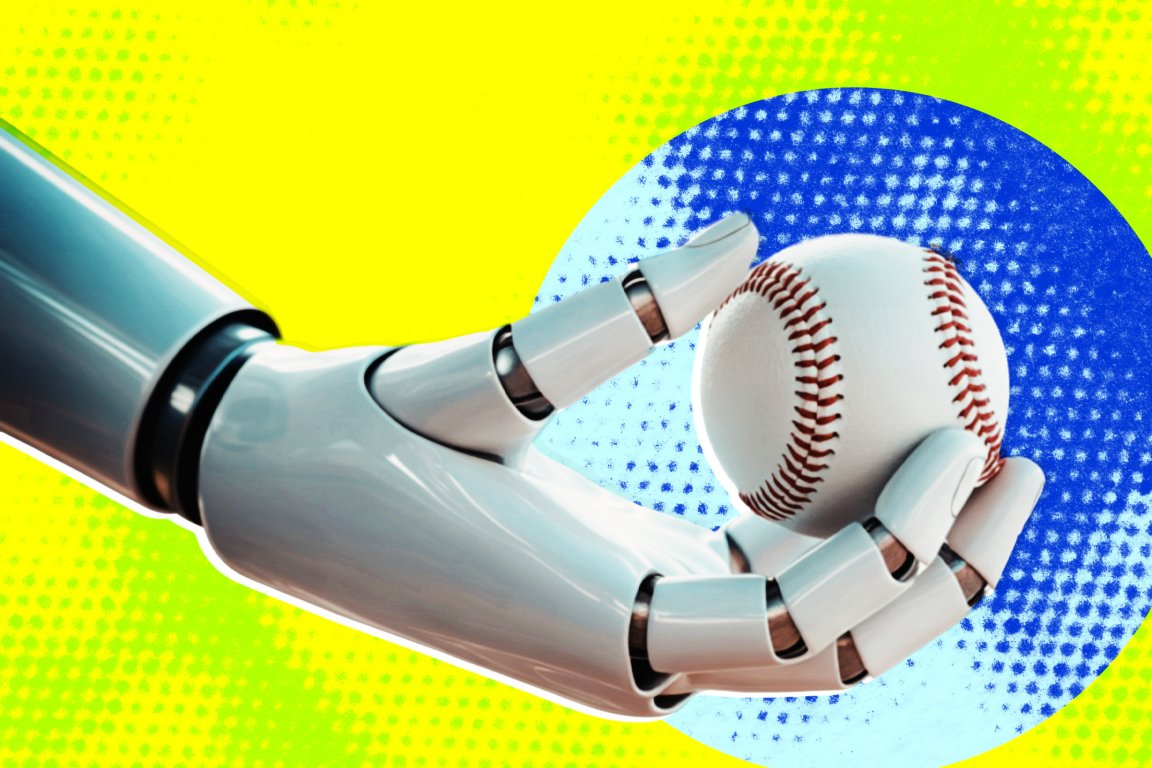
Illustration of a robotic hand holding a baseball, set against a bright yellow and blue background.

Illustration by Tag Hartman-Simkins / Futurism. Source: Shutterstock

Sign up to see the future, today

Can’t-miss innovations from the bleeding edge of science and tech

Good news for sports broadcasters and fans who’d prefer their play-by-plays to have that human-touch: AI doesn’t know ball.

A new study by researchers at the University of North Carolina at Chapel Hill and Northeastern University found that top AI models are horrible at analyzing professional sports. The yet-to-be-peer-reviewed study sought to analyze how capable the most popular AI models are in the fields of perception, reasoning, simulation, and agency — four traits which are difficult to evaluate with existing testing methods.

To probe how AI performs in these areas, researchers turned to the wide world of sports to create a new kind of AI test. Called strategic video intelligence, or “SVI-bench,” the novel test comprised 35,000 hours of sports footage from basketball, soccer, and hockey, as well as 15 million annotated plays, 15,000 hours of professional analysis, 23,000 post-game reports, and 103,000 statistical records.

Where AI performed the best was in perception: identifying which player performs which action at a given point in the match. But even there, they struggled badly. The models, which included ChatGPT, Google’s Gemini, and the open-source model Qwen, successfully eyeballed which player was doing what roughly 74 percent of the time — a rate which would get even a volunteer Little League announcer sacked.

The AI models did far worse on causal reasoning, or explaining why certain plays went down the way they did, with success rates falling near 40 percent on average. For example, when researchers asked the models to identify what was unusual about a Cody Martin three-pointer — which bounced off the top of the backboard before landing in the bucket — ChatGPT replied that it was “his first made three of the game.”

Simulation, or asking AI to find evidence to predict things like where a player would physically go based on their trajectory, was also dismal. During these tests, the best-performing model was functionally flipping a coin in order to guess a player’s next steps, and performance dropped even further when models were asked to plot out longer motion toward a goal or basket.

As computer science researcher at Northeastern and study co-author Lorenzo Torresani said in a press blurb by the university, AI “cannot tell you why things happen, and it cannot tell you what’s gonna happen next.”

When researchers probed the models’ agency — basically asking them to make complex post-game analysis of stats and trends, like a human broadcaster would — its accuracy fell to just 5 percent.

“A good sportscaster does much more than describe what’s on screen — they explain why a play worked, anticipate what’s next, and… decide which moments matter,” Torresani said. “Our study shows AI is already reasonably good at the descriptive part, but collapses on the rest.”

While sportscasters can definitely breathe a sigh of relief, the study’s findings are also good news for other knowledge workers, at a time when there’s been relentless fear of AI automation turning the job market inside out.

“The same gap shows up in any job whose value lies not in describing what’s visible, but in understanding why events unfold, anticipating what comes next, deciding what matters, and recommending what to do about it,” Torresani concluded.

More on AI in sports: Fans Aghast as New York Jets Say They’re Switching to AI