


https://micro-frontends.org/
Techniques, strategies and recipes for building a modern web app with multiple teams that can ship features independently.
The term Micro Frontends first came up in ThoughtWorks Technology Radar at the end of 2016. It extends the concepts of micro services to the frontend world. The current trend is to build a feature-rich and powerful browser application, aka single page app, which sits on top of a micro service architecture. Over time the frontend layer, often developed by a separate team, grows and gets more difficult to maintain. That’s what we call a Frontend Monolith.
The idea behind Micro Frontends is to think about a website or web app as a composition of features which are owned by independent teams. Each team has a distinct area of business or mission it cares about and specialises in. A team is cross functional and develops its features end-to-end, from database to user interface.
However, this idea is not new. It has a lot in common with the Self-contained Systems concept. In the past approaches like this went by the name of Frontend Integration for Verticalised Systems. But Micro Frontends is clearly a more friendly and less bulky term.
Monolithic Frontends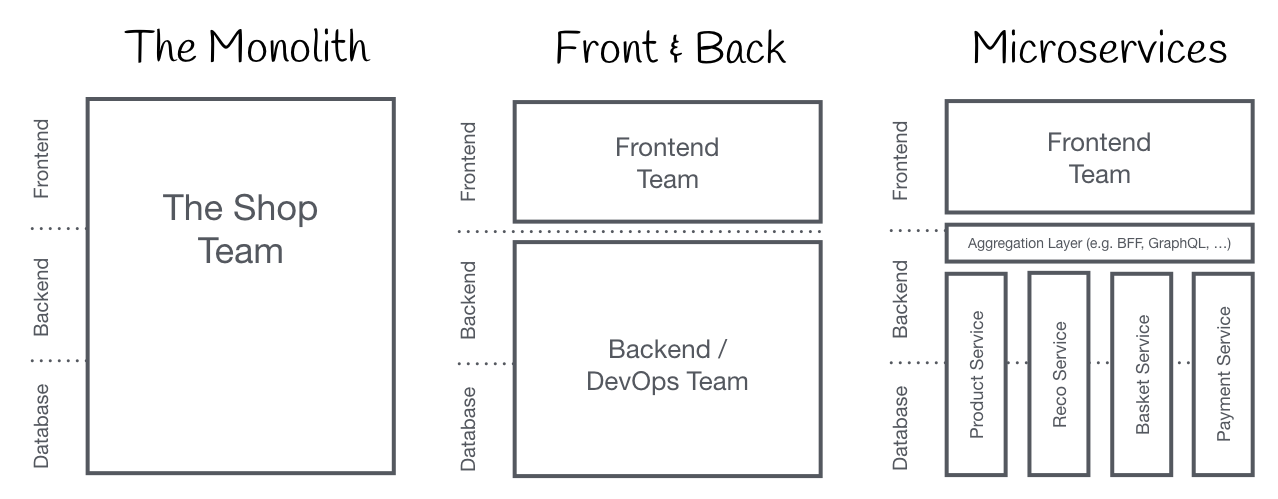
Organisation in Verticals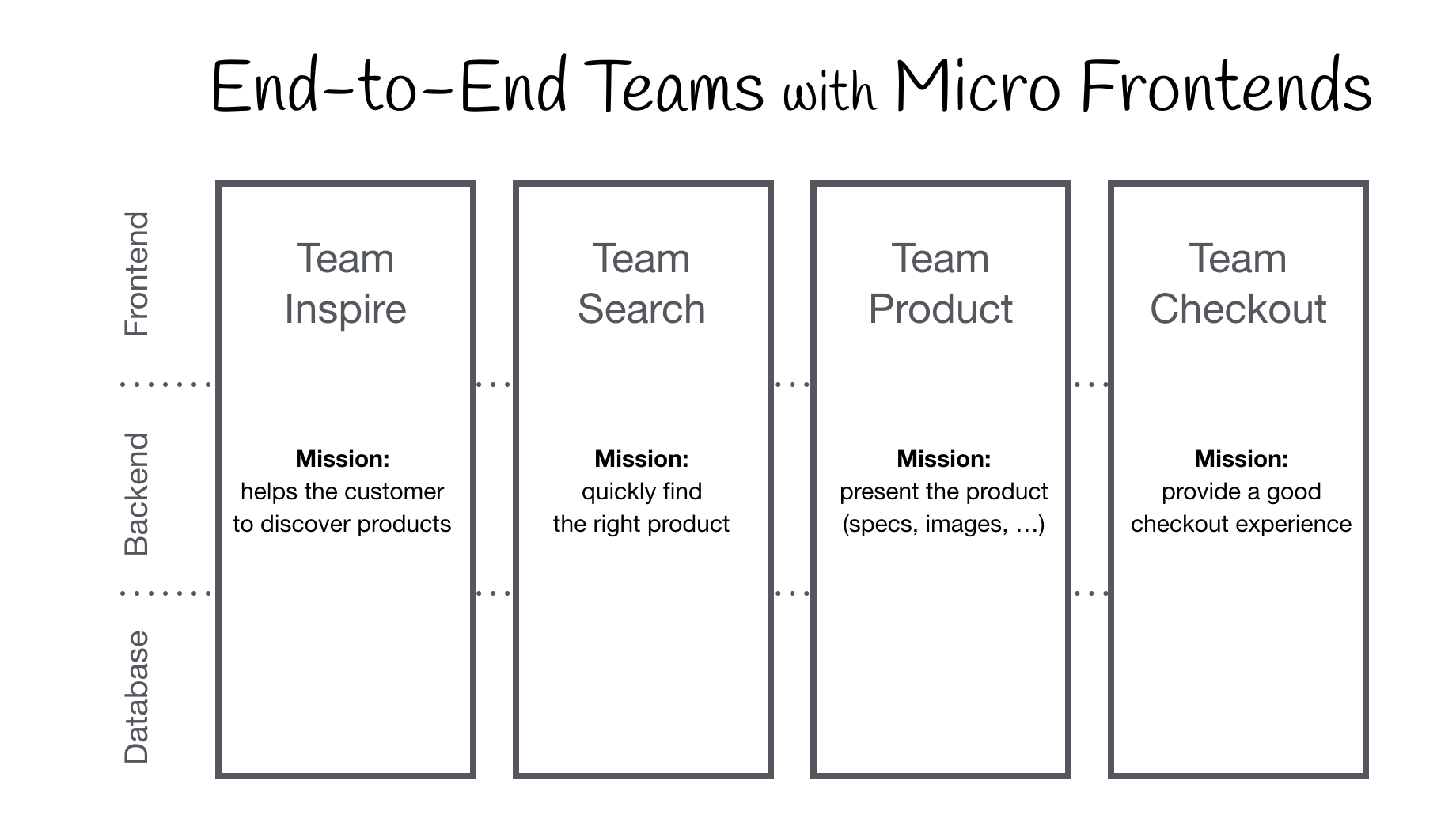
Custom Elements, the interoperability aspect from the Web Components Spec, are a good primitive for integration in the browser. Each team builds their component using their web technology of choice and wraps it inside a Custom Element (e.g. <order-minicart></order-minicart>). The DOM specification of this particular element (tag-name, attributes & events) acts as the contract or public API for other teams. The advantage is that they can use the component and its functionality without having to know the implementation. They just have to be able to interact with the DOM.
But Custom Elements alone are not the solution to all our needs. To address progressive enhancement, universal rendering or routing we need additional pieces of software.
This page is divided into two main areas. First we will discuss Page Composition - how to assemble a page out of components owned by different teams. After that we’ll show examples for implementing client-side Page Transition.
Lets take the buy button as an example. Team Product includes the button simply adding <blue-buy sku="t_porsche"></blue-buy> to the desired position in the markup. For this to work, Team Checkout has to register the element blue-buy on the page.
class BlueBuy extends HTMLElement {
  connectedCallback() {
    this.attachShadow({ mode: 'open' });
    this.shadowRoot = `<button type="button">buy for 66,00 €</button>`;
  }

  disconnectedCallback() { ... }
}
window.customElements.define('blue-buy', BlueBuy);The above example uses the Custom Element Spec which is supported by all modern browsers. No polyfills or hacks are needed. The same is true for Shadow DOM, which is used to encapsulate the Custom Element’s markup and styles.
Because Custom Elements are a web standard, all major JavaScript frameworks like React, Vue, Angular, Svelte or Preact support them. They allow you to embed a Custom Element in your application just like a native HTML tag, and they also provide ways to publish your framework-specific application as a Custom Element.
Using Custom Elements is a great way to achieve a high amount of decoupling between the fragments of the individual teams. This way, each team is free to pick the frontend framework of their choice. But just because you can does not mean that it’s a wise idea to mix different technologies. Try to avoid Micro Frontends Anarchy and create a reasonable level of alignment between the various teams. This way, teams can share learning and best practices with each other. It will also make your life easier when you want to establish a central pattern library. That said, the capability of mixing technologies can be handy when you’re working with a legacy application and want to migrate to a new tech stack.
Custom Elements are great for integrating components inside the browser. But when building a site that is accessible on the web, chances are that initial load performance matters and users will see a white screen until all js frameworks are downloaded and executed. Additionally, it’s good to think about what happens to the site if the JavaScript fails or is blocked. Jeremy Keith explains the importance in his ebook/podcast Resilient Web Design. Therefore the ability to render the core content on the server is key. Sadly the web component spec does not talk about server rendering at all. No JavaScript, no Custom Elements :(
经过梳理与合并,当前主流的微前端框架及方案可以清晰地划分为以下四大类:
这类框架是目前企业级应用中最常用的方案,通过动态加载子应用并配合沙箱机制实现隔离,对技术栈兼容性好。
这类方案不依赖运行时沙箱,而是通过构建工具在编译阶段实现跨应用的模块调用,性能最优。
这类方案提供了微前端的核心机制,但缺乏开箱即用的封装,适合有极强定制需求的团队。
出处:http://www.cnblogs.com/lightsong/ 本文版权归作者和博客园共有,欢迎转载,但未经作者同意必须保留此段声明,且在文章页面明显位置给出原文连接。
此内容由惯性聚合(RSS阅读器)自动聚合整理,仅供阅读参考。 原文来自 — 版权归原作者所有。