A: Oh, I don’t know if you heard, but someone moved into that old house down the road.
B: Yeah, I know. I met the owner of the house yesterday as he was moving in. His name is Armand.
A: Really? What’s he like? You have to fill me in.
B: Actually, he’s a bit strange. I don’t know... I’ve got a bad feeling about him.
A: Really? Why?
B: Well, yesterday I brought over a housewarming gift, but Armand started acting really weird, and then he practically kicked me out! I tried to, sort of, peek into his house, but everything was so dark inside that I couldn’t really get a good look.
A: Well, you’ll never guess what I saw this morning. A delivery truck pulled into his driveway, and it dropped off a long, rectangular box. It almost looked like a coffin!
B: You see! Why would he...
C: Hello ladies...
B: Ah, Armand! You scared the heck out of me! This is my friend Doris.
C: A pleasure to meet you... If you are not doing anything tonight, I would like to have you both for dinner. I mean... I would like to have you both over for dinner.
1. 重点词汇 (Key Words)
Housewarming gift: 乔迁礼物,通常送给刚搬入新家的邻居或朋友。
Peek: 偷看,指偷偷地、快速地查看某物。
Coffin: 棺材,通常与死亡或神秘事件相关,增加了故事的悬疑感。
Rectangular box: 长方形的盒子,这里暗示着某种神秘物品。
2. 常用语句 (Common Phrases)
I’ve got a bad feeling about this: 表达某事物可能不好或令人担忧的感觉。
You scared the heck out of me: 非正式表达,意思是“你吓坏我了”,通常用于突然被吓到的情境。
通过对话“New Guy in Town”,学习者可以掌握与邻里互动、表达怀疑和悬疑情节相关的词汇和表达方式。对话展示了如何通过对话建立悬疑气氛,同时也介绍了西方文化中的邻里关系和乔迁礼物的习俗。
12. Daily Life - Cleaning the House(C0012)
忙碌的家庭清洁场景,反映了合作和紧张的气氛
音频
国内节点
Your browser does not support the audio element.
国外节点
Your browser does not support the audio element.
国外节点
Your browser does not support the audio element.
对话
A: Honey, the house is such a mess! I need you to help me tidy up a bit. My boss and her husband are coming over for dinner, and the house needs to be spotless!
B: I’m in the middle of something right now. I’ll be there in a second.
A: This can’t wait! I need your help now!
B: Alright, alright. I’m coming.
A: Ok, here’s a list of chores we need to get done. I’ll do the dishes and get all the groceries for tonight. You can sweep and mop the floors. Oh, and the furniture needs to be dusted.
B: You know what, I have to pick something up at the mall, so why don’t you clean the floors and I’ll go to the supermarket and get all the groceries?
A: Sure that’s fine. Here is the list of all the things you need to get. Don’t forget anything! And can you pick up a bottle of wine on your way home?
B: Hey, honey I’m back. Wow, the house looks really good!
A: Great! Can you set the table?
B: Just a sec, I’m just gonna vacuum this rug real fast.
A: Wait! Don’t turn it on...
通过对话“Cleaning the House”,学习者可以掌握与家庭清洁和责任分工相关的词汇和表达。对话展示了家庭成员在面临紧急情况时如何分配任务和协调合作,这有助于学习者在日常生活中更好地运用这些技巧和表达。
13. The Office - Out Of Control Spending(C0013)
会议中讨论过度支出的紧张场景,反映了公司管理和财务监督的细节
音频
国内节点
Your browser does not support the audio element.
国外节点
Your browser does not support the audio element.
国外节点
Your browser does not support the audio element.
对话
A: OK, so now the last point on our agenda. Jill, let’s go over the profit and loss statement.
B: Great. Well, the main issue here, as you can see, is that our expenses are through the roof.
A: Let’s see... These numbers are off the charts! What’s going on here!
B: Well, um, sir, the company expenditures on entertainment and travel are out of control. Look at these bills for example. Just this month we’ve paid over twenty thousand dollars for hotel charges!
A: OK, thank you. I’ll look into it.
B: The list goes on and on. Here, this is a bill for five thousand dollars for spa treatments!
A: Thank you; that will be all. I’ll take care of it.
B: Look at this one sir, eight thousand dollars were spent in one night at a place called “Wild Things”?!
A: OK, I get it!! Thank you for your very thorough analysis!
1. 重点词汇 (Key Words)
Profit and loss statement: 损益表,用于展示公司在特定期间内的收入和支出情况。
通过对话“Out of Control Spending”,学习者可以掌握与财务报告、费用支出和公司管理相关的词汇和表达。对话展示了如何在会议中处理财务问题,并如何根据损益表来做出决策,这对理解商业管理和财务透明度非常有帮助。
14. I'm in Debt(B0014)
紧张的求助场景
音频
国内节点
Your browser does not support the audio element.
国外节点
Your browser does not support the audio element.
国外节点
Your browser does not support the audio element.
对话
A: Hello, I'm here to see Mr. Corleone.
B: Right this way, sir.
C: Charlie! What can I do for you?
B: Mr. Corleone, I'm really sorry to trouble you, but I need your help.
C: Anything for you, Charlie! Your father was like a brother to me.
B: Well, sir, you see, this recession has hit me pretty hard; I lost my job and I'm in a lot of debt.
C: I see...
B: Yeah, you know, I've got credit card bills, car payments, I've got to pay my mortgage, and on top of all that, I have to pay my son’s college tuition.
C: So, you're asking for a loan?
B: Well, I just thought maybe you could help me out.
C: What? At a time like this? I'm broke too, you know! You're not the only one who has been hit by the recession! I lost half my money in the stock market crash! Go on! Get out of here!
1. 重点词汇 (Key Words)
Recession: 经济衰退,表示经济活动的下滑,常导致失业率上升。
Debt: 债务,表示欠款,需要偿还的金额。
Credit card bills: 信用卡账单,是常见的债务形式。
Car payments: 车贷,每月需要支付的汽车贷款。
Mortgage: 房屋贷款,通常用于购买房产。
Tuition: 学费,尤其是大学学费。
2. 常用语句 (Common Phrases)
I’m really sorry to trouble you: 礼貌地表达打扰对方的歉意,是求助时常用的句子。
Hit me pretty hard: 表示某种负面事件对自己产生了严重影响,常用于描述经济压力或困境。
通过对话“I’m in Debt”,学习者可以学习有关财务压力的词汇和表达,了解如何在财务困难时礼貌地求助和回应,并学会处理对话中的紧张和情绪波动。
15. Daily Life - I'm sorry, I love you(B0015)
意外撞倒和潜在浪漫情感的场景
音频
国内节点
Your browser does not support the audio element.
国外节点
Your browser does not support the audio element.
国外节点
Your browser does not support the audio element.
对话
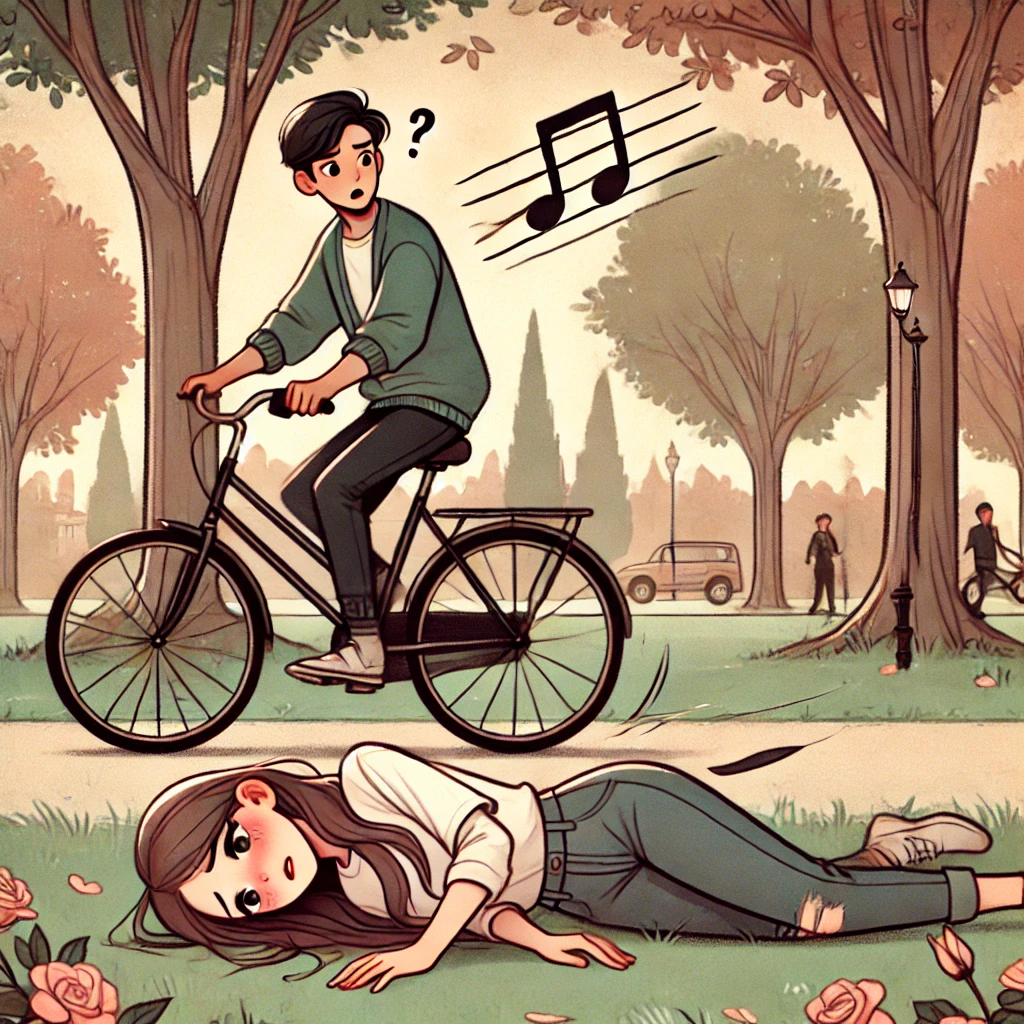
A: Whoa, whoa, what’s going on? Watch out!
B: Hey, watch where you’re going!
A: Oh, no! I’m so sorry! Are you all right?
B: Oh... I don’t know.
A: I feel terrible, I really didn’t mean to knock you over. My tire just exploded, and I lost control of my bike. Really, it was an accident. Please accept my apologies.
B: Just let me try to stand up.
(Song: Why do birds suddenly appear, every time you are near?)
A: Are you okay?
B: Oh, wait a second, you seem really familiar, I think I know you from somewhere.
A: Yeah, I think we have met somewhere before. That’s right! We met at Aaron’s place last weekend! What a coincidence! But anyway, I’m glad to see that you’re not too badly hurt, and I should probably get going. I have a nine o’clock meeting.
B: Ouch! My ankle! I think it’s broken! You can’t just leave me like this! Are you calling an ambulance?
A: Nope, I’m canceling my appointment so that I can stay here with you.
(Song: Do you remember when we met? That’s the day I knew you were my pet. I wanna tell you how much I love you.)
1. 重点词汇 (Key Words)
Watch out: 当心、小心,是提醒对方注意的常用短语。
Knock over: 撞倒,常用来描述某人或物被意外撞倒。
Exploded: 爆炸,用来形容爆胎等意外情况。
Accident: 意外事故,表示非故意发生的事件。
Apologies: 道歉,正式表达歉意时使用的词汇。
2. 常用语句 (Common Phrases)
Are you all right?: 询问对方是否安好,是表达关心的常用句子。
I didn’t mean to...: 表示“我不是故意的”,用于解释无意的行为。
Please accept my apologies: 正式道歉的句子,表达深切歉意。
I think I know you from somewhere: 表示似曾相识的常用语。
What a coincidence!: 表示惊讶,表示偶然相遇。
3. 文化点 (Cultural Insights)
在西方文化中,道歉是很重要的社交礼仪,特别是在造成别人不便或伤害时。这里的“I'm so sorry”是表达歉意的直接方式。
通过对话“I’m Sorry, I Love You”,学习者可以学到有关道歉、表达关心、应对突发事故等实用英语表达。同时,对话中潜在的浪漫元素和情感表达也为学习者提供了日常沟通中的情感管理技巧。
16. Daily Life - Turn left here!(B0016)
两人在开车时紧张对话的场景,表达出急促和焦虑的气氛。
音频
国内节点
Your browser does not support the audio element.
国外节点
Your browser does not support the audio element.
国外节点
Your browser does not support the audio element.
对话
A: Hurry up, get in.
B: I’m in, let’s go!
A: OK, make a left here... no wait, I meant make a right. Come on, speed up!
B: Geez! What’s the rush?
A: Don’t worry about it, just drive. Oh, no, the light is about to change... step on it!
B: Are you nuts! I’m not going to run a red light!
A: Whatever. Just turn right here... The freeway will be packed at this hour... let’s take a side street. Go on! Get out of our way! Move, move!
B: What’s your problem! Geez. Having a fit is not going to help!
A: Here, I know a shortcut... just go down here, and we’ll cut through Ashburn Heights. Let’s go, let’s go! Watch out for that lady!
B: I’m going as fast as I can!
A: Yes! We made it. 5:58, just before the library closes.
B: You’re such a geek!
1. 重点词汇 (Key Words)
Hurry up: 加快,催促对方行动快一点。
Speed up: 加速,指驾驶时加快车速。
Step on it: 用力踩油门,非正式表达,通常用于让司机开快一点。
Red light: 红灯,表示交通灯变成红色,需要停车。
Freeway: 高速公路,常用于城市中的快速通道。
Shortcut: 捷径,表示可以更快到达目的地的路径。
2. 常用语句 (Common Phrases)
Make a left/right: 方向指示,让司机向左或右转。
What’s the rush?: 询问为什么要着急,表达对方过于急促的不理解。
Watch out!: 提醒对方注意某个潜在的危险或障碍物。
What’s your problem?: 用于表达对对方行为的不满或困惑。
Having a fit is not going to help: 表达情绪激动对解决问题没有帮助。
方向指示: 学习如何清楚地给别人指路并及时纠正错误,例如“make a left... no wait, make a right”。
总结
通过对话“Turn Left Here!”,学习者可以掌握与驾驶、方向指示、时间紧迫相关的词汇和表达,同时也能学习如何在紧张的对话中保持冷静和有效沟通。这段对话还展示了都市生活中的一些典型情境,如交通拥堵、时间压力等。
17. Global View - Here Comes the Bride(B0017)
婚礼上新娘入场和客人之间的对话场景,反映了婚礼的庆祝氛围和轻松的社交互动。
音频
国内节点
Your browser does not support the audio element.
国外节点
Your browser does not support the audio element.
国外节点
Your browser does not support the audio element.
对话
A: I can’t believe that Anthony is finally getting married!
B: Yeah, well, it’s about time! He’s been living with his parents for 40 years!
A: Don’t be mean. Look, here come the bridesmaids! Their dresses look beautiful!
B: Who are those kids walking down the aisle?
A: That’s the flower girl and the ring bearer. I’m pretty sure they’re the groom’s niece and nephew. Oh, they look so cute!
B: I just hope the priest makes it quick. I’m starving. I hope the food’s good at the reception.
A: That’s all you ever think about, food! Oh, I think the bride’s coming now! She looks gorgeous. Wait, what’s she doing? Where’s she going?
B: Oh great! Does this mean that the reception is canceled?
通过对话“Here Comes the Bride”,学习者可以掌握婚礼场景中的重要词汇和表达,同时学习如何在社交场合中使用恰当的赞美和轻松的调侃。这段对话也提供了了解西方婚礼文化的机会,包括婚礼仪式、角色分配和婚宴的重要性。
18. Global View - Protest!(C0018)
新闻记者在抗议现场的紧张互动场景,反映了公众的愤怒和抗议的气氛
音频
国内节点
Your browser does not support the audio element.
国外节点
Your browser does not support the audio element.
国外节点
Your browser does not support the audio element.
对话
A: This is Action 5 News reporter Sarah O’Connell reporting live from Washington, D.C., where a protest has broken out. Thousands of angry citizens are protesting against the proposed bailout of the auto manufacturing industry! Sir, sir, Sarah O’Connell, Action 5 News. Can you tell us what’s happening?
B: Yeah, yeah, we’re here because we feel this is an injustice! The financial irresponsibility of big business has to stop! We’re here to show the government that we don’t like the way that they’re spending our tax dollars!
A: Sir, but what exactly is making everyone so angry?
B: It’s an absolute outrage, Sarah. The U.S. government wants to give 25 billion dollars of taxpayers’ money to the auto industry. These are companies that have been mismanaged and are now nearly bankrupt.
A: I see. But, many supporters of the bailout argue that it could help save the jobs of millions of hardworking Americans.
B: That may be true, and I for one don’t want to see anyone lose their job, but how can these CEOs ask for a bailout when they’re making millions of dollars? And then, they have the nerve to fly to Washington in private jets! This costs hundreds of thousands of dollars! And they’re asking for money! That is just not right!
A: Good point. This is Sarah O’Connell reporting live from Washington, D.C., back to you, Tom.
A: I hate working on Christmas Eve! Whoa! Get a load of this guy! Come in central, I think we’ve got ourselves a situation here.
B: License and registration please. Have you been drinking tonight, sir?
A: I had one or two glasses of eggnog, but nothing else.
B: Step out of the vehicle, please. Sir, what do you have in the back?
A: Just a few Christmas gifts, ’tis the season, after all!
B: Don’t take that tone with me. Do you have an invoice for these items?
A: Umm... no... I make these in my workshop in the North Pole!
B: You are under arrest, sir. You have the right to remain silent. You better not pout, you better not cry. Anything you say can and will be used against you. You have the right to an attorney; if you cannot afford one, the state will appoint...
A: You can’t take me to jail! What about my sleigh? It’s Christmas Eve! I have presents to deliver! Rudolph! Prancer! Dancer! Get help!
1. 重点词汇 (Key Words)
License and registration: 驾照和车辆登记证,是警察在拦截车辆时常用的表达。
Eggnog: 蛋奶酒,西方节日期间常见的饮品,尤其在圣诞节。
Invoice: 发票,指购买商品时的正式证明。
North Pole: 北极,通常指圣诞老人居住的地方,在圣诞文化中具有象征意义。
Arrest: 逮捕,警察在特定情况下对某人实施法律拘留。
2. 常用语句 (Common Phrases)
Step out of the vehicle: 警察要求司机下车时常用的正式指示语句。
You have the right to remain silent: 警察在逮捕嫌疑人时,告知他们的法律权利(米兰达权利)。
What do you have in the back?: 警察询问车上携带的物品。
You better not pout, you better not cry: 这句话来自圣诞歌曲《Santa Claus Is Coming to Town》,用在对话中增加了趣味性。
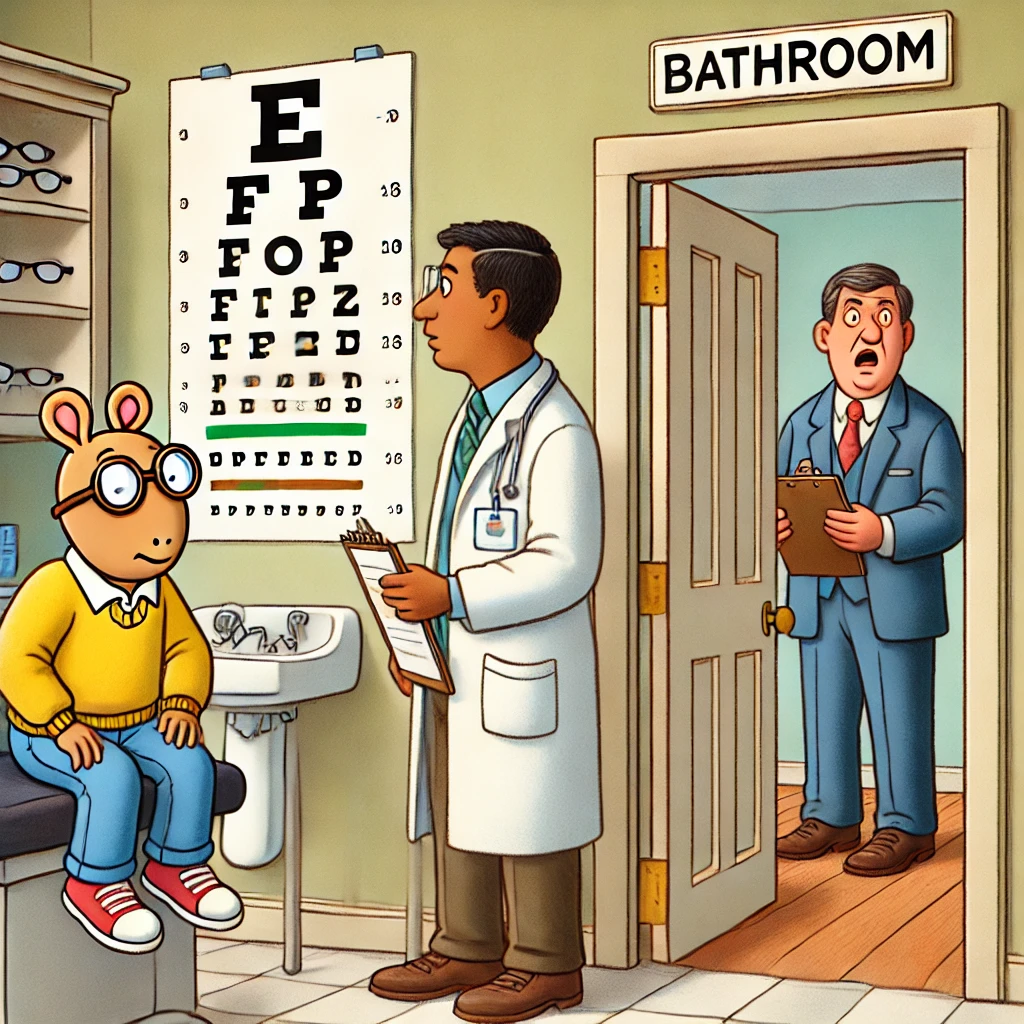
A: Hello, Arthur. What seems to be the problem?
B: Hey doc. Well, I think I might need glasses. I’m getting headaches, and I really struggle to see things that are far away. But I have always had 20/20 vision.
A: Sounds like you may be far-sighted. OK, then, cover your left eye and read the chart in front of you.
B: Mmm... X, E, R, 3, a question mark, and I can’t quite make out the other symbol, but I think it’s the peace sign.
A: Wow, Arthur! You’re as blind as a bat!
B: Yeah, I know, my vision is really blurry at times.
A: Ok then, head on over to the other room and pick out some frames while I fill out your prescription.
B: Thanks doc!
A: Arthur, that’s the bathroom.
1. 重点词汇 (Key Words)
Glasses: 眼镜,用于矫正视力。
Headaches: 头痛,表示视力问题可能导致的症状。
Far-sighted: 远视,指看近处物体有困难的视力问题。
20/20 vision: 视力标准,表示视力正常。
Prescription: 处方,通常指医生开具的药方或矫正视力的眼镜处方。
Frames: 眼镜框,指选择眼镜的外框样式。
2. 常用语句 (Common Phrases)
What seems to be the problem?: 医生询问病人症状的常见表达方式。
Cover your left eye and read the chart: 在视力测试中,医生常用的指令。