








[Ed. note: We’re opening up a Friday column slot on the blog to provide regular insight from voice within the developer community, either here at Stack Overflow of outside of it. This is the first of those columns, a republication of one of the articles on O’Reilly Media’s blog, Radar. We’ll have a repost from them every month.]
This post was originally published on O’Reilly Radar and is being republished here with the author’s permission.
—————————-
Autonomous AI systems force architects into an uncomfortable question that cannot be avoided much longer: Does every decision need to be governed synchronously to be safe?
At first glance, the answer appears obvious. If AI systems reason, retrieve information, and act autonomously, then surely every step should pass through a control plane to ensure correctness, compliance, and safety. Anything less feels irresponsible. But that intuition leads directly to architectures that collapse under their own weight.
As AI systems scale beyond isolated pilots into continuously operating multi-agent environments, universal mediation becomes not just expensive but structurally incompatible with autonomy itself. The challenge is not choosing between control and freedom. It is learning how to apply control selectively, without destroying the very properties that make autonomous systems useful.
This article examines how that balance is actually achieved in production systems—not by governing every step but by distinguishing fast paths from slow paths and by treating governance as a feedback problem rather than an approval workflow.
The first generation of enterprise AI systems was largely advisory. Models produced recommendations, summaries, or classifications that humans reviewed before acting. In that context, governance could remain slow, manual, and episodic.
That assumption no longer holds. Modern agentic systems decompose tasks, invoke tools, retrieve data, and coordinate actions continuously. Decisions are no longer discrete events; they are part of an ongoing execution loop. When governance is framed as something that must approve every step, architectures quickly drift toward brittle designs where autonomy exists in theory but is throttled in practice.
The critical mistake is treating governance as a synchronous gate rather than a regulatory mechanism. Once every reasoning step must be approved, the system either becomes unusably slow or teams quietly bypass controls to keep things running. Neither outcome produces safety.
The real question is not whether systems should be governed but which decisions actually require synchronous control—and which do not.
Routing every decision through a control plane seems safer until engineers attempt to build it.
The costs surface immediately:
This is not a new lesson. Early distributed transaction systems attempted global coordination for every operation and failed under real-world load. Early networks embedded policy directly into packet handling and collapsed under complexity before separating control and data planes.
Autonomous AI systems repeat this pattern when governance is embedded directly into execution paths. Every retrieval, inference, or tool call becomes a potential bottleneck. Worse, failures propagate outward: When control slows, execution queues; when execution stalls, downstream systems misbehave. Universal mediation does not create safety. It creates fragility.
Production systems survive by allowing most execution to proceed without synchronous governance. These execution flows—fast paths—operate within preauthorized envelopes of behavior. They are not ungoverned. They are bound.
A fast path might include:
Fast paths assume that not every decision is equally risky. They rely on prior authorization, contextual constraints, and continuous observation rather than per-step approval. Crucially, fast paths are revocable. The authority that enables them is not permanent; it is conditional and can be tightened, redirected, or withdrawn based on observed behavior. This is how autonomy survives at scale—not by escaping governance but by operating within dynamically enforced bounds.
Not all decisions belong on fast paths. Certain moments require synchronous mediation because their consequences are irreversible or cross trust boundaries. These are slow paths.
Examples include:
Slow paths are not common. They are intentionally rare. Their purpose is not to supervise routine behavior but to intervene when the stakes change. Designing slow paths well requires restraint. When everything becomes a slow path, systems stall. When slow paths are absent, systems drift. The balance lies in identifying decision points where delay is acceptable because the cost of error is higher than the cost of waiting.
A common misconception is that selective control implies limited visibility. In practice, the opposite is true. Control planes observe continuously. They collect behavioral telemetry, track decision sequences, and evaluate outcomes over time. What they do not do is intervene synchronously unless thresholds are crossed.
This separation—continuous observation, selective intervention—allows systems to learn from patterns rather than react to individual steps. Drift is detected not because a single action violated a rule, but because trajectories begin to diverge from expected behavior. Intervention becomes informed rather than reflexive.
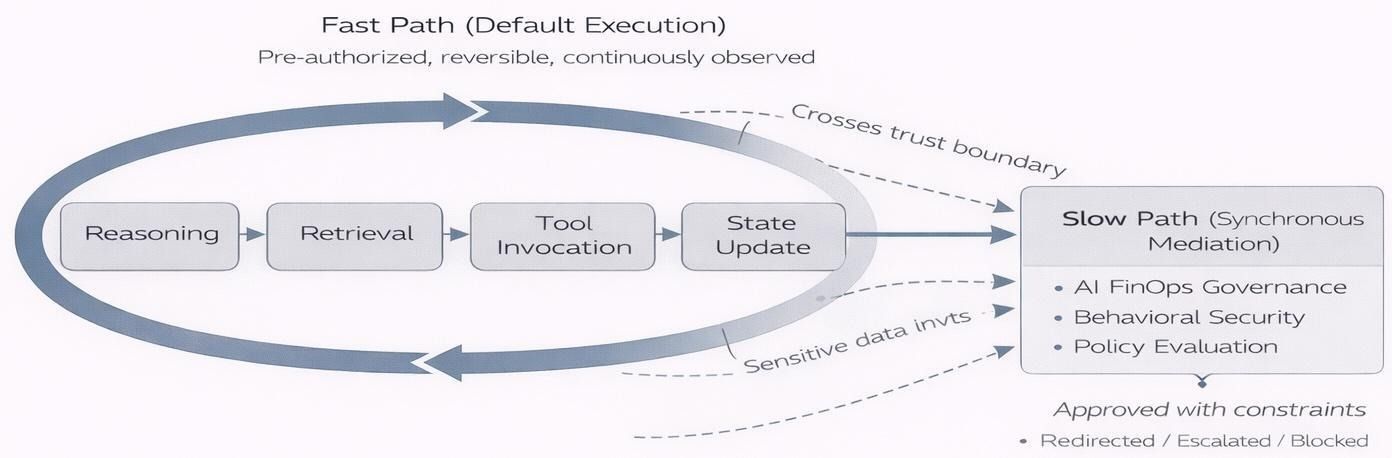
AI-native cloud architecture introduces new execution layers for context, orchestration, and agents, alongside a control plane that governs cost, security, and behavior without embedding policy directly into application logic. Figure 1 illustrates that most agent execution proceeds along fast paths operating within preauthorized envelopes and continuous observation. Only specific boundary crossings route through a slow-path control plane for synchronous mediation, after which execution resumes—preserving autonomy while enforcing authority.
When intervention is required, effective systems favor feedback over interruption. Rather than halting execution outright, control planes adjust conditions by:
These interventions are proportional and often reversible. They shape future behavior without invalidating past work. The system continues operating, but within a narrower envelope. This approach mirrors mature control systems in other domains. Stability is achieved not through constant blocking but through measured correction. Direct interruption remains necessary in rare cases where consequences are immediate or irreversible, but it operates as an explicit override rather than the default mode of control.
Governance has a cost curve, and it matters. Synchronous control scales poorly. Every additional governed step adds latency, coordination overhead, and operational risk. As systems grow more autonomous, universal mediation becomes exponentially expensive.
Selective control flattens that curve. By allowing fast paths to dominate and reserving slow paths for high-impact decisions, systems retain both responsiveness and authority. Governance cost grows sublinearly with autonomy, making scale feasible rather than fragile. This is the difference between control that looks good on paper and control that survives production.
Architects designing autonomous systems must rethink several assumptions:
These shifts are architectural, not procedural. They cannot be retrofitted through policy alone.
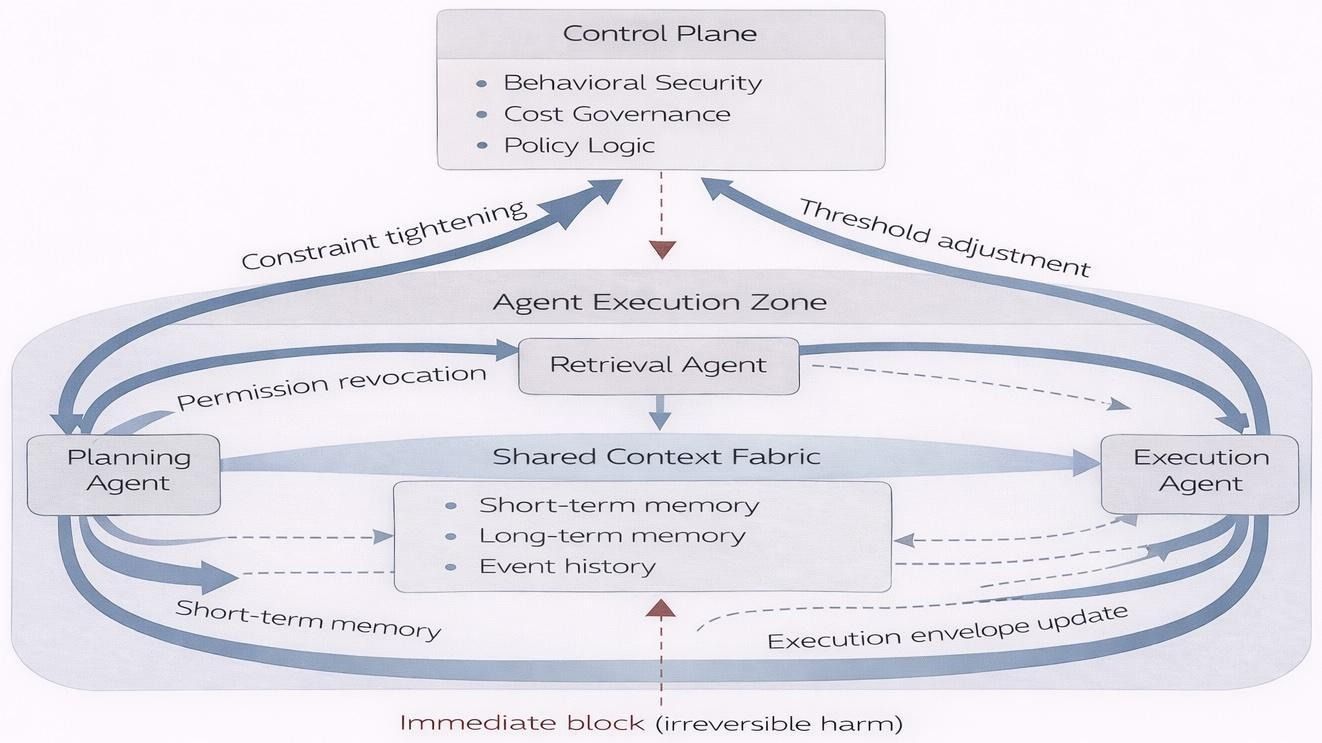
AI agents operate over a shared context fabric that manages short-term memory, long-term embeddings, and event history. Centralizing the state enables reasoning continuity, auditability, and governance without embedding memory logic inside individual agents. Figure 2 shows how control operates as a feedback system: Continuous observation informs constraint updates that shape future execution. Direct interruption exists but as a last resort—reserved for irreversible harm rather than routine governance.
The temptation to govern every decision is understandable. It feels safer. But safety at scale does not come from seeing everything—it comes from being able to intervene when it matters.
Autonomous AI systems remain viable only if governance evolves from step-by-step approval to outcome-oriented regulation. Fast paths preserve autonomy. Slow paths preserve trust. Feedback preserves stability. The future of AI governance is not more gates. It is better control. And control, done right, does not stop systems from acting. It ensures they can keep acting safely, even as autonomy grows.
© 2026 O’Reilly Media, Inc. and/or Its Licensors
此内容由惯性聚合(RSS阅读器)自动聚合整理,仅供阅读参考。 原文来自 — 版权归原作者所有。