





The United States is spending nearly $12 billion to replicate Taiwanese advanced chip production in Arizona. It is a straightforward solution, in theory, to a strategic vulnerability. Three years in, though, the project reveals a truth about power in the modern world: control over a strategic resource does not mean control over outcomes.
By the time that all its fabs are fully operational, Taiwan Semiconductor Manufacturing Company’s (TSMC) Arizona facility will be producing chips that are a generation behind the company’s operations in Taiwan. Even when you can move the factories, you cannot move the learning curves.
And with the breakneck pace of technological change, sovereignty built on ownership alone is fragile.
The same logic is now being applied to artificial intelligence (AI). From the halls of the European Commission to the boardrooms of Silicon Valley, “AI sovereignty” has become the defining geopolitical obsession.
These aspirations miss the larger reality. Control over AI development was always an illusion in the high-velocity, hyperspecialized reality of the modern AI ecosystem. Even if such control were possible, it would be the inferior option.
If you want to prepare an exceptional meal, do you build your own stove, forge your own cookware, craft your own plates – or source from the world’s best producers and invest in mastering the cuisine?
Governments are on track to spend more than $1 trillion by 2030 chasing a sovereign stack, the full range of hardware and capabilities necessary to deploy and operate AI infrastructure.
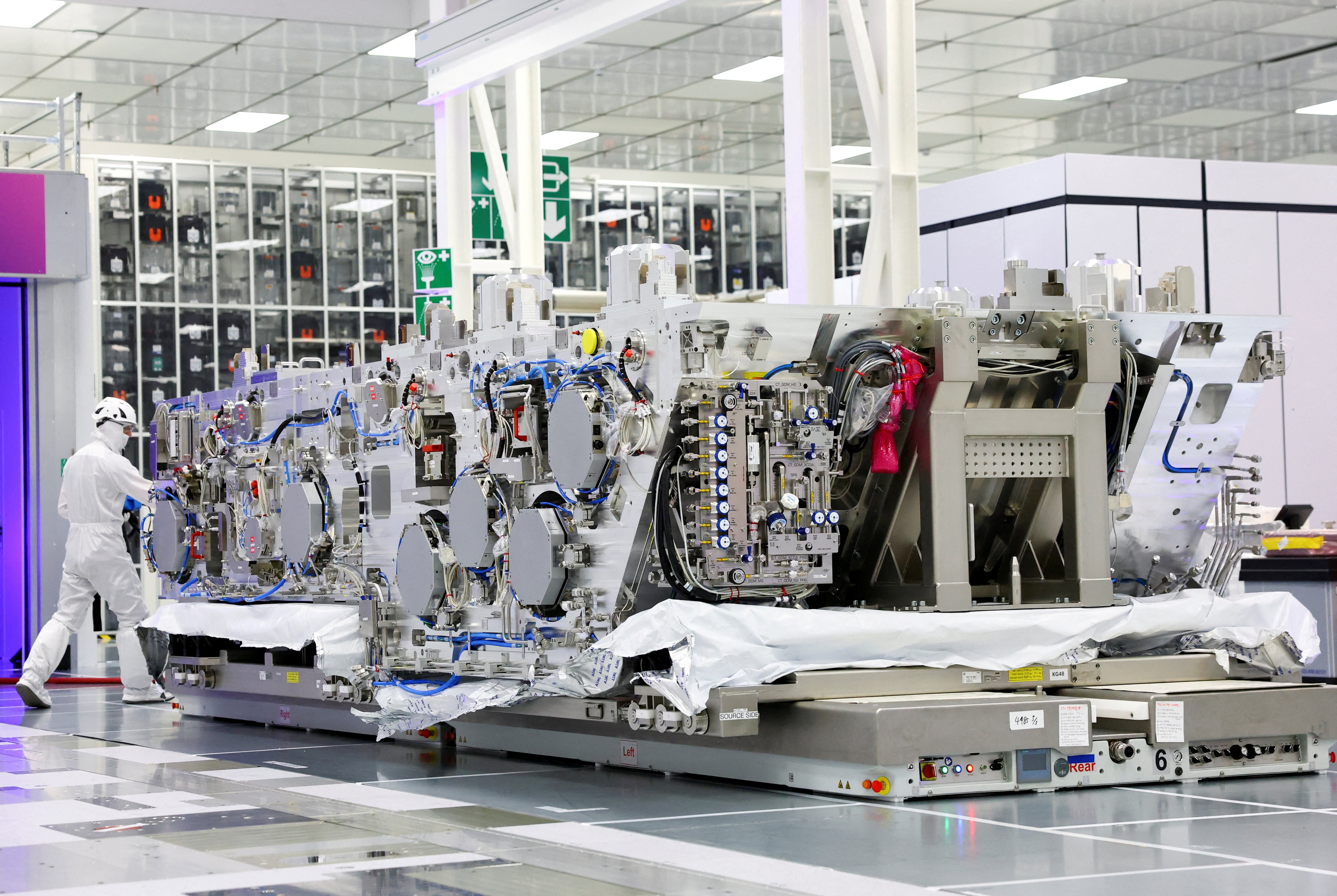
China has spent $150 billion in part to replicate the Dutch lithography technology that is essential to advanced chipmaking, which uses extreme ultraviolet light and chemicals to etch a circuit design onto a silicon wafer.
The European Union (EU) is committing around $50 billion to semiconductor manufacturing, much of it focused on proven but older-generation production rather than the most advanced technologies. All are pursuing strategies designed for a world that no longer exists.
One might point to China as the exception. It has pursued a centralized indigenous innovation strategy since its 2006 National Medium- and Long-Term Plan, explicitly aimed at achieving full-stack technological sovereignty.
The Made in China 2025 plan, which launched in 2015, reinforced the emphasis on domestic content. More recently, Beijing has doubled down on national semiconductor production through its so-called Big Fund investment initiative to reduce dependence on companies such as Nvidia and TSMC.
Yet, despite sustained investment at an enormous scale, Chinese firms remain several generations behind in advanced lithography. Domestic alternatives to ASML’s technology do not exist and will not for years to come.
If a country with China’s centralized capital, vast domestic market, and long planning horizons still faces a strategic speed bottleneck and remains tethered to a small set of global technology monopolies, then the pursuit of autarky for middle powers is not merely difficult. It is a strategic dead end.
That does not mean countries are powerless. It means power has changed. When it comes to AI and other frontier technologies, the goal should be strategic autonomy, ensuring a seat at the table of global interdependence without needing to own the entire board.
To understand the scope of the global interdependence, it is necessary to examine the AI value chain itself. Stepping back from the dominant mantra that AI is merely compute, data and energy reveals a more intricate network of technological choke points.
Hyperpure, semiconductor-grade polysilicon is concentrated among a small number of producers, with critical capacity in the United States, Germany, and Japan. That concentration creates vulnerabilities that no amount of downstream investment can quickly erase.
The most advanced extreme ultraviolet (EUV) lithography systems are manufactured exclusively by ASML in the Netherlands and cost roughly $380 million each. While there is a broader ecosystem for precision optics and industrial lasers, two firms – Zeiss and Trumpf – sit on irreplaceable choke points in the EUV toolchain.
Advanced compute capabilities are similarly concentrated. Semiconductor fabrication is dominated by TSMC and Samsung. Nvidia dominates graphic processing units, while Broadcom anchors the networking and custom silicon that make large-scale AI training possible; high-bandwidth memory is supplied primarily by SK Hynix and Samsung.
More importantly, these nodes co-evolve. When ASML improves its lithography, it enables new chip designs. When TSMC advances fabrication, it unlocks new AI architectures. When those architectures demand faster memory, Samsung innovates in response. The system depends on cross-border collaboration to keep advancing.
This is why AI sovereignty is a strategic miscalculation, not merely an expensive or difficult one. The supply chain evolved this way because extreme specialization produced the fastest innovation. Decades of accumulated learning cannot be reverse-engineered through political will, no matter how much money governments throw at the problem.
This is not just a middle-power problem. As Beijing’s experience makes clear, even superpowers are bound by these constraints – and Washington is no different, though its limitations take different forms.
The United States’ advantage never came from owning the entire supply chain. It came from controlling key choke points: software frameworks, cloud infrastructure standards and chip architectures.
Recent US policy reflects this understanding. This strategy accepts that advanced manufacturing may happen abroad while ensuring the most sophisticated AI systems are built on US platforms, trained with US tools, and deployed through US companies.
TSMC’s Arizona project illustrates both the logic and the limits of this approach. Relocating fabrication to US soil reduces dependence on Taiwan. But physical presence doesn’t guarantee technological parity. The facility will start years behind TSMC’s leading-edge plants in both process technology and production efficiency.
Both Washington and Beijing are discovering that pursuing full sovereignty means potentially sacrificing the advantages that made them competitive in the first place. For Washington, that’s openness and innovation speed. For Beijing, it’s scale and rapid implementation.
The EU’s experience underscores the same challenge. The EU’s Chips Act aims to mobilize roughly $50 billion to rebuild domestic semiconductor manufacturing, a substantial commitment driven by resilience concerns. But capital alone is not enough.
TSMC produces billions of chips each year and is continuously refining its processes. A new European fab begins at zero. By the time it reaches today’s frontier, that frontier will have moved.

Europe has tried similar approaches at the software layer. France’s push to build “sovereign cloud” alternatives to US hyperscalers never achieved meaningful scale despite extensive state support. The result was political reassurance without competitive advantage and a widening gap between European firms and their global peers.
If sovereignty is neither realistic nor smart, what makes sense? Consider the Netherlands. The Dutch do not design chips, fabricate semiconductors or train frontier AI models. Yet ASML’s production gives them more influence over the global AI ecosystem than many countries pursuing far larger industrial strategies.
This is power through indispensability, not independence. ASML spent decades developing capabilities that no one else has in a technology that everyone needs. The result is effective veto power over one irreplaceable node.
The same logic applies elsewhere – and not just for major powers. Countries that succeed in the AI era will identify narrow domains where they can become essential rather than attempting to replicate the entire stack.
Japan has built on decades of precision manufacturing experience and a near monopoly in specialty chemicals to establish Rapidus, a government-backed consortium that is developing advanced semiconductor manufacturing facilities that prioritize high-velocity, customized production over volume.
The United Arab Emirates and Singapore have focused on culturally and linguistically optimized large language models such as Falcon and SEA-LION. The advantage lies in sovereign data and regional relevance that global models often overlook.
India’s digital public infrastructure demonstrates how population scale, identity systems and payment architectures can become foundational to innovation. Several Gulf states are pairing abundant, inexpensive energy with compute-intensive infrastructure, positioning themselves as hubs for data centre expansion.
Vietnam, despite initial efforts to pursue a sovereign stack, is discovering more leverage in becoming a preferred manufacturing location for international tech companies integrating into the global supply chain rather than replicating it.
In each case, unique combinations of expertise, data, resources and market access have become assets that are difficult to duplicate.
The logic is not new. Since Adam Smith, economists have understood that specialization and comparative advantage generate the greatest gains. What makes AI distinctive is not that it defies these fundamentals. It is that the technology’s complexity and velocity intensify them.
The AI supply chain’s extreme specialization means the penalties for autarky are higher and the rewards for finding an indispensable niche are greater. A country might take a generation to build competitive automobile manufacturing through subsidies and tariffs.
With AI, by the time a nation replicates ASML’s lithography or TSMC’s fabrication processes, those technologies will have already advanced several generations.
TSMC’s facilities in Taiwan matter more to the global economy than many standing armies. Nvidia’s software standards shape how AI is built everywhere, regardless of where training occurs. ASML gives a small country outsized influence over a foundational technology.
None of these positions came from trying to control everything. They emerged from specialization that became essential.
For Washington and Beijing, this prompts a strategic choice. Both have the resources to move closer to full sovereignty than anyone else. But pursuing it risks undermining the very advantages that made them dominant in the first place.
For everyone else, the conclusion is more straightforward. Comprehensive AI sovereignty is not achievable within realistic timelines and budgets. In an interdependent system, the question shifts from how to become independent to how to become indispensable.
此内容由惯性聚合(RSS阅读器)自动聚合整理,仅供阅读参考。 原文来自 — 版权归原作者所有。